
GIOVANNI BOSCO, santo — Schemboche photograph from 1880.
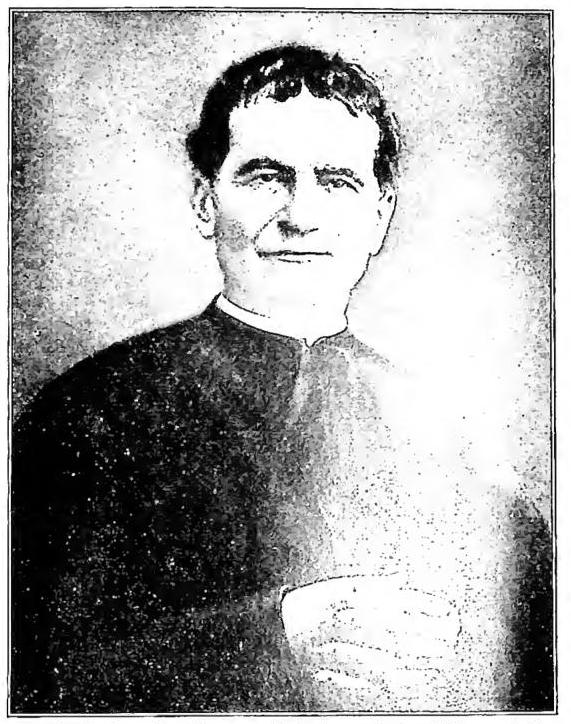
GIOVANNI BOSCO, santo. - Born in a rural hamlet of Castelnuovo d'Asti (today Castelnuovo d. Bosco) on August 16, 1815, and died in Turin on January 31, 1888. Ordained a priest in 1841, he completed his intellectual preparation at the ecclesiastical boarding school in Turin under the guidance of s. Giuseppe Cafasso and began providing moral and religious assistance to poor youths, especially workers living far from their families. Thus, as early as 1841, the work of the festive oratories arose. Having established himself in 1846 in a locality known as Valdocco, with the help of public charity, the Saint founded the Oratory of S. Francesco di Sales, to which he soon added a hospice for students and artisans. Within a few years, this transformed into a college with classical and vocational schools, eventually becoming the center of the Salesian Works. In fact, in 1864 the Saint, greatly favored by the understanding and benevolence of Pius IX, initiated the Society of S. Francesco di Sales, which is composed of priests, clerics, and laymen, and whose purpose, besides the Christian perfection of its members, is the education and instruction of youth, especially the less fortunate, in festive and daily oratories, in arts and crafts schools, agricultural colonies, primary and secondary institutes with boarding and day students, and houses for aspirants to the priesthood. The Salesian Society is also dedicated to pastoral ministry, catechetical and social activities, and, since 1875, to missions among infidels. Alongside it, in a parallel manner, with the assistance of several pious young women at
the head of whom was b. Maria Mazzarello, the Saint also founded the Institute of the Daughters of Mary Help of Christians for the assistance and spiritual, domestic, and intellectual formation of working-class girls. Finally, he added the Pious Union of Salesian Cooperators, as a living third order in the world, both for the increment of Christian life and for the support of his institutions.
After the first one, he opened other oratories, hospices, and colleges in Italy, France, Spain, Belgium, Austria, England, Argentina, Uruguay, Brazil, Chile, and Ecuador; at his death, he left 64 houses with 863 professed religious and 276 novices. He also published, especially in the early days of his apostolate, numerous popular writings aimed at defending Christian doctrine against Protestantism and promoting the sound education of the popular classes; the most notable are: Storia Ecclesiastica (1845); Il giovane provveduto per la pratica dei suoi doveri religiosi (1847); Il cattolico istruito (1853); Storia d'Italia (1856) and Vite dei papi dei primi secoli (1857-65); he also founded Letture Cattoliche in monthly issues, a Biblioteca della Gioventù Italiana to present morally expurgated classics, and the Bollettino Salesiano, the organ of his Works. He erected large churches, including the sanctuary of Mary Help of Christians in Turin and the basilica of the Sacred Heart of Jesus in Rome. He maintained contact with the most prominent politicians of Piedmont and Italy, and enjoyed the trust of Pius IX and Leo XIII, so that in the difficult years before and after 1870, he was able to act as an intermediary both for the appointment of bishops and for the Conclave of 1878.
Pius XI, who met the Saint and decreed the honors of beatification for him in 1929 and canonization in 1934, hailed d. Bosco as a forerunner of the reconciliation between the Holy See and Italy. In the history of modern spirituality, the Saint represents the type of apostolic action suited to the demands of the times, having sought and achieved perfection through labor for the spiritual benefit of his neighbor. His feast is celebrated on January 31.
His thought can be summarized as follows: in the preventive system, the young person sees in the act of the person who forestalls him a demonstration of affection. Indeed, it is not rare for a youth to commit faults precisely because a friendly person has not called his attention to the gravity of that specific course of action. The system also serves to attune the minds of the pupil and the educator, because the latter demonstrates a desire for the success and honor of his protégé. Furthermore, it serves to win more easily the heart of the pupil, thus opening the way to a greater, deeper influence that endures even throughout life. All of this certainly requires in the educator a lively zeal and full dedication to his mission, because he must never separate himself from the educator, but exercise continuous vigilance—gentle and not burdensome, yes, but discerning—and participate in all of the youth's life, even in games.
In particular, G. B. resorted to simple expedients that nevertheless managed to capture hearts: a little word in the ear of someone who left something to be desired; a fine maxim written on a slip of paper; a note delivered at the opportune moment; the association of the best youths to draw the others along by their example; the final evening greeting, after prayers before going to bed: two practical words spoken by the superior around a guiding thought for spiritual life. He judged two means to be indispensable: constancy in religious practices and the Sacraments. Indeed, he said to Lord Gladstone, who was astonished at the results achieved in his institutions: "I know only two means of education: Communion or the stick; I have renounced the stick and chosen Communion." To these are added: excursions, in which recreation must be united with the formation of spirit and character (famous places, sanctuaries, castles, battlefields, workshops); the establishment of musical bands and acting troupes; and the great importance given to the press, which was to provide books of all kinds, from classics, history, and biographies to stories, dramas, comedies, and farces.
(courtesy of d. L. Castano)
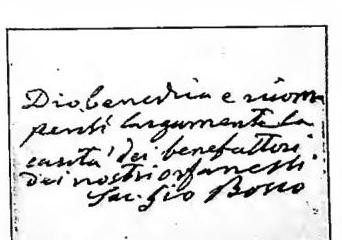
GIOVANNI BOSCO, santo - Autograph.
Thus, there is a full fusion of piety and study, of work and rightful relief, with the sole aim of the full formation of the Christian, the professional or artisan, the citizen. It is natural that such a total and watchful pedagogy, seasoned with so much comprehensive and confident goodness, could yield and still yields so many marvelous and recognized fruits in all fields.