
FOSSANOVA, ABBEY of. — In 1133 Innocent II granted to the Cistercians a Benedictine monastery situated on the southern edge of the Pontine Marshes, not far from Priverno, whose origin is traditionally traced back to St. Benedict himself. The Cistercians reclaimed the locality by constructing a canal to drain the waters (fosso novo, hence the name), and in 1173 began a new church. Dedicated, like all the churches of the Order, to the Virgin, and also to St. Stephen, it was consecrated in 1208 by Innocent III, and is the first construction in the Cistercian style in Lazio.
The simple façade is enriched by a portal with Cosmatesque decorations and by a large rose window. The interior gives an impression of simplicity and clarity: it has three naves, of which the central one is very high, with pointed vaults and groined arches, and is characterized by the octagonal tiburium rising above the presbytery. A portal with a trilobed arch of singular architecture leads to the cloister, whose three sides, dating from the original construction, have round arches grouped in sets of five, while the fourth was rebuilt later (1280–1300) in Gothic forms by Roman marble workers; at the center, this side is interrupted by an aedicule projecting over the area
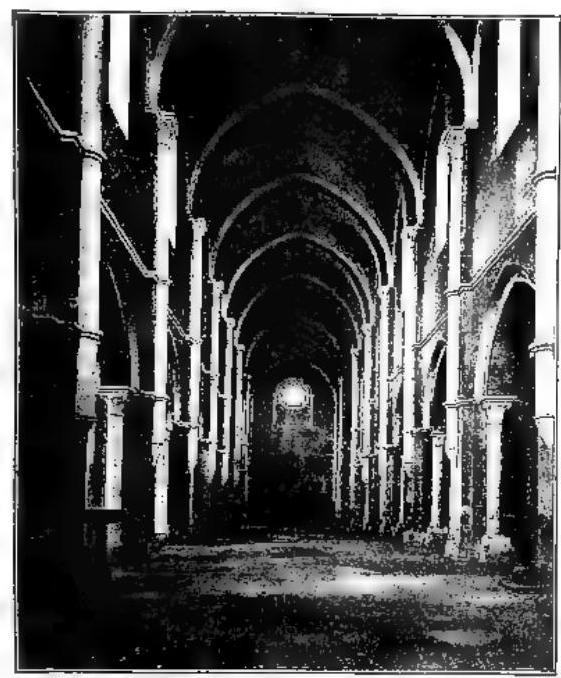
left open as a garden. The vast refectory and the chapter house are in a Romanesque-Gothic transitional style. Taken as a whole, the features of this imposing complex of buildings reveal the convergence in the region of various tendencies, so that Giovannoni’s hypothesis seems acceptable: he considers it the result of collaboration between foreign artists and local craftsmen, as well as craftsmen from other regions of the peninsula, especially the southern ones. In a room of the convent, later transformed into a chapel, St. Tommaso d'Aquino died in 1274. — Vedi tav. XCIX.