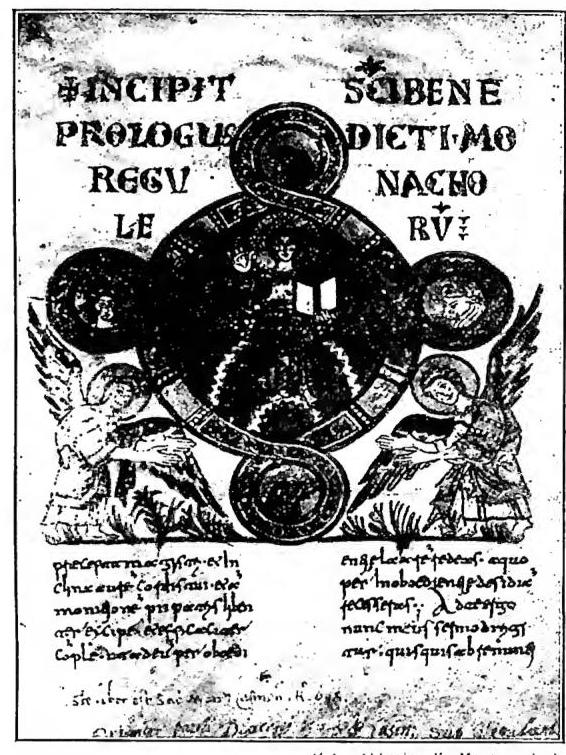
BENEDICTINE MONKS OF VALLOMBROSA. - Monks of the Benedictine Order who took their name from the Abbey of Vallombrosa, founded around 1036 in Tuscany by St. John Gualbert (q.v.), who initiated the new monastic Congregation and trained the monks for the struggle for the freedom of the Church, the sanctification of the clergy, and the restoration of observance in the cloisters and of good morals among the people.
The new institution spread rapidly in Tuscany, in the Romagna, and in other provinces of northern Italy, in France, Corsica, Sardinia, and Sicily, so much so that by 1253 there were as many as 79 abbeys and 29 priories.
At each monastery there was a hospice for wayfarers and pilgrims, and a place where clerics sent from various provinces were gathered to be prepared for the priesthood. The B. V. soon became leaders of Catholic activity in Tuscany in favor of the papacy and in the struggle against heresy. St. John Gualbert introduced into Italian Benedictine monasticism an innovation hitherto unknown: namely, the distinction between monks and lay brothers, and he desired a central government so that all the monasteries and abbeys of the Congregation would be under the authority of a general moderator.
Commendatory abbots first, and then suppressions decreed by civil governments, caused the Congregation to decline from its ancient splendor, just as for the same reasons the entire Benedictine Order had declined. But, after the storm of the French Revolution, with the revival of the old trunk to new life, the B. V. too are showing promising recovery.
At the same time as the male Congregation, St. John Gualbert also founded the Vallumbrosan nuns, to whom he gave, in addition to the Rule of St. Benedict, their own constitutions. The first monastery arose in 1066 or 67 opposite Vallombrosa, in a place called Corte di Caviglia, through the work of Donna Berta, daughter of Lothar, Count of Burgundy, born in Florence ca. 1120. They lead a life of prayer and work according to the Benedictine ideal and also devote themselves to teaching. Their monasteries are autonomous under the jurisdiction of the local bishop, whereas before the Council of Trent they were under the jurisdiction of the general abbot or the nearest abbot.
was in decline. The attempt to revive it to new and more fervent life was shattered by the monks' obstinate will, who even tried to poison him, and he returned «to the place of his beloved solitude.»
Soon the need to become a teacher to the disciples, who increasingly flocked to him, and to adapt to their needs, forced him once again—but this time permanently—to renounce the eremitical life, which had formed his original, ardent ideal. He would always retain such high esteem and deep love for it that, even in the Rule he wrote for cenobites, he held it up as the supreme peak of monastic asceticism. Yet in his new system he did not stray from imitating the great Egyptian examples, and, like St. Pachomius, he divided his disciples into groups: there were twelve, each with its own abbot, in as many houses, while he reserved for himself the training of some select novices. Among these were Maurus and Placidus, the best known of his monks, whose parents, like many others of the Roman nobility, had entrusted them to him. But through daily experience, the legislator’s ideal gradually shifted, orienting itself toward forms increasingly fully cenobitic, closer to the Basilian model.
The persecution, stirred up by the jealousy of a neighboring priest, seemed to drive him finally to put into effect his new plan, and in the full vigor of his mature years he left Subiaco, making his way toward the ancient city of Cassino. The decision was not one made on the spur of the moment. Benedict, in fact, built his new home, the definitive expression of the ideal matured through long years of experimentation, on a mountain that had once been a military acropolis and at that time was still frequented by its various temples of idol worship. He took possession of it without delay, demolished the altars, cut down the sacred groves, and with unremitting preaching (according to some authors he may even have been raised to the priesthood) devoted himself to converting the still pagan portion of the population. All this, given the well-established requirements of civil and canon law, could certainly not have taken place without a specific mission, or at least permission from the competent authorities. And what the Gregorian source, on this as on so many other points, does not say, tradition hints at in various ways: from the divine mission, which the earliest authors recall, to the donation by Tertullus, a patrician, which, despite legendary embellishments, preserves a substratum of truth; from relations with the Roman environment to the approval and encouragement of the Apostolic See.
Thus arose on the mountain’s summit the new monastery, complete in itself, a typical model of the most perfect cenobitism to be practiced under the immediate and continuous direction of a single father. Almost to signify the new orientation, the two oratories built on the site were dedicated in honor of St. John the Baptist, father of the monks of the New Testament and precursor of the Gospel, and of St. Martin of Tours, the apostolic monk of the Gauls. The construction of the buildings, for which Benedict served as the skilled architect, and the organization of the new life must certainly have required time. The date of 529, traditional for more than seven centuries, is probably to be understood as a terminus ad quem. From then on, that new “company of monks, who read, cultivated the land, and practiced the arts in the midst of the great society that was dissolving into barbarism, prepared the germ of the future civilization and the recomposition of the peoples” (L. Tosti).

There was a constant stream of people ascending the mountain: from the humble who came to invoke the protection and aid of Father B., to ecclesiastical dignitaries such as Bishop Sabinus from distant Canosa, to the powerful of the world, like King Totila of the Goths, who sought from the Saint words of life and comfort. Once a year it was the old man himself who would leave the monastery to meet his sister Scholastica and spend sweet spiritual hours in her company. At the spot, according to tradition, where they met, recent excavations (1939), though not yet completed, have brought to light the remains of a small single-apsed church dating, at least in part, to a remote antiquity.
The final meeting, according to the Gregorian source, lasted the whole night, against B.’s will: a violent storm, obtained through the prayers and love of his sister, forced him to remain. Three days later from his tower he saw her soul fly to heaven in the form of a white dove, and had her body carried to the tomb which, on the mountain summit in the oratory of St John the Baptist, he had prepared for them both.
Not long after, B. joined her in eternity. Six days before his death he had the tomb opened; then, feeling his hour had come, he asked to be taken to the oratory, where, fortified with the body and blood of the Lord and in the arms of his disciples, he commended his spirit to God. It was 21 March; the year, especially from the way in which B. and St Sabinus spoke of the impending ruin of Rome at the hands of Totila, cannot be earlier than 547. This date, therefore, like almost the entire chronology of St B.’s life, remains only approximate.
The biography as traced for us by Pope Gregory cannot satisfy all our demands; not through any culpable deficiency, but because of the writer’s exclusive aim of edification and the nature of hagiography in those times. Nor do we find in it secure elements for reconstructing the physical figure of the Saint.
Yet we have a clear spiritual image of him, as it emerges from the candid narrative of Gregory and the immortal pages of the Rule. He is a man of firm and decisive character. In the profound sincerity of his being, intent only on pleasing God, he turns to seek Him and consecrates himself to His service. This single purpose gives unity to his whole life, which he spends in the fear of God, in justice and truth. The natural gifts of his reflective, serious, orderly and peace-loving nature, endowed with a refined sense of balance and discernment, are thus fused and ennobled in the practice of love of God, to Whom he proposes nothing, and of neighbour, to Whom in pious and fatherly teaching he pours out the treasures of his intelligence and experience.

BENEDETTO, SAINT — Meeting of St. Benedict with Totila.
He strove to draw ever closer to God. Thus his natural qualities cooperated with grace to render him fit for the gigantic mission to which Providence had elected him. Living in the time of Italy’s greatest decline, when the ancient Roman world was collapsing in ruins, he prepared its reconstruction through his creation. By adapting the vital principles of the East to the Roman mentality, he saved Western monasticism and, through his sacred Rule, transmitted to the new peoples the traditions of their fathers and the highest practical commentary on the evangelical life. In this way, he provided the Church with workers for the tilling of the immense field of labor that lay before it and prepared the new age.
If, therefore, we consider that “not only in the final catastrophe of the Western Empire did he embody, with rare purity of life, the true Roman spirit, but he was also one of the last executors of the mission assigned by Providence to the spirit of Rome in the history of humanity... we may well say that he was the last Roman” (I. Herwegen). But if we bear in mind that he was one of the architects of European unity, the true father of peoples hastening under the sacred name of Christ and under the august name of Rome, we may equally salute him as “the first of the new Romans, especially those in whom the virtue of the Roman stock, grafted onto the plant that was to give rise in the Italian nation to its glorious daughter... as he whose name and work form one of the strongest threads around which, from beginning to end, the unity of Italy’s national history is woven” (C. Calisse, S. B., in Nuova Antologia, 1929, IV, p. 11 ff.).
II. ICONOGRAPHY
Equal to the historical importance and scope of St. Benedict’s work has been the cult with which peoples have shown their gratitude and devotion, comparable only to that accorded to the Apostles; in recent centuries, however, after the ruins accumulated by errors and political upheavals, it has notably diminished. Yet in Italy there are still many localities and churches that bear the name of the Cassinese patriarch, as well as works of art that glorify his image and episodes from his life. Here we recall only the oldest painting from the 8th century (Rome, S. Ermete on the Salaria vetus) and the famous pictorial cycles of Subiaco (S. Speco, 12th–15th c.), Florence (S. Miniato al Monte, Spinello Aretino, 14th c.), Naples (S. Severino, A. Solario called lo Zingaro, 16th c. and F. De Mura, 18th c.), Monte Oliveto Maggiore (Sodoma, 16th c.), Montecassino—irremediably lost to the nefarious destruction of the abbey (Luca Giordano, 17th c., and the Beuronese School, 19th c.); to these must be added, noteworthy also for the history of costume, the series of miniatures by the Cassinese monk Leo (11th c., cod. Vat. lat. 1202).III. Medal
A characteristic form of devotion to St. Benedict is still today the medal, which enjoys among the faithful a widespread popularity second only to that of the Scapular. Its historical origins are obscure, but they must undoubtedly be related to what St. Gregory recounts regarding the efficacy of the cross used by St. Benedict. A specific element is indeed a square cross reproduced on the reverse with initials, and the cross is likewise in the hand of the Saint whose figure is reproduced on the obverse.Between the arms of the cross are arranged the four letters C.S.P.B., i.e., Crux Sancti Patris Benedicti; on the vertical arm: C.S.S.M.L.; on the horizontal arm: N.D.S.M.D.; around: V.R.S.N.S.M.V. S.M.Q.L.I.V.B. These last three series are the initials of words forming six half-lines in rhythm, containing invocations to the cross and the renunciation of Satan, from whom the cross has delivered us, namely: Crux sancta sit mihi lux; Non draco sit mihi dux; Vade retro Satana; numquam suade mihi vana; sunt mala quae libas; ipse venena bibas. The medal has in the Roman Ritual a special formula of blessing and enjoys many indulgences, which are more numerous for that particular type especially struck at Montecassino in memory of the XIV centenary of the birth of St. Benedict (1880).
IV. THE RULE.
— Besides the Gregorian Dialogues, another source for knowing the intimate life of St. B. and his psychology is the Rule. The holy man, as Gregory himself attests, could not teach otherwise than he lived, and his teaching, his mission, «omnes magisterii illius actus», is continued precisely in the Rule which the biographer enumerates among the other miracles of the Saint.
1) The history of the text. — Since the Rule is the expression of the mature thought of the legislator and summarizes his final experience, that which is decidedly cenobitic, without doubt its definitive redaction was made at Montecassino. Therefore, that sacred mountain by all monastic tradition came to be considered as the place whence, according to the beautiful image attributed to Urban II, as from a paradisiacal source there sprang forth the venerable institution of the monastic Order, and by the medievals it was willingly compared to Sinai.
Che la Regola sia opera di s. B. nessuno ha mai seriamente dubitato. Contrariamente alla tesi tradizionale, in questi ultimi anni un benedettino di Solesmes, A. Ge-neust (La Regle du Maître et la Regle de la Bénédiction de la Bénédiction de la Bénédiction de la Bénédiction de la Bénédiction de la Bénédition de la Bénédiction de la Bénédiction de la Bénédiction de la Bénédiction de la Bénédicion de la Bénédiction de la Bénédiction de la Bénédiction de la Bénédiction de la Bénédiction de la Bénédition de la Bénédiction de la Bénédiction de la Bénédiction de la Bénédiction de la Bénédicion de la Bénédiction de la Bénédiction de la Bénédiction de la Bénédiction de la Bénédiction de la Bénédition de la Bénédiction de la Bénédiction de la Bénédiction de la Bénédiction de la Bénédicion de la Bénédiction de la Bénédiction de la Bénédiction de la Bénédiction de la Bénédiction de la Bénédition de la Bénédiction de la Bénédiction de la Bénédiction de la Bénédiction de la Bénédicion de la Bénédiction de la Bénédiction de la Bénédiction de la Bénédiction de la Bénédiction de la Bénédition de la Bénédiction de la Bénédiction de la Bénédiction de la Bénédiction de la Bénédicion de la Bénédiction de la Bénédiction de la Bénédiction de la Bénédiction de la Bénédiction de la Bénédition de la Bénédiction de la Bénédiction de la Bénédiction de la Bénédiction de la Bénédicion de la Bénédiction de la Bénédiction de la Bénédiction de la Bénédiction de la Bénédiction de la Bénédition de la Bénédiction de la Bénédiction de la Bénédiction de la Bénédiction de la Bénédicion de la Bénédiction de la Bénédiction de la Bénédiction de la Bénédiction de la Bénédiction de la Bénédition de la Bénédiction de la Bénédiction de la Bénédiction de la Bénédiction de la Bénédicion de la Bénédiction de la Bénédiction de la Bénédiction de la Bénédiction de la Bénédiction de la Bénédition de la Bénédiction de la Bénédiction de la Bénédiction de la Bénédiction de la Bénédicion de la Bénédiction de la Bénédiction de la Bénédiction de la Bénédiction de la Bénédiction de la Bénédition de la Bénédiction de la Bénédiction de la Bénédiction de la Bénédiction de la Bénédicion de la Bénédiction de la Bénédiction de la Bénédiction de la Bénédiction de la Bénédiction de la Bénédition de la Bénédiction de la Bénédiction de la Bénédiction de la Bénédiction de la Bénédicion de la Bénédiction de la Bénédiction de la Bénédiction de la Bénédiction de la Bénédiction de la Bénédition de la Bénédiction de la Bénédiction de la Bénédiction de la Bénédiction de la Bénédicion de la Bénédiction de la Bénédiction de la Bénédiction de la Bénédiction de la Bénédiction de la Bénédition de la Bénédiction de la Bénédiction de la Bénédiction de la Bénédiction de la Bénédicion de la Bénédiction de la Bénédiction de la Bénédiction de la Bénédiction de la Bénédiction de la Bénédition de la Bénédiction de la Bénédiction de la Bénédiction de la Bénédiction de la Bénédicion de la Bénédiction de la Bénédiction de la Bénédiction BENEDICTION
The term *benediction* (from the Latin *benedictio*, derived from *benedicere*, "to speak well of," "to bless") in the Catholic liturgy and theology signifies both the act of blessing and the formula by which it is expressed. The concept of benediction is rooted in the biblical tradition, where blessing is an essential element of divine favor and human response. In the Old Testament, blessing is often associated with God’s promise of prosperity, fertility, and protection (e.g., Genesis 12:2-3; Numbers 6:24-26). In the New Testament, Christ’s blessings extend to the spiritual realm, emphasizing grace, peace, and salvation (e.g., Matthew 5:3-12; Luke 24:50-51).
In the liturgical context, benediction encompasses a variety of rites and formulas through which the Church invokes God’s favor upon persons, objects, or places. These may include solemn blessings, such as those imparted by bishops or priests during Mass or other sacred ceremonies, as well as simpler blessings for daily use, such as those for meals, homes, or sacred vessels. The *Rituale Romanum* and other liturgical books provide specific texts and rubrics for these blessings, ensuring their proper execution within the Church’s tradition.
Theologically, benediction is understood as a sacramental, a sacred sign instituted by the Church to prepare the faithful to receive grace and to sanctify various circumstances of life. Unlike sacraments, which confer grace *ex opere operato*, sacramentals, including blessings, derive their efficacy from the prayer of the Church and the faith of those who receive them (*ex opere operantis Ecclesiae*). The Catechism of the Catholic Church (n. 1667-1679) emphasizes that sacramentals "do not confer the grace of the Holy Spirit in the way that the sacraments do, but by the Church’s prayer, they prepare us to receive grace and dispose us to cooperate with it."
Among the most solemn forms of benediction is the *Benediction of the Blessed Sacrament*, a Eucharistic devotion in which the consecrated Host is exposed in a monstrance and blessed upon the faithful with the sign of the cross. This practice, deeply rooted in medieval piety, underscores the real presence of Christ in the Eucharist and the Church’s belief in the power of His blessing. The rite typically includes hymns, prayers, and incensation, culminating in the priest’s blessing with the Host.
BIBL.:
A. Michel, *Bénédiction*, in *Dictionnaire de Théologie Catholique*, vol. II, Paris 1905, coll. 553-580;
J. Jungmann, *The Mass of the Roman Rite*, New York 1951-1955;
*Rituale Romanum*, ed. typica 1952;
*Catechism of the Catholic Church*, Vatican City 1994.
G. D.BÉNÉDICTION
The term *bénédiction* (from the Latin *benedictio*, -onis) indicates, in a general sense, the act by which a person or thing is consecrated to God or placed under His protection through a sacred rite. In a more specific sense, it refers to the formula or prayer pronounced by a minister of the Church to invoke divine blessing upon persons, objects, or places.
In the Old Testament, the concept of blessing is closely linked to the idea of divine favor and protection. The patriarchs, priests, and prophets often pronounced blessings upon the people or individuals (Gen. 12:2; 27:27-29; Num. 6:24-26). The blessing of Aaron (Num. 6:23-27) is particularly significant, as it became the model for liturgical blessings in the Church.
In the New Testament, the risen Christ imparts His blessing to the disciples (Luke 24:50-51; cf. Mark 16:18). The apostles, in turn, bless the faithful (2 Cor. 13:13; Eph. 1:3). The Church, as the continuation of Christ's mission, has preserved and developed the practice of blessing, integrating it into her liturgy.
The liturgical books of the Church distinguish between *bénédictions solennelles* (solemn blessings) and *bénédictions simples* (simple blessings). Solemn blessings are reserved to bishops or priests and are accompanied by specific rites, such as the use of holy water, incense, and liturgical vestments. Simple blessings, on the other hand, can be imparted by any priest or even a deacon, and are often integrated into other liturgical actions, such as the blessing of meals or the blessing of objects.
The *Pontificale Romanum* and the *Rituale Romanum* contain numerous formulas for blessings, ranging from the blessing of churches and altars to the blessing of rosaries, medals, and other sacramentals. The blessing of persons includes blessings for the sick, the dying, travelers, and various states of life, such as marriage or the religious profession.
Theological significance
Theologically, the blessing is an efficacious sign of God's grace. It is not merely a pious wish but a sacramental that, by the Church's invocation and the power of Christ, obtains divine assistance for the recipient. The blessing of objects, such as holy water or blessed candles, sanctifies them for a sacred purpose and makes them instruments of grace for the faithful.
The blessing also expresses the Church's maternal care for her children. Through blessings, the Church guides the faithful in their spiritual journey, invoking God's protection and grace upon their daily lives and activities.
Historical development
The practice of blessing has ancient roots in the Church. The *Didache* (late 1st or early 2nd century) mentions the blessing of the cup and bread (10:7), and the *Apostolic Tradition* of Hippolytus (early 3rd century) includes blessings for various occasions. The early Church Fathers, such as St. Augustine, frequently refer to blessings in their writings.
During the Middle Ages, the number and variety of blessings increased significantly. The *Pontificale Romanum* began to take shape, incorporating blessings for coronations, the blessing of kings, and other state ceremonies. The *Rituale Romanum*, promulgated by Pope Paul V in 1614, systematized many of these blessings and remains a key reference for the Church's liturgical practice.
In the modern era, the Church has continued to adapt the practice of blessing to the needs of the faithful. The Second Vatican Council (1962-1965) emphasized the importance of popular piety and the blessing of persons and objects as a means of sanctifying everyday life.
G. M. C.BENEDICTION
The term *benediction* (from the Latin *benedictio*, derived from *benedicere*, "to speak well of," "to bless") in the Catholic liturgy and theology indicates both the act of blessing and the formula used to invoke divine favor upon persons or things. The concept of benediction is rooted in Sacred Scripture, where it appears as a fundamental element of the relationship between God and humanity, as well as among human beings themselves. In the Old Testament, benediction is a prerogative of God, who blesses His people (Gen 12:2-3; Num 6:24-26), and of those who act as His representatives, such as patriarchs (Gen 27:27-29) and priests (Lev 9:22-23). In the New Testament, the benediction acquires a Christological dimension, as Jesus Himself blesses His disciples (Lk 24:50-51) and entrusts the power of blessing to the Church (Mt 28:19).
In the liturgical tradition of the Church, benediction takes on various forms and degrees of solemnity. It can be *constitutive*, when it confers a sacred character upon persons or objects (e.g., the blessing of an abbot, the consecration of a church), or *invocative*, when it simply implores divine grace (e.g., the blessing of the faithful at the end of Mass). The formulas of benediction are contained in liturgical books, such as the *Rituale Romanum* and the *Pontificale Romanum*, and vary according to the object or person being blessed.
Among the most significant benedictions in the Catholic liturgy are:
- The *Benediction of the Blessed Sacrament*, a Eucharistic devotion in which the priest, using a monstrance, blesses the faithful with the consecrated Host.
- The *Papal Blessing*, imparted by the Supreme Pontiff *Urbi et Orbi* (to the city of Rome and the world) on solemn occasions, such as Easter and Christmas.
- The *Blessing of the Palms* on Palm Sunday, which commemorates Christ’s entry into Jerusalem.
- The *Blessing of the Ashes* on Ash Wednesday, a sign of penance and conversion.
The theological foundation of benediction lies in the belief that God is the source of all good and that His grace is communicated through the mediation of the Church. The power to bless is thus an extension of the priesthood of Christ, exercised by bishops and priests in virtue of their sacred ministry. Benediction is not a magical act but an efficacious sign of God’s presence and action in the world, calling the faithful to a deeper participation in the life of grace.
BIBL.:
- *Sacra Congregazione dei Riti*, *De benedictionibus*, Roma 1925;
- A. Bugnini, *La liturgia della benedizione*, in *Ephemerides Liturgicae*, 60 (1946), pp. 129-150;
- J. Jungmann, *Missarum Sollemnia*, vol. II, Wien 1949, pp. 450-460;
- V. BENEDIZIONE EUCARISTICA; V. RITUALE ROMANO.
A. ROSSIla Bénédiction de la Bénédiction de la Bénédiction de la Bénédition de la Bénédiction de la Bénédiction de la Bénédiction de la Bénédiction de la Bénedicion de la Bénédiction de la Bénédiction de la Bénédiction de la Bénédiction de la Bénédiction de la Bénédition de la Bénédiction de la Bénédiction de la Bénédiction de la Bénédiction de la Bénedicion de la Bénédiction de la Bénédiction de la Bénédiction de la Bénédiction de la Bénédiction de la Bénédition de la Bénédiction de la Bénédiction de la Bénédiction de la Bénédiction de la Bénedicion de la Bénédiction de la Bénédiction de la Bénédiction de la Bénédiction de la BénédictionBÉNÉDICTION
The term *bénédiction* (from the Latin *benedictio*, -onis) signifies the act by which a person or thing is sanctified and dedicated to God through a sacred formula pronounced by a minister of the Church. In the liturgical sense, it is a sacramental that, while not conferring grace *ex opere operato*, disposes the soul to receive it and serves as a means of obtaining divine favors.
I. **Nature and Effects of Blessing**
1. **Definition and Purpose**. Blessing is a solemn invocation of divine goodness upon persons, objects, or places, with the intention of sanctifying them or rendering them fit for sacred use. It differs from consecration (*consecratio*), which is reserved to God alone and effects a permanent dedication, whereas blessing is often temporary and revocable. The Council of Trent (Sess. XXII, cap. 1) distinguishes between blessings and sacraments, noting that the former are not necessary for salvation but are aids to piety.
2. **Effects**. The effects of a blessing vary according to the intention of the Church and the disposition of the recipient. Generally, they include:
- **Sanctification**: The object or person is set apart for divine service.
- **Protection**: A shield against evil influences.
- **Grace**: A spiritual help to lead a holy life.
- **Fruitfulness**: In the case of objects, such as water, salt, or bread, blessing renders them efficacious for sacred purposes.
3. **Minister**. The ordinary minister of blessing is a cleric, usually a priest or bishop, though in certain cases, deacons or even laypersons may bless certain objects (e.g., parents blessing their children). The *Rituale Romanum* prescribes specific formulas for various blessings.
II. **Classification of Blessings**
Blessings are traditionally divided into several categories:
1. **Blessings of Persons**:
- **Blessing of the Faithful**: Such as the blessing of the sick, the dying, or the faithful after Mass.
- **Blessing of Religious**: The solemn blessing of novices, professed religious, or abbots.
- **Blessing of Children**: Often performed by parents or clergy.
2. **Blessings of Objects**:
- **Sacramentals**: Such as holy water, blessed salt, palms, candles, and ashes.
- **Utensils and Vestments**: Chalices, patens, cruets, vestments, and church furnishings.
- **Foods**: Bread, wine, fruits, and meals (e.g., the blessing of food on Easter Sunday).
3. **Blessings of Places**:
- **Churches and Altars**: The dedication and blessing of churches and altars.
- **Cemeteries**: The blessing of burial grounds.
- **Houses and Fields**: The blessing of homes and agricultural lands.
4. **Blessings of Times**:
- **Seasons and Feasts**: The blessing of the new year, the blessing of fields at Rogation Days, and the blessing of the Easter candle.
III. **Liturgical Rites**
The Roman Ritual (*Rituale Romanum*) contains detailed instructions for the administration of blessings. These rites typically include:
- **Procession**: In some cases, a procession may precede the blessing (e.g., the blessing of fields).
- **Prayers**: The recitation of psalms, antiphons, and collects.
- **Sign of the Cross**: The minister traces the sign of the cross over the person or object being blessed.
- **Sprinkling with Holy Water**: A common element in many blessings.
- **Incensation**: The use of incense in certain solemn blessings.
- **Formula**: The recitation of the prescribed blessing formula.
IV. **Theological Significance**
The blessing is rooted in the Old Testament, where patriarchs and priests blessed their people and objects (Gen. 12:2; 27:27-29; Num. 6:24-26). In the New Testament, Jesus blessed children (Mark 10:16) and the bread at the Last Supper (Luke 24:30). The Church, as the continuation of Christ’s mission, perpetuates this practice, seeing in it a means of drawing all things to God.
The blessing is a visible sign of the Church’s care for all aspects of life, sanctifying the ordinary and elevating it to the divine. It reflects the Catholic belief in the sacramental nature of the world, where material things can become channels of grace.
V. **Historical Development**
The practice of blessing in the early Church is attested by the *Didache* and the writings of the Fathers. By the medieval period, blessings had become highly ritualized, with a proliferation of formulas and rites. The *Rituale Romanum*, first published in 1614 under Pope Paul V, standardized many of these practices. The Second Vatican Council (1962-1965) has encouraged a renewal of liturgical practices, including blessings, to make them more accessible to the faithful.
VI. **Abuses and Corrections**
Throughout history, abuses have crept into the practice of blessings, such as the commercialization of indulgences tied to blessings or the use of blessings for superstitious purposes. The Church has repeatedly condemned such practices, emphasizing that blessings are not magical incantations but sacred rites that foster devotion and piety.
---
P. PARISIBENEDICTION
The term *benediction* (from the Latin *benedictio*, derived from *benedicere*, "to speak well of," "to bless") in the Catholic liturgy and theology indicates both the action of invoking divine favor upon persons or things and the formula by which this invocation is expressed. The concept of benediction is rooted in Sacred Scripture, where it appears as a fundamental element of the relationship between God and humanity, as well as among human beings themselves. In the Old Testament, benediction is primarily an act of God, who blesses His creatures (Gen 1:22, 28; 2:3), the patriarchs (Gen 12:2-3; 22:17), and the people of Israel (Num 6:22-27). In the New Testament, the benediction acquires a Christological dimension, as Christ is the mediator of every blessing (Eph 1:3) and the Church, through Him, continues to dispense divine grace (2 Cor 13:13).
In the liturgical tradition of the Church, benedictions are classified into two main categories: *constitutive* and *invocative*. Constitutive benedictions, such as those of the Eucharist, holy oils, and sacred vessels, confer a permanent sacred character upon the object or person blessed, rendering them suitable for divine worship. Invocative benedictions, on the other hand, such as those for the faithful, food, or objects of daily use, implore divine protection and grace without altering the intrinsic nature of the recipient.
The ritual of benediction typically includes the sign of the cross, the imposition of hands, and the recitation of specific prayers. The sign of the cross, in particular, symbolizes the invocation of the Trinity and the participation of the blessed in the paschal mystery of Christ. The imposition of hands, a gesture of ancient origin, signifies the transmission of divine power and grace. The prayers, often drawn from Scripture or the liturgical tradition, articulate the Church’s petition for God’s favor.
Among the most significant benedictions in the Catholic liturgy are the *Benedictio Solemnis*, reserved for solemn occasions such as the conclusion of the Mass or the blessing of the people by the bishop; the *Benedictio Ad Omnia*, a general blessing for various needs; and the *Benedictio Cerei Paschalis*, the blessing of the Paschal candle during the Easter Vigil. Special mention must also be made of the *Benedictio Apostolica*, the papal blessing *Urbi et Orbi*, which is imparted on solemn feasts and carries a plenary indulgence.
The theological foundation of benediction lies in the Church’s belief in the communion of saints and the efficacy of prayer. Through benediction, the Church exercises its role as mediator of grace, uniting the faithful to Christ and extending His salvific work into the world. The power to bless is conferred upon ordained ministers, particularly bishops and priests, though in certain cases, such as the blessing of a home or family, the laity may also participate in this ministry under the guidance of the Church.
BIBL.:
A. G. Martimort, *L’Église en prière*, Paris 1961; J. A. Jungmann, *The Mass of the Roman Rite*, New York 1951-1955; P. de Puniet, *Dictionnaire d’archéologie chrétienne et de liturgie*, V. Bénédiction; H. Leclercq, *Dictionnaire d’archéologie chrétienne et de liturgie*, V. Bénédiction; A. Chavasse, *La liturgie de la bénédiction*, in *La Maison-Dieu*, 1950.
G. B. MONTINI

Some of its norms, such as those ordering the liturgical cursus and forming the penitential code, had an independent existence even prior to the rest, to which they were later joined. The autograph of the Regula (with, at most, the addition of the adjective *sanctus*) is lost. The first eighteen chapters of the Rule deal with the life of the soul: chs. I-VIII prescribe the norms of liturgical and common prayer, while chs. XIX-XX indicate the spirit that must enliven it along with private prayer. Once spiritual life is thus arranged, the text proceeds to establish the organization of the monastery. Chs. XXI-XXX order the monastery in its general lines, while chs. XXXI-LVII regulate its material administration. From ch. LVIII to LXI, recruitment is addressed. The following group, chs. LXII-LXVII, arranges the hierarchy and order of the community, as well as its relations with the outside. The remaining chapters, from LXVIII to LXXII, are later additions intended to clarify particular points of discipline or asceticism, especially in relation to community life. Ch. LXXIII constitutes the epilogue.
Closing what he calls his “minimam inchoationis regulam,” St. B. directs the disciple desirous of further perfection to the teachings of the Holy Fathers of Sacred Scripture. His code, in Bossuet’s words, is a compendium of the Gospel, of Christianity. The phrase of St. Gregory, recognizing in him the spiritual heir of all the just, must be understood in the broadest sense. Not only does he reproduce in his life, as his biographer attests, the virtues and wonders of the ancient Fathers, but in his Rule he recapitulates the ascetical doctrines of his predecessors, adapting them to the Latin world. What was vague and imprecise in earlier monastic legislation found in him a definitive and authoritative systematization. While moving within the great traditional lines, he succeeds in creating an original work: the scattered materials come to constitute an organic whole. And so that this may be open to all, in his spirit of discernment and balance, he rejects all that might be excessive. He therefore legislates solely for cenobites, but intends their life to be truly communal, excluding any manifestation of individualism, which is often an index of that egoism to be utterly banished. He replaces the arbitrary will of the monastery’s head with the authority of a stable code. Even when permitting other usages, he requires that they not depart from fundamental principles and that their choice be withdrawn from the arbitrariness of individuals, remaining reserved to the abbot.

Benevento, codex of the Capitular Library.
This building receives cohesion and a guarantee of security from the vow of stability. With it St. B. takes a firm stand against vagrancy and individual arbitrariness, the evils that afflicted and threatened the monasticism of his times. With it the monk remained almost anchored by a spiritual anchor in his path of perfection, in the holy purpose of persevering in the monastery until death. And the Benedictine monastery thus assumes that juridically stable physiognomy which, while making it the model of religious life, offers souls a secure refuge. In this small society, a complete and autonomous image within itself of that greater union of the faithful which is the Church, every soul desirous of living the Christian life more intimately finds the conditions to develop in safety the supernatural seeds deposited in it by Baptism. Without proposing any particular or external aims, the legislator intends to prepare for these souls, who set out in search of God from whom they had strayed through the disobedience of sin, a school, a militia, an association. Here they can learn and at the same time practise divine service, almost in a true paedagogium of the heavenly palace. But above all this environment is a family whose individual members labour to reproduce within themselves the image of the Son of God, under the guidance of a father who represents divine fatherhood and in the practice of the great Christian precept of love for one’s brothers. He who is the centre and keystone of this family, the abbot, stands in the place of Christ and unites in his person the offices of teacher and father. In this Rule, eminently Christocentric, the modern word “superior” is unknown: he who presides over the monastery, in the place and name of Christ, has the character and functions of a father, not of an authority to be feared; and his office is more the care of souls than the rigid custody of discipline and the maintenance of order. Chosen by the community and canonically installed, his office is by its nature perpetual, like that of the pastors of the Church and of natural fathers, with no other limits than those willed by the law of God, the provisions of the Church and the Rule itself.
If paternal authority gives consistency and character to this family, recollection and separation from the world ensure the necessary conditions of environment so that one may without hindrance attend to the search for God. For every soul, for its part, must strive to this end, tending, in imitation of Christ, to a complete adherence of its own will to that of the Lord through obedience; to self-knowledge, in the exercise of humility; to a total renunciation of its own ego and of every private material good, through chastity and the most complete personal truth, by which it must hope for the necessary sustenance from the providence of the father of the family, and through the practice of fraternal love, which will be the life-giving element of this environment from which every selfishness is fundamentally banished. In a word, the disciple will keep himself in a continuous disposition to live in the presence of God, in a perfect renunciation of self.
This life of union with God is expressed in prayer, especially in that which forms the principal occupation, not the end of the monk, the opus Dei, that is, liturgical and common prayer, the expression of perfect community life. Even in this case St. Benedict was guided by discretion and notably reduced it in comparison with ancient monks. It will divide the monk’s day together with work, another essential element, which the legislator ennobles and extends, so that *ora et labora* will then be for centuries the synthetic motto of his Rule. And if work will take on the most varied forms according to times and places, it will always be such as to safeguard the sole concern of the Saint, that of leading souls to God. With a view to this exclusive end, the house, as a true *domus Dei*, will be «administered with the greatest care», so that «no one may be saddened or disturbed». It will therefore be necessary that the abbot, being unable to do everything himself, entrust «part of his burdens» to others. If the number of monks is large, they will be divided into groups of ten entrusted to the immediate care of deans; one of them, with the name of provost, may, if it is deemed necessary, directly assist the abbot and act in his place. The Rule will also enumerate other offices, whose officials now perform even the duties of the ancient deans: the cellarer, who will have charge of all temporal goods «as a father for the whole community»; the master of novices, «an elder full of solicitude» in examining the dispositions of the candidates; the guest-master «whose soul will be full of the fear of God»; the infirmarian likewise endowed with the fear of God; the porter «an old man of wisdom whose age prevents him from wandering».
All these offices are to be exercised according to the directives given by the abbot, who may remove

BENEDETTO, SAINT — Reliquary of St. B. (1450). Norcia, Palazzo del Comune.
Besides these aids, the abbot has that of a twofold category of counsellors. Although it is for him to regulate and dispose all things in his own monastery, nevertheless St. Benedict wishes that everything be done with counsel, so as not to give occasion for future regrets. Therefore, in ordinary cases the abbot will seek the opinion of the elders among the brethren, who constitute almost a senate of the monastery. But in graver matters all, as is natural in a family, will be called to council. Thus the discretionary and paternal power of the abbot is supernaturally tempered, and the form of economic government, fundamentally familial, appears as a happy balance between the monarchical, oligarchic, and democratic.
From this society no age, no condition, nor race is excluded: the Goth and the Roman, the noble and the slave, the old man and the child, all may find a place in it, since “in Christ we are all one thing.” Before the profession, publicly made in the oratory with the explicit promise of stability, obedience, and conversion of manners, or conversatio (the other vows are included in these), a year of novitiate must precede, in a separate place, and the Rule will be read there three times in its entirety. Children (oblates) are offered by their parents. Among such diverse temperaments and persons, discipline is guaranteed more by love than by servile fear. The same penitential code that St. Benedict had to adopt for the good of the community, to protect and preserve charity, is without comparison more lenient than the other monastic rules of the time.
What medieval painting places in the hand of the Saint does not appear to be, as some modern authors maintain, a staff, but rather an instrument for indicating the hours. This delicate task, which at that time was also not easy, is reserved by the Rule to the abbot. Everything must be done at the established hours, according to a schedule fundamentally modeled on the division of the Roman day and, like it, variable so that every action may take place in daylight. On average, more than eight hours are allotted to sleep, including the afternoon rest in summer, but the Rule makes no provision for interrupting nighttime sleep with the recitation of the Office. The remaining time is divided between prayer, reading, and work. Among the exercises of common life, meals hold an important place; and here St. Benedict, in contrast to the particularism of other rules, requires that all partake together. Silence is to be observed, with attention paid to the reading done aloud. The brethren capable of performing this office are to take turns weekly, as also in the service of the refectory and the kitchen. Even meals are regulated by that spirit of discretion which adapts itself to all and seeks to win all for God. It is this common principle of love, in its twofold form toward God and toward neighbor, that fuses the two aspects of the monastic community—school of divine service and family—into a single society whose true center is Christ.
The spread of these societies, that is, the propagation of the Benedictine Rule, was immense (v. BENEDETTINI). This small code, which in the centuries of printing has had editions so numerous as to be surpassed only by those of Holy Scripture and the Imitation of Christ, soon became the “holy Rule,” the “Rule of the Fathers,” the Rule par excellence, on whose model and directives the whole of religious life in the West subsequently moved. Its influence was so great in all fields and under all aspects as to justify the assertion of Viollet-le-Duc (Dictionnaire raisonné de l'architecture française du XIe au XVIe siècle, I, Paris 1854, p. 242): “The Rule of St. Benedict is perhaps the greatest historical fact, even considered from the purely philosophical point of view.” Vedi Tavv. LXXVII-LXXVIII.
Among the Italian translations: [G. Fornari], *La Regola dei monaci*, Montecassino 1921; P. Lugano, Rome 1929; S. Vismara, *S. B. nella sua vita e nella sua Regola*, Milan 1929; ancient vernacular versions have been edited, among others, by G. De Luca, *S. B., vita e Regola*, Florence 1923. A copious bibliography is also provided by R. Bauerreiss, *Bibliographie der Benediktinerregel*, in *Studien und Mitt. zur Geschichte des Benediktiner-Ordens*, Reigen bei Brünn 1940, pp. 3-20.
Among the commentaries on the Rule, numerous from the 8th century to the present day, we cite only: P. Delatte, *Commentaire sur la Règle de St Benoît*, Paris 1913, with continuous reprints; I. Schuster, *La « Regula monasteriorum »*, 2nd ed., Alba 1945, and the recent work by G. Herwegen, *Sinn und Geist der Benediktinerregel*, Einsiedeln 1944, rich in erudition but with views that are too particularly personal. For the style of the Rule, in addition to Linderbauer, *S. Benedicti Regula mon. philologisch erklärt*, Metten 1922, it is essential to take into account A. Lentini, *Il ritmo prosaico nella Regola di s. B.*, in *Miscellanea cassinese*, 23 (1942); id., *S. B., la Regola, testo versione e commento*, Montecassino 1947, constitutes an excellent manual for the various needs of readers.
For a concise exposition of the principles of the Rule: M. Wolter, *Praecipua ordinis monastici elementa*, Bruges 1880, Italian trans. and abridg. by T. Lecosotti, Montecassino 1937; C. Butler, *Benedictine monachism*, 2nd ed., London 1924 (French trans. by C. Grolleau, Paris 1924); C. Marmion, *Il Cristo ideale del monaco*, Italian trans. by M. Galli, Praglia 1931; G. Morin, *L'ordine monastico e la vita della società cristiana nei primi secoli*, Italian trans., Sorrento [1934]; D. Gorge, *A l'école de St Benoît. La vie intérieure pour notre temps*, Paris 1937; Anon., *Un giorno nella casa di s. B.*, 2nd ed., Montecassino 1938; A. Stolz, *L'ascesi cristiana*, Brescia 1943, which frames the Rule within the general asceticism of Christianity.
2) ST. GREGORY THE GREAT, *Dialogorum liber II*. This is entirely devoted to St. Benedict; essentially a work of edification, it is nonetheless substantially reliable, even in the judgment of modern critics. The most notable edition of our time is that of U. Moricca, in *Fonti per la storia d'Italia* (ed. Istituto Storico Ital., LVII), Rome 1924. Many other editions also exist of Book II. Italian translations, in addition to those already cited under the names of De Luca, Lugano, and Vismara: A. Fiorini, *Vita e miracoli di s. B.*, 2nd ed., Montecassino 1924; V. ARTOTIRITI, *Fioretti degli antichi padri*, Milan 1925 (all the dialogues).
3) Another source, independent of the Gregorian collection, is the *Carmen de s. Benedicto* by the poet Marcus, who is said to have been a disciple of the Saint. Some modern scholars, however, consider it a more recent composition, perhaps from the 8th century. But the traditional thesis still has authoritative supporters; among them M. Galdi, *Il carmen di Marco poeta e l'apoteosi di s. B.*, Naples 1929, with the text and Italian trans. in verse. Another edition: PL 80, 183-84.
II. — For an initial information on St Benedict and his work we recommend: C. Butler, op. cit.; S. Vismara, op. cit.; Ph. Schmitz, *Histoire de l'ordre de St Benoît*, I, Maredsous 1942. Among the biographies: L. Tosti, *S. B.*, Montecassino 1892, which, although outdated critically, still retains its character as a noteworthy work of art; J. Herwegen, *S. B.*, Italian trans. from the 3rd German ed., Montecassino 1932, which is the most interesting modern study of the Saint’s figure and character; L. Salvatorelli, *S. B. e l’Italia del suo tempo*, Bari 1929, which, despite the author’s rationalistic tendencies, is one of the most notable historical reconstructions; J. Chapman, *St. Benedict and the Sixth Century*, London 1929, a valuable work but with personal views not always acceptable; I. Schuster, *La storia di s. B. e dei suoi tempi*, 2nd ed., Milan 1943, which, almost in the form of a commentary on Gregory’s narrative, masterfully places the Saint within the era he lived: this reworking, more than a new edition of the work, with its sumptuous presentation and abundance of photographic illustration, almost forms a monumental corpus for the history of St Benedict.
III. — On the medal the most complete and latest study is that of B. Danzer, *Die Benediktus-Medaille. Ihre Geschichte, Gebrauch und Wirkungen*, St. Ottilien 1928; V. also G. Fournier, *Sur les origines de la médaille de St Benoît*, in *Revue liturgique et monastique*, 16 (1930-1931), various articles for a study left unfinished due to the author’s death.
Tommaso Leccisotti BENEDETTO
d'ANIANE, St. — Benedictine, the second father of Western monasticism, b. ca. 750, d. at Cornelimünster near Aix-la-Chapelle.
§ 47. Son of Aigulf, Count of Maguelone (Languedoc) of the ancient Visigothic nobility, he was originally named Vitiza and was educated at the court of Pippin, in whose service, as later in that of Charlemagne, he remained until the age of 27. After a narrow escape from death at Pavia (he had tried to save a brother who was about to drown in the Ticino), he carried out a resolution formed years before to withdraw from the world. On the advice of a holy hermit he entered the Benedictine monastery of S. Sequano (St-Seine) near Dijon (774), adopting a life of severe penance and austerity. He even thought that the Rule of St Benedict was not strict enough and preferred the Rules of St Basil and St Pachomius.
After five years he returned to his homeland and founded on the banks of the Aniane a monastery according to his own ideal, but having learned from experience that extreme poverty and austerity were not for everyone, he began to appreciate the moderation of the Rule of St Benedict, of which he subsequently became the greatest propagator. Gradually he extended his influence over other monasteries in southern France, and Louis the Pious, then King of Aquitaine, appointed him superior of all the monasteries in his kingdom, while Charlemagne had granted him privileges to ensure the free election of abbots. In 817 the Emperor Louis the Pious sent him as abbot to Marmoutier near Saverne (Alsace), but to have him as a closer counsellor he recalled him to the court at Aix-la-Chapelle, appointing him abbot of the monastery then founded on the Inde, two leagues from Aix-la-Chapelle, today Cornelimünster. In 817 there was a great gathering of abbots of the empire at Aix-la-Chapelle to deliberate on the reform of the monasteries. B. was the guiding spirit, and the decrees adopted are attributed to him. His work in this regard is variously judged by modern scholars. It is certain that he freed many monasteries from secular abbots, who were often the cause of disciplinary and economic ruin. To him is also due the idea of what later became known as the Congregation, fully realized at Cluny. On the other hand, by introducing new liturgical rites not envisaged by the Rule of St Benedict, such as the office for the dead and the hours of the B.V.M., the monk spent much of the day in choir and the proper balance between prayer and work was in some way disturbed.
Al consolidamento della riforma servirono anche le due opere principali scritte da B.: Codex regularum monastacarum et canonicarum, nel quale radunò tutte le regole occidentali e orientali da lui conosciute. L'opera fu edita in 3 voll. in-4° da Luca Olstenio (v. HOLLSTEIN), Roma 1661 e Parigi 1663. L'Ostenio vi aggiunse altri testi, i quali furono ancora accresciuti nell'edizione di M. Brocchi, 6 voll. in-fol. (Augusta 1759), ed anche in PL 103, 393-702, dove però molti testi sono indicati solo con rinvii ad altri volumi della serie. L'altra, la Concordia regularum, doveva mostrare la concordanza della Regola di s. Benedetto con la dottrina delle altre regole già in uso nella Chiesa. Ogni capitolo della Regola benedettina veniva chiarito e commentato con numerosi passi corrispondenti. Fu edita da H. Ménard (Parigi 1638), e in PL 103, 702-1380. Fra gli altri scritti è notevole il trattato teologico contro l'adozianismo di Felice d'Urgel: PL 103, 1381-1413. Il nome del Santo manca nel Martirologio romano. La festa è all'11 o 12 febbr.
BENEDETTO (Manettus) dell'ANTELLA, santo: V. SETTE FONDATORI DELL'ORD.