
MILTON, JOHN. — English poet, b. in London on 9 Dec. 1608, d. there on 8 Nov. 1674. Even before going to the University of Cambridge, the studies he had undertaken as a boy had already given him a knowledge of various languages and of philosophy.
At Cambridge he distinguished himself through several Latin compositions, both in prose and verse, and wrote his first lyric of broad scope: The Hymn on the Morning of Christ’s Nativity. After spending several years in his father’s house at Horton, where he continued to study and compose verse (to this period belong L’Allegro, Il Penseroso, and Lycidas, the latter an elegy on the death of Edward King, his companion at Cambridge), he made, in 1638–39, a journey to Italy, where he received compliments from the men of letters of our Academies (some of his poems in Italian may have been written before the journey), and from there returned to take part in the Cromwellian revolution. Having joined the Protector’s party, he became secretary for Latin correspondence with princes, and, setting aside, though not entirely, poetry and the execution of the plans for dramas with which he had returned from Italy, he published a considerable series of prose works of a political, religious, and pedagogical nature. The poem for which M. is best known, Paradise Lost, although it is not known precisely in what year the poet began composing it, appeared in its first edition, in 10 books, in 1667, and in its second, in 12 books, in 1674. Paradise Regained, in 4 books, appeared in 1671, together with the tragedy Samson Agonistes.
This work, which recounts, in the classical form with its long monologues, lively dialogues, and choral comments, the story of the biblical hero, was written approximately 40 years after M.’s other dramatic work, Comus, which dates from 1634 and which presents in vivid form, under that of the masque, that is, the musical play, carnal temptation, violent but easily overcome. Comus is, in a certain respect, a continuation of the medieval moralities, with the typical figures of virtues and vices struggling for the possession and liberation of a maiden abducted by Circe’s son, Comus.
The theme of temptation was particularly dear to M., who developed it in the two Paradises. The first, in fact, recounts, in blank verse, the expulsion of the spirits from the heavenly Paradise and that of humankind from the earthly Paradise. It is the archangel Raphael who recounts the first to the progenitors, whereas for the second the narrator is the poet himself. The description of Hell, that is, of those who have lost eternal Paradise, opens the poem, which closes with the expulsion of Adam and Eve from the earthly Paradise. They depart, “hand in hand, with wandering and slow steps,” not without hope in the future Redeemer, indicated in the prophetic vision of history given them by the archangel Michael.
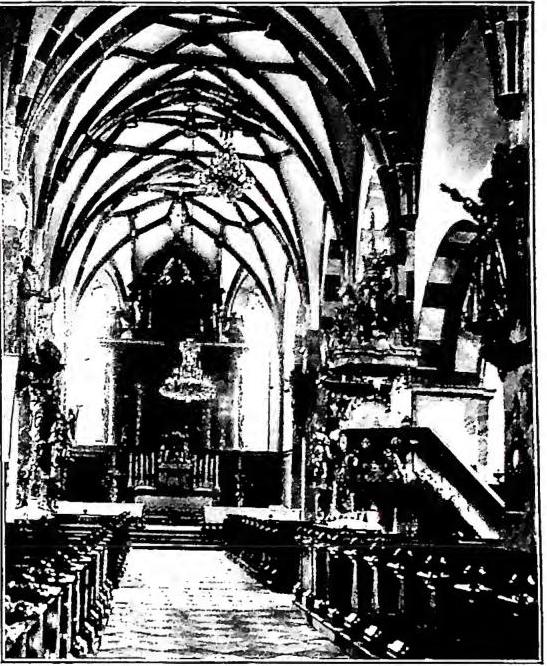
(phot. Bildarchiv d. G. Nationalbibliothek)
Almost all of M.’s prose works deal with polemical subjects: the reform of the institution of marriage, the reform of the Church, freedom of the press, and the defense of the republicans in their struggle against the monarchy.
At several points M.’s thought departs both from dogma and from orthodox morality.