
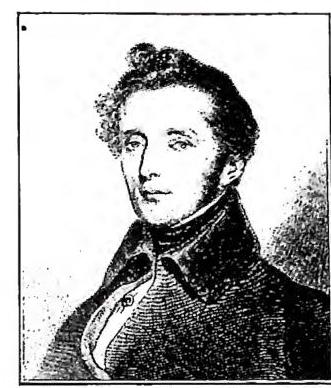
LAMARTINE, ALPHONSE-MARIE-LOUIS de. – French poet, writer, and politician, born at Mâcon on 10 October 1790, died in Paris on 28 February 1869. He completed his studies at the College of the Fathers of the Faith (former Jesuits) at Belley and in his youth stayed in Italy and Switzerland. In 1820 he married an English Protestant, M. E. Birch. Having entered the diplomatic career, he was attached to the legation in Naples (1821), then embassy secretary in London, and finally chargé d’affaires at the court of Tuscany. After the accession to the throne of Luigi Filippo, he entered the political arena, drawing closer to the liberals, whereas in the early years of the Restoration he had been a conservative. In 1832 he travelled with his family to the East, where he lost his daughter Julie. The following year he was elected deputy for the Bergues constituency, and from this moment his political fortune began, due above all to the skill of his speeches, which remained famous. He was a member of the provisional government of 1848 as Minister of Foreign Affairs, and in this capacity he consistently maintained a policy of prudence and respect for the democratic institutions of other countries. On 23 April 1848 he was elected a member of the Constituent Assembly, but in June of that
Among his numerous works in verse and prose, the following should be mentioned: Méditations poétiques (1820), the short poem La mort de Socrate (1823); Dernier chant du pèlerinage d’Harold (1825), inspired by the death of Byron at Missolonghi; Harmonies poétiques et religieuses (1830); Souvenirs, impressions, pensées et paysages pendant un voyage en Orient (1835); on the Index, decree of 22 September 1836); two episodes of a cyclic epic that L. never completed: Jocelyn, journal trouvé chez un curé de village (1836); on the Index, decree of 22 September 1836) and La chute d’un ange (1838; on the Index, decree of 27 August 1838); Histoire des Girondins (1847), a work entirely lacking any scruple regarding historical truth. Having withdrawn from politics, he wrote, among other works: Confidences (1849), Raphaël (1849), Graziella (1852), Histoire de la Restauration (1852), Cours familier de littérature (1856–69).
Although the impetus of his inspiration lacks the vigilance that might have spared it rhetorical redundancy, L.’s poetry possesses a charm that time cannot succeed in diminishing. His verse has a musicality such as is found in the work of none of the other great French Romantics. At the same time, however, this lyrical facility gives rise to a superficial interpretation of things, in which L. indeed attains solemnity, never depth; the voice of the universe that he makes resound in his poetry has a moved accent, not one of passion. His novels, idyllic representations of people and settings that are greatly falsified, among which Graziella, set in a Neapolitan environment, is particularly well known in Italy, possess the merit of effective stylistic elegance and freshness of description.
L. AND THE QUESTION OF THE PROLETARIAT. — Although his success was short-lived, L. was undoubtedly a great statesman. In the provisional government of 1848 he represented the moderate element. He even faced unpopularity, provided that legality was respected. Among the first, he grasped the enormous importance of the proletarian question and foresaw the danger arising from a failure to resolve this problem: in this he was a forerunner. He advocated the need to legalize charitable assistance and to establish state philanthropic and welfare institutions, but more in order to bar the way to socialism than to combat the injustice of the workers’ inhuman conditions. His is a conservative republic, in which there is no talk of revising fortunes or redistributing wealth.
L. must be considered in all his greatness and courage, and also with his baseness. Apparently, his political life is a succession of inconsistencies; in reality, he did nothing but carry out an extremely skilful strategy which, at the opportune moment, was to bring him to power. His uncertainties and changes of allegiance were the continuous expression of an intention to win the confidence of the masses in order to keep them under control, channel them, and thereby prevent the overthrow of the established order and the advent of socialism.
this is the romantic thesis in vogue in his time (cf., for example, Paul et Virginie by Bernardin de St-Pierre). In La Chute d'un ange, besides the legend of the angel Cedar, who falls in love with a daughter of the Cainites, Daidha, and is therefore condemned to regain eternity, lost as punishment for the step he had taken, through misery and suffering, L. sets forth an entire scheme of purifying metempsychosis and of education conducted on the premises of J.-J. Rousseau. The Souvenirs et impressions..., moreover, clearly show
that for L., who at Christ’s tomb in Jerusalem had not recovered his lost faith and, having returned to France, had increasingly yielded to the spirit of the age, religion is reduced to a pure sentiment, to a disposition of the soul that produces a quietistic adaptation, a volitional inertia in the face of events; truth is defined not as a conviction, but as a mere state of mind, which varies as circumstances and the reactions of feeling vary. These defects are not redeemed by the enchantment of the style or by the many expressions—also correct from a Christian standpoint—that have sprung solely from a surge of sentiment, which consistently ignores Revelation, the profound truths of the faith, and the moral duties that stand above all sensitivity.