
CÌTEAUX (Cistercium), ABBEY of. — Also called New Monastery, perhaps in contrast to Molesme, it was founded by St. ARDIGO, ROBERTO (v.), abbot of Molesme. Desiring a life more in keeping with the rigor
of the Benedictine Rule, on 21 March 1898 he went with twenty monks into the solitude of Cîteaux in the Côte-d'Or, not far from Dijon, a damp and wooded place belonging to Viscount Rinaldo, where he built a wooden house and a crude chapel dedicated to the Virgin. But, because of the scarcity of water, a few years later the religious withdrew to the banks of the Vouge River nearby, where they built the Ar-
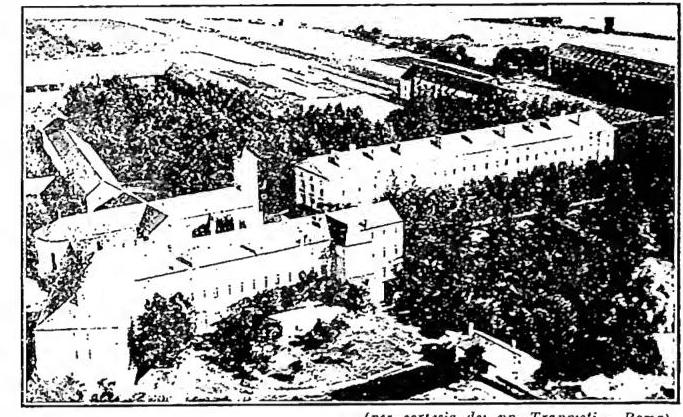
The strong organizational will of the third abbot of C., St. Stefano Harding (1109–34), who admitted the young Bernardo di Fontaines and his thirty companions to religious life (1112), made the new abbey the driving center of the nascent Cistercian Order (v.), which spread with astonishing rapidity throughout Europe, so much so that, toward the end of the 12th century, people used to say, with a touch of exaggeration, “totus mundus Cistercium est.”
But after the golden period of more than two centuries, the decline of the Order and consequently of the Cenobium began; it was plundered several times between the 14th and 17th centuries. The last abbot, Fr. Trouvé, was forced to relinquish his office because of the suppression of 13 February 1791, after having built a large wing of the monastery. The abbey complex was sold for the sum of 862,000 francs (4 May 1791). In 1864, a penal colony directed by the Brothers of S. Giuseppe was established there until 1888, after which it was converted into a correctional institution. In 1898, the monastery was redeemed by the Reformed Cistercians, or Trappists, and is legally the property of the Abbot General, who, however, resides in Rome. Nothing now remains of the ancient monastery or of the ancient church. The church, of grandiose proportions, was consecrated on 17 October 1193. Its quadrangular apse, which became characteristic of Cistercian architecture, is noteworthy. The archive and library have been dispersed.