Machine translation of the 1948–1954 Italian original. The original text is authoritative.
CRIVELLUCCI, AMEDEO. — Historian, born in Acquaviva Picena on 20 April 1850, died in Rome on 11 November 1914. He was professor of Modern History at the University of
Pisa, where he remained from 1885 to 1907, when he was called to the University of Rome.
He began with the study Del governo popolare in Firenze e del suo ordinamento secondo il Guicciardini (Pisa 1877), and with I primi saggi della storiografia fiorentina (Rome 1882); but he soon directed his research toward relations between the State and the Church from their origins onward, and particularly during the age of the Lombards. The Storia delle relazioni tra lo Stato e la Chiesa (vols. I and II, Bologna 1885–86) extends from the earliest times of Christianity to the fall of the Western Empire, and from there to the end of the pontificate of Gregorio Magno. But where the eighteenth-century rationalism, which brought him close to Giannone, and his impetuous passion are best tempered is in vol. III, on the origins of the Papal States (Pisa 1909), surpassed, however,
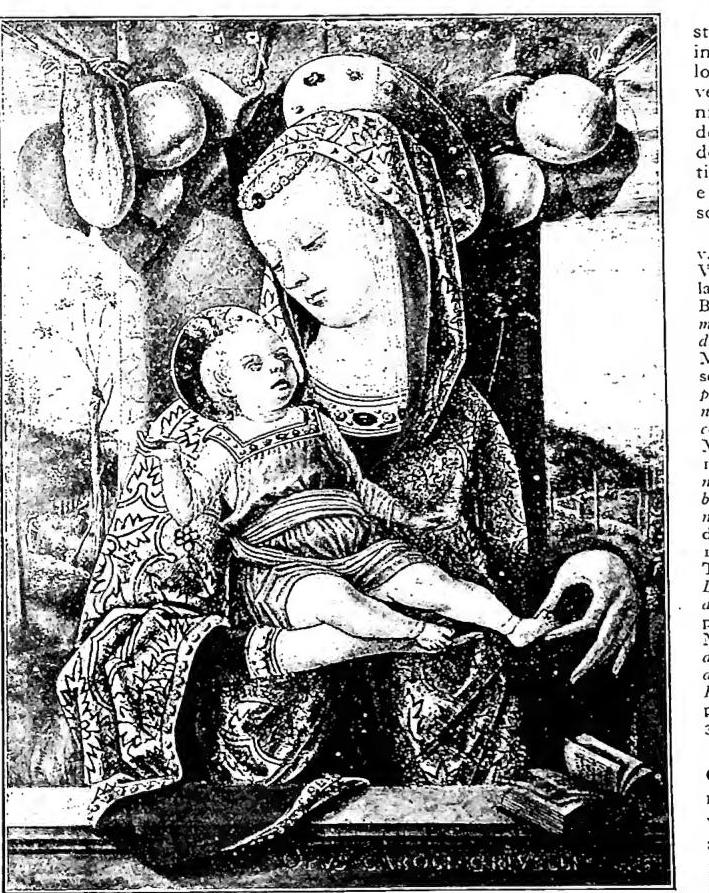
(photograph by Anderson) CRIVELLI - The Virgin with the Child - Ancona, Pinacoteca.surpassed by Duchesne’s studies and conclusions. The work, taken as a whole, suffers from a certain monotony and from excessive labor on the texts, which are forced beyond their meaning. He proved himself a better scholar, moreover, in his particular contributions (such as those on Church and Empire in the Time of Pelagius II and Gregory II [1892] and on The Catholic Churches and the Arian Lombards in Italy [1895–96]) than in comprehensive works, owing to a lack of general ideas and a skepticism regarding the supreme values of history, attributable to the philological method he had learned and perfected in Berlin, and subsequently introduced into Italy. To this was due his lack of interest in general questions and his greater attention to methodology and heuristics, which led him, in Bernheim’s Manual, to translate only the sections relating to them (Pisa 1897), and to undertake extensive bibliographical enterprises, such as the Annuario bibliografico della storia d’Italia, begun in 1902, compiled with Monticolo and then alone from 1904 to 1913, and which is, in any event, a perfect working tool. The same may be said of the editions of Paul the Deacon’s Historia Romana and Landolfo Sagace’s Historia romana (Rome 1912–13), and of the journal Studi storici, which, from 1892 until his death, he labored to publish with every effort and personal sacrifice.
BIBL.: Fr. Baldasseroni, A. C., in Arch. stor. ital., 79 (1915, II), pp. 420–36; G. Croce, Storia della storiografia italiana nel sec. XIX, II, Bari 1921, pp. 187–92; G. Volpe, Storici e maestri, Florence 1924, pp. 31–64. Pier Fausto Palumbo
Cite this article
“CRIVELLUCCI, AMEDEO.” Enciclopedia Cattolica, vol. IV (1950), p. 563. Azione Romana digital edition, https://azioneromana.com/article/crivellucci-amedeo.