XANTEN (Ad Sanctos). - In the Rhineland (Germany). It stands on the site of the ancient "Colonia Traiana" founded by the emperor of the same name.
The present city of X. grew up around the venerated tomb of the martyrVictor; indeed X. is nothing but a derivative of "ad sanctos". Gregory of Tours relates that his colleague Ebregisel, bishop of Cologne, founded a basilica to the martyr Mallosus, whose sepulcher had been found near the "oppidum Bertensium" (present-day Birten, 3 km. north of X.), and that the tomb of the martyr Victor was also there, but his body had not yet been found (In gloria martyrum, 62). In the Hieronymianum Mallosus and Victor appear under 10 October. Around the latter's sepulcher a pagan burial ground and a Christian cemetery developed, and a basilica was built over his tomb, repeatedly renewed.
In the works carried out in 1933, ancient walls and sarcophagi were found beneath the floor of the sacred building; a cell was identified which constituted the nucleus of the Basilica, with a mensa, beneath which two skeletons were found enclosed in a wooden chest; a coin collected there dates back to Theodosius I (379-95). The church underwent an enlargement around the age of Pepin, of whom a coin was also found; a little later the building was enlarged and had a nave 14 m. long, with a mosaic floor; after being sacked by the Normans in 864, the present Gothic church was then built. - See plate CLVII.
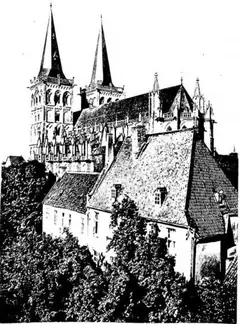
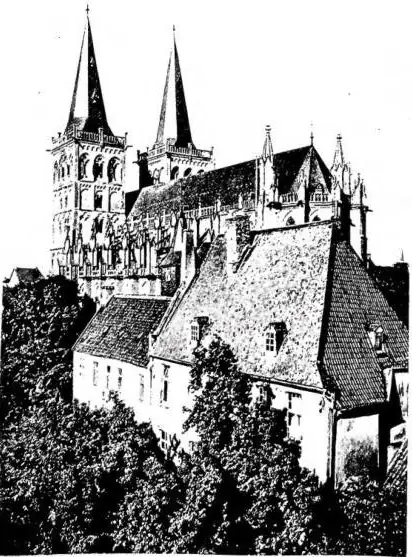
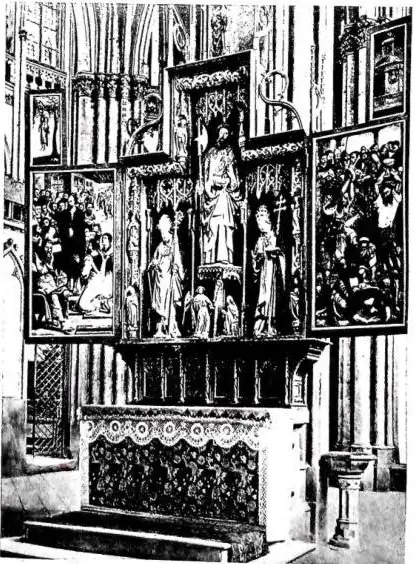
Plate CLVIILeft: SOUTH SIDE OF THE DUOMO, begun by Master Giacomo in 1263, finished in 1530 - Xanten. Right: ALTAR OF ST. MATTHIAS. The sculptures are by Master Heinrich of Holt (1525-31). The statues represent SS. Servatius, Matthias and Cornelius. The shutters with the preaching and martyrdom of St. Matthias (above Judas hanging from the tree) were painted in 1544 - Xanten, Duomo.(da E. Klapheck - W. Hege, per Don in Xanthe, Berlino 1930, p. 21)Bibliography4 worksR. Klaphe-W. Hege, Der Dom zu X., Berlin 1930; J. P. Kirsch, Scopera di una chiesa cimitero, del sec. V in un cimit. crist. ant., at X. on t
BIBL.: R. Klaphe-W. Hege, Der Dom zu X., Berlin 1930; J. P. Kirsch, Scopera di una chiesa cimitero, del sec. V in un cimit. crist. ant., at X. on the Rhine, in Riv. di archeol. crist., 11 (1934), pp. 363-71; W. Neuss, Eine altchrist. Märtyrerkirche in X., in Röm. Quartalschr., 42 (1934), p. 177 ff.; W. Bader, X., Vortrag auf der I. deutschen boethist. Tagung, Brühl 1948.
Josi, Enrico. “Xanten (Ad Sanctos).” In Enciclopedia Cattolica, vol. XII, col. 1725. Città del Vaticano: Ente per l’Enciclopedia Cattolica e per il Libro Cattolico, 1954. https://azioneromana.com/article/xanten-ad-sanctos.
MLA
Josi, Enrico. “Xanten (Ad Sanctos).” Enciclopedia Cattolica, vol. XII, Ente per l’Enciclopedia Cattolica e per il Libro Cattolico, 1954, col. 1725. Azione Romana, https://azioneromana.com/article/xanten-ad-sanctos.
BibTeX
@incollection{ec12_xanten_ad_sanctos,
  author    = {Josi, Enrico},
  title     = {Xanten (Ad Sanctos)},
  booktitle = {Enciclopedia Cattolica},
  volume    = {XII},
  pages     = {1725},
  note      = {Cited by column},
  publisher = {Ente per l’Enciclopedia Cattolica e per il Libro Cattolico},
  address   = {Città del Vaticano},
  year      = {1954},
  url       = {https://azioneromana.com/article/xanten-ad-sanctos}
}
One of some 20,000 entries brought back from the twelve printed volumes (1948–54). Spotted something? Help us improve it.
Click or scroll to zoom · drag to pan · Esc to close