
GIOVANNA D'ARC (DARC), SANTA

JEANNE D'ARC (D'ARC), Saint. — Heroine of the purest national claims of France, she united some of the most tragic moments of its history.

In 1415 Henry V of England invaded France, disputing the throne with Charles VI; the Franco-English war intertwined with the civil war between the Armagnacs and the Burgundians. The assassination of the Duke of Burgundy at Montereau (1419) drove Burgundy into alliance with England: Henry V married a daughter of Charles VI, claiming to succeed to the throne of France, eliminating the Dauphin Charles, accused of the assassination at Montereau and suspected of illegitimacy. In 1422 Henry V succeeded Charles VI in Paris, and now the English forces prepared to occupy all of France, driving out the Dauphin Charles, who, with few forces at Bourges, was designated by decision as the King of Bourges. In 1428 the English besieged Orléans; the fall of the city could decide the conflict. At this desperate moment, when France was about to disappear as an independent power, JEANNE D'ARC came to its salvation.
She was a peasant girl from Domrémy (French Barrois), born to Jacques d'Arc (or Darc) and Isabelle Romée, perhaps on 6 January 1412; she had brothers and sisters. She had no education (she would sign with a cross), but she had a profound religious sentiment. In 1425, at the age of 13, in her father’s garden, she heard her first supernatural “voice”; then, repeatedly, she had luminous visions: Saint Michael, Saint Margaret, Saint Catherine. The “voices” encouraged her to go to the aid of France. Only in 1428, under the impression of the terrible events, did she decide to obey the “voices.” An uncle accompanied her to the royal captain at Vaucouleurs, but there she met with ridicule; she returned a second time, and now Robert de Baudricourt, impressed by the energetic tone of the seventeen-year-old shepherdess, communicated the matter to Charles VII and received orders to send the girl to him. JEANNE left Vaucouleurs on 23 February 1429 dressed as a man, with a small escort; she arrived at Chinon on 6 March; introduced to the King, she recognized him among the courtiers and calmed his doubts about his birth: he was truly the son of Charles VI.
After a religious examination by a commission of prelates, some matrons confirmed her virginity, which she had already offered to God from Domrémy. No one doubted the sincerity of JEANNE when she announced that she had a divine mission to fulfill. Certainly many hesitated over what a girl could do, but many became her zealous collaborators. The moment was grave: only an intervention beyond the natural could save the country. The Maid ordered the expedition to Orléans after having written to the English generals.

Article illustration
(d. II l'allen, Jeanne d'are, Parigi 1277, p. 190)
JEANNE D'ARC, Saint — Letter to the citizens of Riom (or Nov. 1429) with autograph signature. The hand of the saint, who was illiterate, was guided. — Riom, Municipal Library.

Dressed as a warrior, with a white banner on which she had had painted Christ enthroned between angels, on 27 April she left Blois with a band of armed men escorting a column of carts with provisions; on 28 April the convoy entered Orléans, and on 29 April the Maid appeared there, welcomed as a liberator. In the following days fierce fighting took place to drive back the enemy: JEANNE was wounded in the chest, but on 8 May the English definitively abandoned the siege. Now the Maid, with the Duke of Alençon, made an expedition to clear the English from the banks of the Loire; then she insisted on accompanying the king to Reims for his coronation; only in this way would the “gentle Dauphin Charles,” as she called him, truly become the King of France.

The Maid left on 27 June with the vanguard for Reims. Charles VII followed two days later; only at Troyes was there resistance, and JEANNE directed the attack and forced the population to yield. On 17 July the consecration and coronation of the King took place in Reims; the Maid stood beside him during the ceremony with her banner. “Gentle king, now is fulfilled the pleasure of God,” she said to the King after the coronation.

JEANNE D'ARC had now completed the mission that the “voices” had entrusted to her and thought of returning to Domrémy: we do not know why she instead remained. Was it an order from the “voices” or the insistence of her comrades-in-arms? She was already known everywhere: legends about “Jeanne the Maid sent by God” were already circulating. She insisted on attacking Paris; on 26 August she occupied Saint-Denis, but encountered the indolence and distrust of the King and his advisors. In the attack on 8 September at the Porte Saint-Honoré she was again wounded, but remained all day to encourage the fighters. Then the enterprise was postponed to the following year. In May 1430 she was at Compiègne: faced with an enemy attack, she left the city to fight, and on her return was captured by the Burgundians (23 May). She was taken to Beaulieu, to Beaurevoir, to Arras, then the English bought her for 10,000 livres tournois and took her to Rouen; hated as a witch destined for the stake, she was chained at the neck, hands, and feet.

In January 1431 the trial began under the direction of the Bishop of Beauvais, Pierre Cauchon, who acted on behalf of English interests; he was assisted by the representative of the Inquisition. The aim was to extract from JEANNE a confession that the story of the “voices” was nothing but her deception and that all her actions were due to sorcery. In this way, the honor of English arms and interests would be rehabilitated. From 21 February to 17 March, JEANNE, chained, was subjected to exhausting interrogations; the acts of the trial show how much simplicity and honesty were in the Maid, and how much malice and determination to condemn her were in her inquisitors. She was accused of lies, superstition, blasphemy, impiety, and idolatry. Not even the threat of torture induced JEANNE to deny what she sincerely believed. On 24 May, in the cemetery of Saint-Ouen, with the most terrible threats, the Maid was induced to abjure what were said to be her errors: she declared that she wished to obey the Church. But realizing that the freedom promised her was a snare to make her admit to having sinned, she immediately returned to declaring her faith in the “voices.” As a result, as a relapsed heretic, she was handed over to the secular arm and on 30 May 1431 mounted the pyre in the Place du Vieux-Marché. Her ashes were cast into the Seine.
Charles VII remained inert in the face of the capture and trial of the Maid. Only in 1453, at the official request of JEANNE’s mother and at the urging of the government, did Pope Calixtus III authorize a papal commission to review the trial and annul it for serious defects of form and substance. On 6 June 1456 the sentence of rehabilitation appeared.

Declared Blessed by Pius X on 18 April 1909; Benedict XV proclaimed JEANNE a saint on 9 May 1920. Feast day, 30 May. In France, a law of 10 July 1920 proclaimed the anniversary of the Maid’s martyrdom a national holiday.

Article illustration
(by courtesy of mons. A. P. Frutaz)
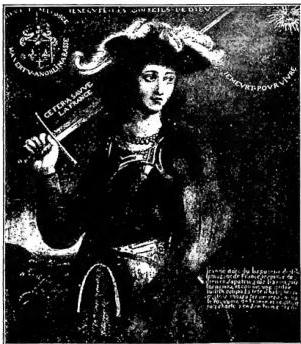
JEANNE D'ARC, Saint — Portrait. Painting by an unknown French artist (early 17th century). — Rouen, Town Hall.

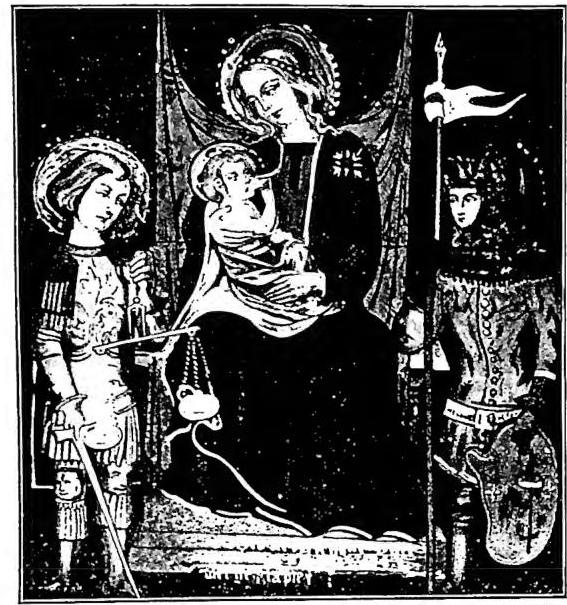
GIOVANNA D'ARC, Saint — The Virgin enthroned between Saint Michael and Saint JEANNE D'ARC. Painting from the 15th century. — Paris, private collection.

BIBL.: Quicherat, Procès de condamnation et de réhabilitation de Jeanne d’Arc, 5 vols., Paris 1841-1849; id., Aperçus nouveaux sur l’histoire de Jeanne d’Arc, Paris 1875; Wallon, Jeanne d’Arc, 2 vols., Paris 1860; Siméon Luce, Jeanne d’Arc à Domrémy, Paris 1886; id., Jeanne d’Arc à Orléans, Paris 1891; id., Jeanne d’Arc en prison, Paris 1892; id., Jeanne d’Arc à Compiègne, Paris 1894; id., Jeanne d’Arc et l’Université de Paris, Paris 1896; id., Jeanne d’Arc et les ducs d’Alençon, Paris 1897; id., Jeanne d’Arc et les Rémois, Paris 1898; id., Jeanne d’Arc et les Bourguignons, Paris 1899; id., Jeanne d’Arc et les Anglais, Paris 1900; id., Jeanne d’Arc et la seconde guerre de Cent ans, Paris 1901; id., Jeanne d’Arc et la politique, Paris 1902; id., Jeanne d’Arc et la politique anglaise, Paris 1903; id., Jeanne d’Arc et la politique bourguignonne, Paris 1904; id., Jeanne d’Arc et la politique française, Paris 1905; id., Jeanne d’Arc et la politique pontificale, Paris 1906; id., Jeanne d’Arc et la politique impériale, Paris 1907; id., Jeanne d’Arc et la politique royale, Paris 1908; id., Jeanne d’Arc et la politique de la cour de Rome, Paris 1909; id., Jeanne d’Arc et la politique de la cour de France, Paris 1910; id., Jeanne d’Arc et la politique de la cour d’Angleterre, Paris 1911; id., Jeanne d’Arc et la politique de la cour de Bourgogne, Paris 1912; id., Jeanne d’Arc et la politique de la cour de Charles VII, Paris 1913; id., Jeanne d’Arc et la politique de la cour de Henri VI, Paris 1914; id., Jeanne d’Arc et la politique de la cour de Philippe le Bon, Paris 1915; id., Jeanne d’Arc et la politique de la cour de Charles le Téméraire, Paris 1916; id., Jeanne d’Arc et la politique de la cour de Louis XI, Paris 1917; id., Jeanne d’Arc et la politique de la cour de François Ier, Paris 1918; id., Jeanne d’Arc et la politique de la cour de Henri VIII, Paris 1919; id., Jeanne d’Arc et la politique de la cour de Charles Quint, Paris 1920.
Bibl.: There are countless works dedicated to GIOVANNI D’A.: none is truly satisfactory. His biographers range from those with a markedly hagiographical tendency to those with a rationalist tendency. GIOVANNI D’A. was also discussed and explained for the use of physicians and psychiatrists. The reality of the divine mission is something beyond all human explanation; from a historical point of view, it cannot be denied that GIOVANNI D’A. felt this divine mission, believed in it, and acted in its name and for its sake. There is no doubt that his enterprise was facilitated by certain political circumstances and that the mystical element favored those who took part in II. The most important document for the study of GIOVANNI D’A. is the trial edited by J. Quicherat, *Procès de condamnation et de réhabilitation de Jeanne d'Arc*, 5 vols., Paris 1841–49; there is also an edition of the trial of condemnation by P. Champion, *Procès de condamnation de Jeanne d'Arc*, 2 vols., 1920–21 (and by the same author, *Notice des manuscrits du procès de réhabilitation de Jeanne d'Arc*, 11 1930). Among the biographies, the following should be noted: M. Sépet, *Jeanne d'Arc*, 11 1930; J. B. J. Ayrolles, *La vraie Jeanne d'Arc*, 11 1930; A. France, *Vie de Jeanne d'Arc*, 11 1930; Ph. Dunand, *Histoire complète de Jeanne d'Arc*, 11 1930; G. Hanotaux, *Jeanne d'Arc*, 11 1930; A. Fabre, *Etude sur Jeanne d'Arc*, 11 1930; G. Goyau, *Les étapes d'une gloire religieuse*, 11 1930; G. Goyau, *Les Fribulles*, 5 vols., 11 1930.

Her intentions, however, did not correspond to an easy realization. With a restless and sensitive soul, she had a spiritual director who increased her scruples with complicated religious practices.

Only after she met St. Francis de Sales in Dijon (March 1604) and chose him as her spiritual director (August 1604) did the essence of true Christian freedom—rich in sweetness and condescension—become clear to her. St. Francis de Sales also instructed her in the most fruitful method of prayer: no longer at fixed hours (and often the most inconvenient in the economy of a household), but at every moment of the day with joy and simplicity of heart. With the Salesian method, GIOVANNI F. was able to bridge the gap between her sublime aspirations and the daily difficulties of the spirit. She remained too preoccupied with obtaining interior consolation, but St. Francis de Sales instilled in her the principle that in the interior life, even the perfect one, one must not aim at consolation.

In 1610, she decided to leave the world and, together with Francis de Sales, founded the Visitation (in Annecy in June 1610). The Order, modeled on the gentle and humble spirituality of the sisters (St. Francis de Sales had emphasized that *charité est une humilité montante et l’humilité de charité descendante*), had initially arisen as a contemplative Order but at the same time dedicated to helping the poor. However, the opposition of the Archbishop of Lyon, who insisted that the sisters remain always within the cloister and not visit the poor, led the Order to revert to essentially contemplative foundations. The constitutions were approved by the Holy See in 1626. Only later did the Visitation dedicate itself to the education of young girls.

The closeness of GIOVANNI F. to Francis de Sales has been, in the history of the Church, one of the highest examples of holy Christian brotherhood. It was not only the Saint who inspired GIOVANNI F.; she also knew how to enlighten the Saint on the path of seeking God: it is GIOVANNI F. who reveals to the Saint the secret treasure of the mystical life, or at least contributes to dispelling suspicions about mystical illuminations. The Saint’s mystical experiences greatly aided the Saint in beginning the composition of the *Traité de l’Amour de Dieu*.

The Saint survived her spiritual director by many years, governing her Institute with great skill. She was beatified by Benedict XIV on 13 November 1751 and canonized by Clement XIII on 16 July 1767. Feast day: 21 August.

Bibl.: E. Bougaud, *Histoire de St. Ch. et des origines de la Visitation*, 2nd ed., Paris 1863; M. Müller, *Die Freundschaft des hl. Franz von Sales mit der hl. Johanna Franziska von Ch.*, Regensburg 1924; A. Saudreau, *L’oraison d’après St. Jean de la Fondation*, Paris 1926; E. Du Jeu, *M. de Ch. Sa vie dans le monde et sa vie religieuse*, 3rd ed., 1872; V. Giraud, *St. Jeanne de Ch.*, 1878; E. Maire, *St. François de Sales et St. Jeanne de Ch.*, 1893; A. Hämel-Stier, *Das Seelenleben der hl. J. Franziska von Ch.*, Würzburg 1937; F. Trochu, *St. François de Sales*, Massimo Petrocelli, Lyon 1933; A. Hämel-Stier, *Das Seelenleben der hl. J. Franziska von Ch.*, Würzburg 1938; F. Trochu, *St. François de Sales*, Massimo Petrocelli, Lyon 1934, passim.