
DOGMATISM. — From δόγμα, opinion, judgment, d. in its primitive meaning is every direction or system that defends, at least in general and within certain limits, the possibility and reality of certainty. Understood in this way, the word has a positive sense and was already opposed in antiquity to skepticism (cf. Diogene Laerzio, IX, 74; Sesto Emp., Pyrrh. Hypot., I, 3). The primitive sense is altered in Kant, who retains the antithesis between d. and skepticism, but understands d. in a pejorative sense, as “the procedure that reason follows without a preliminary critique of its power” (Critique of Pure Reason, Italian trans. by G. Gentile, Bari 1940, p. 31).
To this dogmatic procedure, which according to Kant is the cause of metaphysical skepticism, he opposes criticism as the sole path to true science (ibid., p. 53). The meaning current today derives from Kantian usage; a dogmatic procedure is in fact generally synonymous with an uncritical procedure, and d. is any system or method founded on gratuitous assertions. Even essentially negative systems, and even skepticism in some of its partial forms, may thus be reduced to d. when they proceed from un demonstrated presuppositions. Always in relation to this general meaning, d. sometimes denotes the a priori method that proceeds by systematic constructions
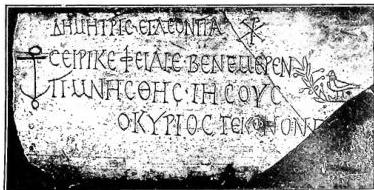
(phot. Pont. comm. arch. sacra) DOGMATICHE, ISCRIZIONI - Inscription in which Demetrio and Leonsia commend their daughter to Christ (4th century). - Rome, Cemetery of Domitilla.
CIEMO).