
### ÁVILA, DIOCESE OF
In Spain, a suffragan of Valladolid (1851), with its see at Ávila (Abila, Abela, Abula), a city of Old Castile, situated at a high elevation on a tributary of the Duero, 120 km from Madrid. It is the capital of an extensive province (8,047 sq km). During the persecution of Diocletian, it had three martyrs: Vincent, Sabina, and Cristeta. The installation of Priscillian by his partisans is the first certain record of the see. It disappeared at the beginning of the 8th century and was restored at the end of the 11th. Innocent II fixed the boundaries of the diocese on 19 March 1738. The bishops took an active part in the political and religious events of Castile. Ávila reached its greatest prosperity in the 15th–16th centuries. It had eminent bishops: Alfonso Fernández de Madrigal, “El Tostado,” Fernando de Talavera, O.S.H. (1485–93), Diego de Alava (1548–59), who attended the Council of Trent. The city had many parishes, 10 male and 7 female convents. Among these, the monastery of St. Joseph is famous as the cradle of the reform of St. Teresa of Jesus (q.v.), and the Dominican convent of St. Thomas became a university in 1550. Among the numerous convents of the diocese (outside Ávila) is the one founded by St. Peter of Alcántara (q.v.) at Arenas de San Pedro. One of the protomartyrs of Japan, St. Peter Baptist (d. 1597), canonized by Pius IX in 1862, was from this diocese.
The diocese has an area of 9,760 sq km, 295,893 inhabitants, all Catholic; 393 parishes; 289 diocesan priests and 67 regulars.
The cathedral, built by the masters Álvaro García de Estella, Eruchel, and Mateo (11th–12th centuries), is in the Romanesque style, with later transformations and additions; there are other Romanesque churches in the city. The church (convent) of St. Thomas is Gothic (late 15th century). The seminary, founded in 1578 and enlarged in 1850, possesses a rich library. The diocese has an art museum, but the archives were transferred to Madrid in 1869.
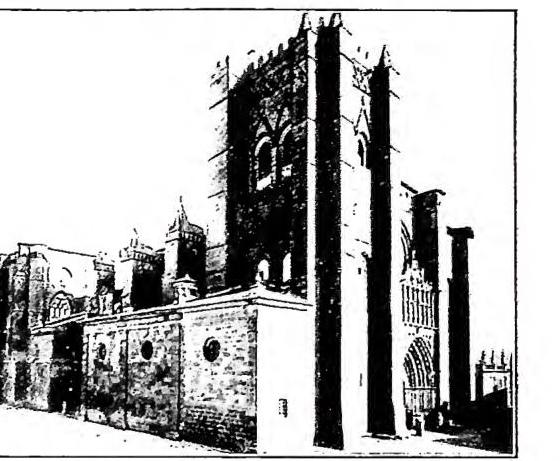
ÁVILA - The cathedral was begun in 1150 by the master Eruchel.
On the request of Philip II, the latter's work was ratified by the bull In apostolatus culmine of 4 April 1576 (Bullarium Ord. Praed., V, 344 ff.).
Later, the Studium also acquired faculties of arts, medicine, and law. Its principal activity, however, remained theology. Among its most illustrious masters are to be remembered the Dominican fathers Domingo Báñez and Pedro Ibáñez, spiritual directors of St Teresa.
Innocent X, with the constitution Exponi nobis of 10 March 1645 (Bull. Ord. Praed., VI, 152), sanctioned its statutes. In 1807, however, the liberal government suppressed it, together with other secondary (minor) universities.