
GIOSUÈ. -
I. THE PERSON
Son of Nun, of the tribe of Ephraim (Num. 13:9, 17; 1 Chr. 7:22-27), successor of Moses as theocratic leader (cf. “the man in whom is the spirit,” Num. 27:18) of the people of Israel during the conquest of the land of Canaan and the settlement of the various tribes in their territories.The Hebrew name is Jēhōfāa', Jēhōfūa', earlier in the form Hōfēa' (cf. Num. 13:8 with 13:16), abbreviated as Jēfāa' (Neh. 8:17), whence the name “Jesus,” probably meaning “Jahweh (is) salvation,” cf. Josh. 1:9.
Already during the desert crossing he had been chosen by Moses as his “minister” (Ex. 24:13) and entrusted with special missions of trust, such as the war against the Amalekites while Moses prayed on the mountain (Ex. 17:9-13) and the exploration of Canaan (Num. 13). Moses took him up Mount Sinai when he received the Tables of the Law (Ex. 24:13) and always held him in affection (Num. 11:29; 14:6 ff.). Long before, Joshua had been designated to succeed Moses and initiated by a kind of investiture rite (Num. 27:18-23) to his office; as Moses lay dying he repeated the designation, stressing the particular task entrusted to him of leading Israel to the conquest and division of Canaan (Deut. 31:3, 7, 23; cf. Josh. 1:6-9, where the insistence on the exhortation to be “strong and courageous” refers to the military functions characteristic of Joshua’s activity).
The chronology of the conquest of Canaan depends on the system chosen for fixing the Exodus (v.): if one admits that the pharaoh of the Exodus was Merneptah of the XIXth Dynasty (end of the 13th century B.C.), one would arrive for Joshua at the period immediately following the death of Ramesses III (1167), when Egypt’s power in Palestine was steadily declining and local sovereignties were asserting themselves (cf. 13:2-3).
II. THE BOOK OF JOSHUA
The story of Joshua is closely bound up with that of the conquest, a period of perhaps thirty years, the subject of the book that bears his name, and it occupies the sixth place in the Old Testament, after the Pentateuch, of which it is, in its narrative portion, the continuation: a relation at once vivid and detailed, at times schematic and concise, of that epic enterprise.The book is divided into two parts of equal length: the occupation (chaps. 1–12) and the division of Canaan (chaps. 13–24). In the first part the preparations are narrated (chaps. 1–5), then the conquest: Jericho (chap. 6), Ai (chaps. 7–8), and the remaining southern (chaps. 9–10) and northern (chap. 11) territories. The account closes with a summary list of the defeated kings (chap. 12). The second part recounts the distribution of the territory to the tribes, beginning with those beyond the Jordan (chap. 13), then moving westward: Judah (chap. 14), Ephraim (chaps. 15–16), Manasseh (chap. 17), Benjamin (chap. 18) with the remaining six (chap. 19), followed by the fixing of the “cities of refuge” (chap. 20) and the Levitical cities (chap. 21). Once these operations were completed, the tribes beyond the Jordan were sent back to their homes (chap. 22). The book concludes with the account of two discourses by Joshua and the narrative of his death and burial (chaps. 23–24).
Archaeological exploration, especially in the region of Jericho, and the documents from el-ʿAmārnah have shed light on this period in its general significance: thus, for example, it is established for this period that there was an armed penetration into Palestine from outside. The excavations carried out at Jericho in 1907–1909 by a German society under the direction of Sellin, and then in 1929–31 by the Englishman Garstang, revealed a strong wall, violently overthrown, dating to the fifteenth to thirteenth centuries B.C.; many identify it with the walls that fell in Joshua’s time. Excavations begun as early as 1902 at Ai (v.), Gezer, Bethel, and Lachish have likewise yielded fruitful results. No scholar can any longer doubt the historical existence of a leader who, at that time, guided a great penetration into Canaan from the southeast desert.
For the historical-literary problems up to recent decades, criticism treated the Book of Joshua as sharing Pentateuch (v.), of which it was considered an integral part (v. ESATEUCO); today, however, agreement with Jewish and Christian tradition has been reached at least in the almost universal recognition of the book’s individuality. Criticism nonetheless continues to seek the “sources” of the book in distinct writings of different origin and character, essentially those “classical” of the Pentateuch (J, E, D, P, to which, for some, has more recently been added the “secular source” L), much later than the events narrated, and compiled together in the present book. The book as it stands cannot go back to Joshua, since it speaks of his death (24:29 ff.) and of subsequent events (cf. Josh. 15:13–19 and 19:47 with Judg. 1:10–15 and 18:27–29; Josh. 13:30 with Judg. 10:3–5, etc.); the indications to the contrary, to which ancient Jewish opinions and very few late Christian testimonies refer, can be explained otherwise (Josh. 24:26 refers only to the renewal of the covenant; certain first-person plural expressions are critically erroneous, as in 5:1, or suspect, or assign to Joshua individual passages, etc.); the lower chronological limit is the time of David (cf. 15:63 with 2 Sam. 5:6–8, etc.; also 16:10 with 1 Kgs. 9:16, from Solomon’s time); the author is unknown. He was, however, not far removed from the events narrated and drew upon sources contemporary with the events themselves or from good traditions. The most notable of these documents is the “Book of the Just” Yāšār (others read “Book of Israel,” Yēšurūn; or “of the Song,” sîr), perhaps a collection of epic-lyric celebrations of the great national deeds and heroes, from which, as the text itself explicitly attests (10:13), derives the well-known poetic passage containing Joshua’s command to the sun and moon to “stand still” at Gibeon and in the Valley of Aijalon.
The text of Joshua shows slight differences between the Hebrew and the Greek (Septuagint) form: the latter is sometimes better, but here and there contains expansions that must be regarded as later additions.
III. ICONOGRAPHY
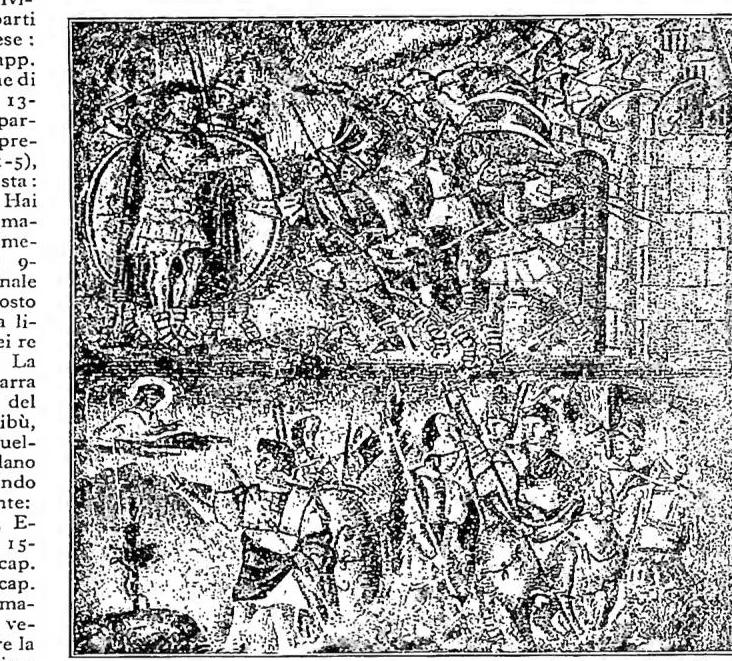
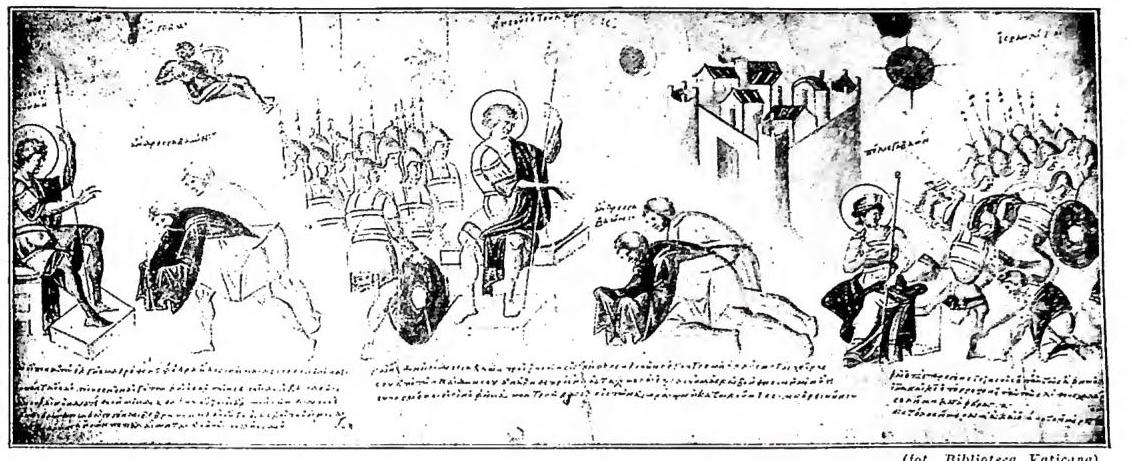
The exploits of JOSHUA were illustrated in some mosaics of the Old Testament cycle in S. Maria Maggiore in Rome and in the “Joshua Roll,” cod. Vat. Palat. gr. 431.This is a scroll or volumen on parchment, which, although lacking its beginning and end, is 11.50 m long and between 0.64 and 0.87 m wide. It contains the story of Joshua from Jos. 2:15–16 to Jos. 10, with 23 illustrations that have much in common with the mosaics of S. Maria Maggiore, accompanied by legends in Greek uncial cursive. It is a 10th-century copy of an original perhaps dating before the 6th century. Joshua is also represented in some gold-glass vessels. The arrangement of the groups, the movement of the warriors, the series of mythological figures, naiads, nymphs, and deities recall those of the Vienna Genesis; and, as in these, the classical tradition persists.
Artists of all ages and countries have drawn inspiration from the wondrous tales of the Book of Joshua: one may recall Ghiberti’s relief on the so-called Gate of Paradise in the Baptistery of Florence, Benozzo Gozzoli’s fresco in the Camposanto of Pisa (The Capture of Jericho), some frescoes in Raphael’s Logge, a sketch by Tiepolo in Milan (Museo Poldi Pezzoli, The Miracle of the Sun), and, for the 19th century, drawings by German Romantic painters as well as a painting by Segantini (Rahab Hides the Spies on her Roof). On the other hand, certain episodes of the book lent themselves to the typological concept of the Middle Ages: in the baptismal font of Hildesheim (first half of the 13th century) the Crossing of the Jordan prefigures the Baptism of Jesus; in the antependium of Klosterneuburg (1181) and in the reliquary of Tongres, Joshua and Caleb bearing the miraculous vine symbolize the Crucifixion and specifically Jesus bearing the cross. — See pl. XXXVI.
Together with Zorobabel he mobilized the workforce and materials for the reconstruction of the Temple, which began, amid great demonstrations of faith, in May 536 (Ezra 3:7–13). Rejecting, for the sake of pure Yahwism, any collaboration with the Samaritans (Ezra 4:1–3), he resumed construction under the urging of Haggai and Zechariah after it had been forcibly suspended (520 BC). Giosuè solemnly consecrated the new Temple in 516 (Ezra 5:1 sqq.; 6:14–17). With Zorobabel he was the driving force behind every initiative (Hag. 1:1–12, 14; Zech. 1–8). His zeal is praised in Sir. 49:14.