### GIORDANI, CEMETERY OF
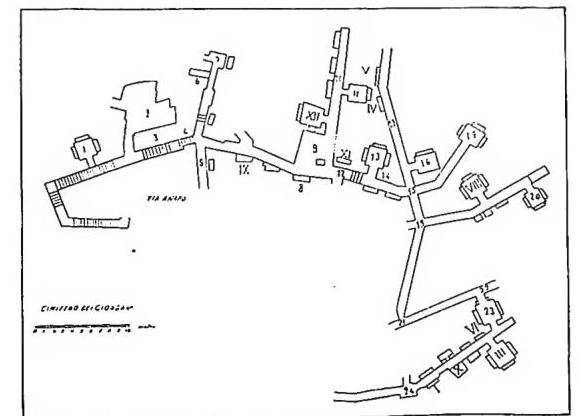
On the new Via Salaria. Nothing certain can be said about the plural form of this cemetery’s name, which has led some to think it a corruption of *Germanorum*, others to connect it with the river *Iordanus*, and still others to see it as a name of an association. It contains the tombs of the martyrs Martialis, Vitalis, and Alexander, whom legend presents as three of the seven sons of St Felicitas (q.v.). Commemoration of these martyrs was already being celebrated by the first half of the 4th century, as indicated by the *Depositio martyrum* on the *VI idus julias*, a date also found in the Leonine Sacramentary and the Hieronymian Martyrology, which records that on 31 December seven virgins—Donata, Paulina, Rogata, Dominanda, Serotina, Saturnina, and Ilaria—were buried in the same cemetery and commemorated there. Both these virgins and the three martyrs mentioned above were venerated in the 7th century, as attested by the *Itineraria*.
The cemetery, restored by Pope Symmachus (498–514), may have had an open-air oratory dedicated to St Alexander, one of the three martyrs. Damaged during the Gothic sack, it was restored by Pope Vigilius and is mentioned in the *Capitularia Evangeliorum*; the final restoration was carried out by Pope Adrian I (772–95). After the general abandonment of Roman cemeteries in the 9th century, following the translation of relics into the city, the Cemetery of the Giordani was accidentally rediscovered on 31 May 1578, when workmen digging in a vineyard on the new Via Salaria came upon the cemetery’s galleries, still sealed by their inscriptions, as well as painted cubicles and arcosolia. This discovery aroused not only the curiosity of visitors such as St Peter Canisius and Cardinal Cesare Baronio, but also that of scholars who copied the inscriptions and recorded the paintings, among them the Fleming Philip De Winghe and the Spanish Dominican Alonso Chacón (q.v.).
The cemetery was ruined again in 1590–91.
---
### GIONATA
(Hebrew *Jónāthān*, “Jahweh has given”). Eldest son of Saul (q.v.), one of the richest and most attractive figures in the Bible. He was perhaps twenty years old when he first appears at his father’s side, who had probably reigned for fifteen years. Jonathan wished to shake off the Philistine yoke, and it was he who, by killing a garrison commander, gave the signal for revolt (1 Sam 13). Soon after, accompanied only by his armour-bearer, he attacked another Philistine garrison, scaling impossible cliffs, an exploit that led to a dazzling Israelite victory (1 Sam 14). Slightly older than David, he loved him as his own soul from the moment they met after David’s duel with Goliath (1 Sam 18–20; 23.15–18). Even when he learned that David rather than he would be king of Israel, he continued to love and defend him against his father, despite incurring Saul’s wrath and insults. He died bravely beside Saul on Mount Gilboa, fighting the Philistines.
David mourned him in a famous elegy, recalling “the bow of Jonathan, which never turned back,” his anguish for “my brother Jonathan,” who was “dear to me beyond the love of women,” whose affection was “more precious to me than the love of women” (2 Sam 1.19–27). At his death Jonathan left a five-year-old son, Mephibosheth (q.v.), whom David, in memory of his friend, later took as his perpetual guest (2 Sam 9).
Other biblical figures: *V. JONATHAN*.
---
### GIONDA, CEMETERY OF
On the new Via Salaria. Nothing certain can be said about the plural form of this cemetery’s name, which has led some to think it a corruption of *Germanorum*, others to connect it with the river *Iordanus*, and still others to see it as a name of an association. It contains the tombs of the martyrs Martialis, Vitalis, and Alexander, whom legend presents as three of the seven sons of St Felicitas (q.v.). Commemoration of these martyrs was already being celebrated by the first half of the 4th century, as indicated by the *Depositio martyrum* on the *VI idus julias*, a date also found in the Leonine Sacramentary and the Hieronymian Martyrology, which records that on 31 December seven virgins—Donata, Paulina, Rogata, Dominanda, Serotina, Saturnina, and Ilaria—were buried in the same cemetery and commemorated there. Both these virgins and the three martyrs mentioned above were venerated in the 7th century, as attested by the *Itineraria*.
The cemetery, restored by Pope Symmachus (498–514), may have had an open-air oratory dedicated to St Alexander, one of the three martyrs. Damaged during the Gothic sack, it was restored by Pope Vigilius and is mentioned in the *Capitularia Evangeliorum*; the final restoration was carried out by Pope Adrian I (772–95). After the general abandonment of Roman cemeteries in the 9th century, following the translation of relics into the city, the Cemetery of the Gionda was accidentally rediscovered on 31 May 1578, when workmen digging in a vineyard on the new Via Salaria came upon the cemetery’s galleries, still sealed by their inscriptions, as well as painted cubicles and arcosolia. This discovery aroused not only the curiosity of visitors such as St Peter Canisius and Cardinal Cesare Baronio, but also that of scholars who copied the inscriptions and recorded the paintings, among them the Fleming Philip De Winghe and the Spanish Dominican Alonso Chacón (q.v.).
The cemetery was ruined again in 1590–91.
JONATHAN (Heb. Jónáthán, “Jahweh has given”). — The eldest son of Saul (q.v.), one of the richest and most attractive figures in the Bible. He was perhaps twenty years old when he first appears beside his father, who had probably reigned for fifteen years. Jonathan sought to shake off the Philistine yoke, and it was he who, by killing a garrison commander, gave the signal for revolt (1 Sam 13). Soon after, accompanied only by his armor-bearer, he attacked another Philistine garrison, scaling impossible cliffs: an exploit that led to a brilliant Israelite victory (1 Sam 14). Slightly older than David, he befriended him immediately after David’s duel with Goliath (q.v.) (that same year), as if he were his own soul. Even when he learned that David, not he, would be king of Israel, he continued to love and defend him against his father, despite drawing Saul’s wrath and insults (1 Sam 18–20; 23:15–18). He died bravely beside Saul on Mount Gilboa, fighting against the Philistines.
David mourned him in a famous elegy, “the bow of Jonathan that never turned back,” his anguish for “brother Jonathan,” who was “dear to him beyond measure,” whose love was “more precious to him than the love of women” (2 Sam 1:19–27). Jonathan left behind a five-year-old son, Mephibosheth (q.v.), whom David, in memory of his friend, later made his perpetual guest (2 Sam 9).
Other biblical figures: V. SWIFT, JONATHAN.JONATHAN (Heb. Jónáthán, “Jahweh has given”). — Eldest son of Saul (see), one of the richest and most attractive figures in the Bible. He was perhaps twenty years old when he first appears beside his father, who had probably reigned for fifteen years. The Israelites sought to throw off the Philistine yoke, and it was Jonathan who, by slaying a Philistine garrison commander, gave the signal for revolt (1 Sam 13). Soon after, accompanied only by his armor-bearer, he attacked another Philistine garrison, scaling impossible cliffs: an exploit that led to a dazzling Israelite victory (1 Sam 14). Slightly older than David, he felt an immediate bond with him after David’s duel with Goliath (see) (that same year), as if Jonathan’s soul were knit to his. Even when he learned that David, not he, was to be king of Israel, he continued to love and defend him against his father, despite drawing Saul’s wrath and insults (1 Sam 18–20; 23:15–18). He died bravely beside Saul on Mount Gilboa, fighting the Philistines.
David mourned him in a famous elegy, “the bow of Jonathan turned not back,” his anguish for “my brother Jonathan,” who was “dear to me beyond measure,” whose love was “more precious to me than the love of women” (2 Sam 1:19–27). Jonathan left behind a five-year-old son, Mephibosheth (see), whom David, in memory of his friend, later made his perpetual guest at table (2 Sam 9).
Other biblical figures: see JONATHAN.
GIONATA (Heb. Jónáthán, “Jahweh has given”). — The eldest son of Saul (q.v.), one of the richest and most attractive figures in the Bible. He was perhaps twenty years old when he first appears at his father’s side, who had probably been reigning for fifteen years. The Israelites sought to throw off the yoke of the Philistines, and it was G. who, by slaying a Philistine garrison commander, gave the signal for revolt (1 Sam 13). Immediately afterward, accompanied only by his armor-bearer, he attacked another Philistine garrison, scaling impossible cliffs: an exploit that led to a dazzling Israelite victory (1 Sam 14). Slightly older than David, he met him for the first time after David’s duel with Goliath (q.v.) (l