
MOLTIPLICAZIONE DEI PANI. - The depiction of the miracle of the multiplication of the loaves and fishes recounted by the four Evangelists (Mt. 14, 13-21; Mc. 6, 32-44; Lc. 9, 10-17; Io. 6, 1-13) appeared very early on in early Christian funerary art.
The act of the multiplication is found on the back wall of cubiculum A. 3 in Callisto, from the beginning of the 3rd century; the tripod with
bread is found in the adjoining cubicle A. 2 (Wilpert, Pitture,
pl. 38); the baskets filled with loaves vary in number, mostly
being seven; in one case twelve (id., ibid., pl. 15, 2).
There is then a series of representations of symbolic
banquets, mostly with seven persons seated at table, with
fish on the platters and baskets with loaves, from the middle of the 2nd century at
Priscilla, and in cubicles A. 2, A. 3, A. 6 in Callisto. G. Cristo
works the miracle either by touching the loaves with the virga virtutis,
mostly in cemetery frescoes, or by laying his hands
upon the loaves gathered in baskets presented to him by the
Apostles, as generally on sarcophagi and in a fresco
of the cubicle known as « delle pecorelle » in Callisto, from the
end of the 4th century (id., ibid., pp. 276-77, pl. 237, 1).
On many sarcophagi G. Cristo lays his hands on the one side
on the basket of loaves and on the other on the platter with the fish presented
to him by two disciples (id., Sarcofagi, pls. 96 and 218, 1);
on others, instead, the Redeemer holds the thaumaturgical rod
with his right hand and with it touches the baskets that are at his
feet, while with his left hand he blesses the platter of fish
presented by a disciple (id., ibid., pls. 104, 6; 111, 1;
128, 2; 180, 2). On other sarcophagi, instead, he touches with the
thaumaturgical rod the baskets of loaves placed at his feet
(id., ibid., pl. 127, 2).
The crowd gathered at a banquet in the desert is represented
in the polychrome fragments of the Museo delle Terme; there
are six baskets full of loaves and six diners, among them two youths,
one in the act of drinking, the other receiving a loaf
from G. Cristo, who lays his hand upon it, blessing it; on
this loaf is partly incised, partly painted, the mono-
gram of Christ (G. Wilpert, I due frammenti di sculture
policrome del Museo delle Terme, in Römische Quartalschrift,
35 [1927], pp. 273-85; id., Sarcofagi, p. 343, pl. 220, 1).
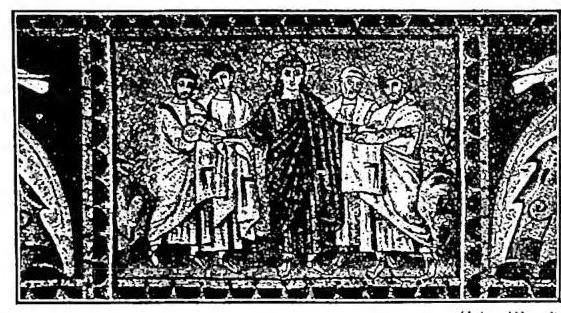
In non-cemetery art the multiplication is represented in Ravenna
in one of the mosaics of the cycle in S. Martino in caelo aureo, now
S. Apollinare Nuovo, ca. 520 (Wilpert, Mosaiken, pl. 98).
As early as 1911 P. Karge had begun ar-
chaeological investigations, later suspended, on the
very site where, according to tradition, G. Cristo
had performed the miracle of the multiplication of the loaves
and fish near Lake Genesareth, distinguished
by the designation el-tābga from the Greek
ἐντάκγιον (Χωρίον), that is, the region of the seven
springs. In 1932 a complete exploration
brought to light a remarkable basilica with three
naves and a transept, 56 m long, 33 m
wide on the west and only 24.30 m on the east,
owing to the impediment of the terrain and to the great
road of Cafarnao. The site corresponds ex-
actly to the description of Paolo Diacono
(12th cent.) derived from that, now lost,
of the Peregrinatio Etheriae from the end of the 4th
cent.; there it was indicated that the stone « super quem
dominus panem posuit » had become an altar
and that pilgrims chipped off fragments
from it for remembrance and veneration. The excavation
brought back to light this stone, which shows
signs of removals and exhibits at the corners
four holes to fix the legs of the altar.
The floor mosaic represents a basket with loaves and
a fish on each side; the rest of the decoration is
ornamental. The construction material and the mosaic technique
have been dated to the end of the 4th cent., with restorations from the
end of the 5th or the beginning of the 6th cent.; the church was destroyed
already during the wars of 614 (A. M. Schneider, Die Brotver-
mehrungskirche von el-tābga am Genesarethsee und ihre Mo-
saiken [Collectanea Hierosolymitana, 4], Paderborn 1934).