
MONOGRAMMA. – The monogram results from the interweaving of all the letters composing a word in general, or merely of the initials or consonants forming it; it is used chiefly for proper names. There is no consistent rule for reading monograms; indeed, Nicomachus Flavianus asserted that the monogram engraved on his ring, which he used to seal his letters, was «magia intelligi quam legi promptum est» (Ep., II, 12). It has remote origins: examples are found in Greece, on the coins of various cities; and at Rome, under the Republic and the Empire.
I. ARCHAEOLOGY
A fine example of the m. formed from the two names HICOCYCE XPHCTOC (Jesus Christ) is found in the cemetery «inter duas lauros», where on a marble slab one reads in Greek the wish addressed to an ΕΖΟΤΙΠΕΡΑΝΤΙC ΖΗCEC ΕΝ ΘΕΩ Ης * namely, «O Esuperantius, may you live in God Jesus Christ» (G. Wilpert, Beiträge zur christlichen Archäologie, Rome 1908, p. 91). In some cases the initial letter is larger, and all the other letters composing the name are arranged around it, as, for example, in the inscription of a ΜΟΛΕCΤΟC in the cemetery of Callistus (G. B. De Rossi, Roma sotterranea, II, Rome 1867, pl. 43, no. 44), in that of a ΚΗ(Ν)ΟΦΡΕΙΝΟC in the same cemetery (op. cit., pl. 43, no. 43), or in Dominika, where De Rossi proposed reading ΕΛΛΑC Η ΚΑΙ ΛΕΥΚΑΛΙΑ (cf. Bull. arch. crist., 2nd series, 6 [1875], p. 61 and pl. 5, 1), in the m. of a Flavilla (loc. cit., pl. 5, 2) at Praetextatus for the name ΑΓΑΙΠΗ (G. Wilpert, La cripta dei Papi e la cappella di S. Cecilia, Rome 1910, p. 38, fig. 21), in the m. of John II (533–35), on the screens in S. Clemente in Rome (cf. G. B. De Rossi, Scoperta di un insigne speleo mitrico sotto l'antica basilica di S. Clemente, in Bull. arch. crist., 2nd series, 1 [1870], pls. x–xi, no. 4). De Rossi likewise illustrated the m. of the bishops Pietro, Neone, and Giuliano, found on the cushions of capitals in the churches of S. Agata and S. Vitale in Ravenna; that of the bishop Vincenzo on a capital in the church of S. Giovanni Maggiore in Naples; and that of the bishop Eufrasio at Poreč (La basilica di S. Giovanni Maggiore a Napoli e i nomi dei vescovi incisi sui capitelli nelle chiese di Italia, d'Africa e di Oriente, in Bull. arch. crist., 3rd series, 5 [1880], pp. 160 ff.). Enrico JosiII. DIPLOMATICS
In the Middle Ages, the use of monogrammed signet rings was very common; they were used in place of autograph signatures. Mention is made of them, for example, in a letter of St. Avitus dating from about 520. Numerous monogrammed rings belonging to ecclesiastical or lay dignitaries and private individuals, used as seals, have survived, as well as others bearing a m. intended simply for ornament, or forming the owner’s name or a religious invocation.In diplomatics, the m. is a sign composed of a cross or of a large capital letter, to which other smaller letters are attached, or a ligature; it is placed at the end of the text of charters in place of the king’s signature. At first, the m. comprised the letters making up the sovereign’s name, and later also those of his titles and dominions. In Merovingian charters, where it appears only sporadically, it replaces the monarch’s signature, especially when, because of his minority, he was unable to write; with Charlemagne, it began to be used systematically. His m. is arranged in the form of a cross, while those of other sovereigns are based on the initial of the name.
The m. distinguishes the actual letters from the connecting strokes: the former, and part of the strokes, were written by the chancery official, while one or more strokes, written in a different ink, are regarded as the king’s autograph marks. The formulas explicitly declare the sovereign’s intervention, by which he participated in the completion of the charter, but it is not certain that this always actually occurred. M. bearing some verified mark of the monarch are called «signed m.». In the charter, the m. is generally accompanied by the formula: «signum manus N. gloriosissimi regis», or a similar one. Under Sigismund and Frederick III, the sign was apparently made with a stamp; in the time of Charles IV it fell into disuse, because the sovereigns began-
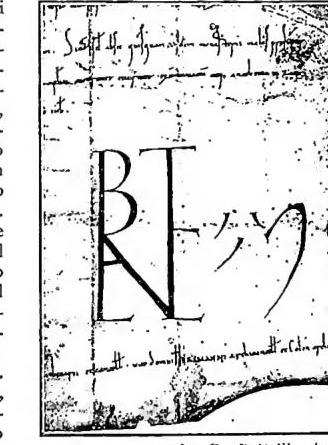
MONOGRAMMA – Monogram of Bene valete accompanied by the comma in a privilege of Pope Leone IX (11 October 1051) – Vatican, Archivio secreto, Instr. Tudertina I.
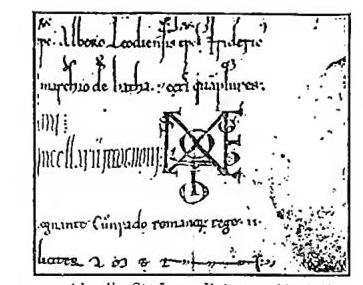
MONOGRAMMA - M. of Corrado III (Cuauaradus Dei gratia Romanorum rex) from a diploma dated 28 May 1139. S. Gallo, Monastery Archive.
arranged in ligature; it appears for the first time in the diplomas of Enrico III (1042) and ends with Enrico V (c. 1125). Finally, a monogrammatic sign appears in papal bulls in the mid-eleventh century: the auspicious formula Bene valet (v.) gradually contracts until it forms the familiar m. - Vedi tav. LXXXIX.