
SFRAGISTICA. — From the Greek σφραγίς, or “sigillography” (Latin sigillum, diminutive of signum), this is the discipline that studies seals from the juridical, historical, diplomatic, and artistic perspectives. It attained the status of an autonomous subject in the eighteenth century, chiefly through the work of Heinecke and Heumann; the latter was the first to use the term ars sphragistica, in 1745.
For a long time, the seal was the best means of validating documents. The Sacred Scriptures, Greek and Latin authors, and others mention them. Museums preserve numerous Assyrian, Babylonian, Phoenician, Egyptian, Hellenic, Roman, and other seals. Especially in the Middle Ages, the seal was the sign by which authorities authenticated their acts, and in many cases it came to replace autograph signatures. At first reserved for sovereigns, princes, great lords, and ecclesiastical hierarchies, in the twelfth century it was adopted by municipalities, and subsequently by corporations, colleges, institutions, and private individuals, with differing juridical value.
The term seal denotes both the matrix engraved “in negative” and the positive impression made in wax (metal impressions, called bullae, are rare). The matrix may be an engraved stone mounted in a ring (and such are most of the seals of antiquity; V. ANELLO; MONOGRAMMA), or an engraved metal stamp or die: bronze, steel, and, more rarely, gold or silver. The impressions, that is, wax seals, are divided into attached and pendant seals: in the former case, the wax was melted and poured directly onto the document and then pressed, while hot, with the stamp; in the latter, the wax was poured and impressed over cords, ribbons, or strips of parchment or paper hanging from the document. Hanging seals sometimes bear, impressed on the reverse, a second, generally smaller impression, called a counterseal. Natural or colored wax was used. The fragility of pendant seals made protection necessary (pouches of cloth or leather, cases of wood or metal). The predominant shapes of seals are circular, pointed oval, and oval; shield-shaped, octagonal, hexagonal, and other examples are rare. A seal consists of the image and the legend (if the latter is absent, the stamp is called anepigraphic). There are portraits, sacred, profane, mythological, and allegorical figures, or views (of cities, castles, churches, and mountains); designs of plants, heraldic or symbolic animals, and so forth. The legends generally express the name and titles of the person, office, or city; sometimes they contain mottoes, invocations, or leonine verses (e.g.: Roma caput mundi - regit orbis frena rotundi). The importance of the seal is also evident from the fact that sovereigns entrusted its custody to dignitaries of absolute trust, so that the office of keeper of the seal became one of the highest appointments. In bishoprics, the seal was kept by the vicar general or the chancellor; in medieval municipalities, by the podestà, the notary of the seal, or another person of proven honesty. Special regulations governed the use of seals and imposed penalties for forgery, improper use, and so forth.
I. PUBLIC SEALS
Limiting the examination to the Middle Ages, one observes that the diplomas of the early Carolingians were authenticated with impressions of Roman engraved stones, and later with seals bearing the bust of the king, roughly carved. In the 11th and 12th centuries the engraving improved, until Gothic art, in its luxuriant development, also reached these small objects of legal use and enriched and refined them. Sovereigns are represented seated on a throne (with crowned heads, their hands holding the scepter or orb, or the sword, or the lily) or on horseback in armor; queens are standing or on horseback (in hunting dress and with the falcon), rarely on the throne. In exceptional cases, gold bulls were used: for example, that of Federico I presents the bust of the Emperor emerging from a circle of walls; on the reverse, a view of Rome (v. BOLLA). Imitating the sovereigns, dignitaries, princes, dukes, and feudal lords also adopted seals, sometimes with a portrait (usually equestrian), sometimes with coats of arms; and gradually they were followed by offices, the various authorities, and finally judges, notaries, etc. The Italian Communes,(courtesy of Prof. G. C. Bascapè)
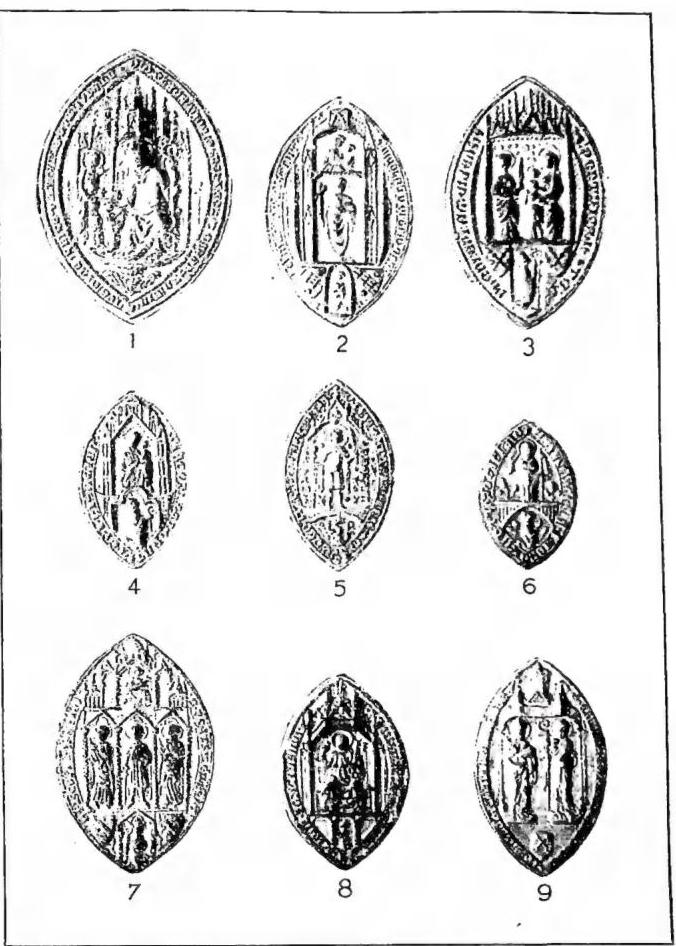
SFRAGISTICA — Ecclesiastical seals: 1. of the Congregation of the Monks of the Observance of S. Giustina, first half of the 15th century (Museum of Bologna); 2. of Nicola — Episcopatus Bovanensis Administrator, ca. 1340 (there); 3. of Stefano, bishop of Amelia, mid-14th century (Bascapè collection); 4. of Giacomo, bishop of Bisaccia, end of the 14th century (there); 5. of Radiberto, abbot of S. Pancrazio de Roca Ascarense, 14th century (cast in the Vatican Archives); 6. of Manfredino, canon of Campo Galliano, end of the 14th century (Bascapè collection); 7. of Alberto, bishop of Ferentino, end of the 14th century (there); 8. of the Chapter of the Cathedral of Bologna, ca. 1450; 9. of the abbot of S. Pietro of Modena, end of the 14th century (Museum of Bologna).
which until the middle of the 12th century were not regarded as political entities endowed with autonomy, and therefore had to have their civic acts validated by notaries appointed by the emperor, then began, in their turn, to adopt the seal, which constituted one of the signs of independence, formally sanctioned after the Peace of Constance. Civic seals almost always feature allegorical figures: the horseman designates the noble class, which initially exercised a certain predominance in various cities; towers and walls symbolize power and, above all, independence; images of the saints distinguish the « pars populi » and, after 1250, the popular Commune; finally, there are the Guelph and Ghibelline insignia, symbols of alliance, subjection, etc.
II. PRIVATE SEALS
From a juridical standpoint, they have characteristics quite different from those of public seals: they are limited to the function of signs of recognition and, by sealing the letter, guarantee the secrecy of correspondence. Engraved on them are coats of arms, emblems, allegories, monograms, images relating to the name (known as “canting” images), or to an art, profession, devotion, etc. The figure of the holder appears only on certain seals of nobles (equestrian types) and of doctors of law, professors, etc., depicted on their cat-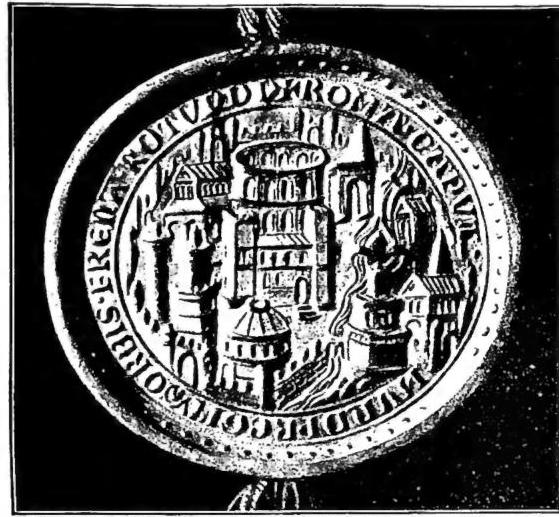
SFRAGISTICA — Golden Bull of Ludovico il Bavaro with a panorama of Rome (after 1328) and the legend, in leonine verse: “Roma caput mundi regit orbis frena rotundi” — Munich, Bavarian State Archives.
chair or seat and clad in the toga. The seals of merchants, which for the most part bear monograms or reproduce the designs of commercial marks, were also used to authenticate private contracts and business documents.
III. ECCLESIASTICAL SEALS
On papal seals V. ANELLO del Pescatore; BOLLA. The seals used by dignitaries of the Church originally had an oval or circular form, which became ogival around the middle of the 12th century. This typically Gothic model characterizes almost all ecclesiastical seals and endured for a long time (not even the Renaissance abandoned it entirely, although it preferred the circular or oval line). There were no consistent practices regarding the colours of the wax: besides red and green, which were very common, white, yellow, brown, etc., are also found. The first mentions of episcopal seals occur in the 7th and 8th centuries, but it was only in the 11th century that they began to appear in considerable numbers. Almost all the seals subsequently adopted by ecclesiastics derive from them. They usually bear the engraved image of the officeholder or patron saint, now shown half-length, now standing, now seated on a faldstool or cathedra. Of the type with a bust, very rare in Italy and disappearing during the course of the 12th century, two examples will suffice: Altemanno, bishop of Trento (1124-1149), and Mauro, bishop of Arezzo (1137); the former is noteworthy for the unusual mitre arranged with two lateral horns and open in front, which fell out of use in the middle of the century; the latter is one of the very few profile portraits.The standing figure—bishop or abbot—wears pontifical vestments and the mitre; for the most part he raises his right hand in blessing, while his left holds the pastoral staff or a book (if it is the patron saint, recognizable by the halo, the attributes are different: martyrs carry palms or the instruments of martyrdom, etc.). In types with the seated figure, the faldstool recalls certain Roman seats, with armrests shaped as lions’ or wolves’ heads and bases in the form of paws.
In the first half of the 13th century, while the ogival outline remained unchanged, the figures evolved; the hieratic static quality of the dignitary yielded to a more animated and complex composition; architectural motifs were added and soon became elaborate: columns, pinnacles, and canopies formed Gothic aedicules or even altarpieces and church façades, designed with lively decorative taste and engraved with the utmost care; in short, the seal tended to become an ornamented and precious object. There are several niches: the upper one with the bust of the Madonna, the middle one or ones with saints, and the lower one with the officeholder kneeling, sometimes flanked by two shields: that of the family and that of the diocese, Chapter, or abbey. To accommodate so many figures, the seal expanded until it reached its maximum dimensions in the 16th century. Alongside the solemn types, however, simpler models were also used, bearing a single figure, a symbol, or a coat of arms (sigillum mediocre, minus, secretum, ad causas, etc.). The higher clergy were imitated by vicars, archdeacons, archpriests, parish priests, canons, and priests (personal or dignity seals), as well as by curiae, cathedral Chapters, rural vicariates, plebanies, and churches, and finally by bodies subject to ecclesiastical jurisdiction (hospitals, shelters, pious foundations), as well as by the entire regular clergy. In religious Orders, the General Curia and the master general generally adopted on their seals the image of the holy founder or patron, or one of his symbols, or the coat of arms of the Order; each “province” chose a particular saint, who was almost never the founder and sometimes did not belong to the Order; visitors, provincials, and holders of other offices had their own seals, sometimes with the family arms, sometimes with sacred symbols or images of saints; abbeys, priories, commendams, convents, etc., displayed on their seals the patrons of their respective churches. From the 15th century onward, in the use both of the secular and of the regular clergy, seals with heraldic or symbolic insignia prevailed over figurative ones. - Vedi tavv. XXVI-XXVII.