
INTER DUAS LAUROS, CEMETERY OF. — By this topographical designation the Hieronymian Martyrology indicates, at the fourth milestone, the site on the Via Labicana where the martyrs Gorgonius, Marcellinus and Peter, Tiburtius, and another group of thirty martyrs were buried. As for the name of the cemetery, the same document says of Gorgonius that he was venerated on 9 September (V idus septembres) in cimitero eiusdem, that is, in the cemetery of Gorgonius.
But the martyr Gorgonius was already mentioned in the fourth century in the Depositio Martyrum (v.) under the same date: Gorgoni in Lavicana. Moreover, the itineraries of the seventh century, besides the martyrs mentioned above, indicate at the same site the group of the Four Crowned Ones; in addition, the Notitia ecclesiarum indicates a group of forty martyrs who become milites in the itinerary incorporated by William of Malmesbury into the Notitia portarum; likewise, the thirty martyrs are milites in the de locis itinerary; the same document also adds the names of the martyrs Geminus and Maximus, the former of whom is given by William of Malmesbury as Geminus.
As for the group of the Four Crowned Ones, the aforementioned Depositio Martyrum records them as venerated in the fourth century in Comitatum. For many archaeologists, this expression has been identified as a topographical indication of the locality inter or ad duas lauros, and therefore as imperial property, identical with that of Subaugusta on the Via Labicana.
The cemetery of i. d. l. is very extensive; it consisted of an above-ground area, in which the martyr Tiburtius was deposited, whose sanctuary Stevenson believed he could identify; and also of two underground levels, in which the various stairways indicate the different original nuclei or hypogea later connected with one another.
After the abandonment of the cemeteries, following the translation of the martyrs’ relics into the interior of the city, the cemetery of i. d. l. likewise fell into oblivion. The first to venture into some of the underground galleries were Pomponio Leto and his companions, who left their names written there around the middle of the fifteenth century. A. Bosio began his explorations there in 1594 and continued them for a long time, discovering many painted cubicula, among them one with a fifth-century fresco on the vault depicting, in the lower field, the divine Lamb on the mountain from which the four rivers flow, surrounded by the martyrs Peter, Marcellinus, Tiburtius, and Gorgonius, identified by their names. In the upper zone was the bearded Savior, with long hair, a nimbus, and the letters A and D, between the apostles Peter and Paul.
In the first half of the eighteenth century M. Boldetti removed many inscriptions from this cemetery. In 1779 Fr. G. M. Partenio erected a marble altar in a crypt in a region near the mausoleum of S. Helena. G. B. De Rossi discovered a fourth-century region and reported it in his Bullettino di archeologia cristiana. Methodical studies of the cemetery of i. d. l. were begun by E. STEVENSON, JOSEPH (v.), who is credited with the discovery of the region in which the martyrs Marcellinus and Peter were buried, deposited by a pious Lucilla in two simple loculi in a gallery on the first level of the cemetery. Subsequently, the opposite wall of the gallery was cut through and a small apsidal sanctuary was constructed, leaving the tombs of the two martyrs intact. They were decorated by Damasus (366–84), who also composed a poem in their honor; its text was transmitted by the Passio, and a fragment of it was found at SS. Quattro Coronati on the Caelian. On the plastered walls of the sanctuary and of the adjoining galleries numerous pilgrims wrote their names or invocations, such as “Marcelline Petre petite.” Pope Hadrian I (772–95) constructed a special stairway providing access to the two venerated tombs. The martyr Gorgonius was buried in another region, probably on the lower level, given the indication “in inferiore antro” in the Notitia ecclesiarum; but his tomb has not yet been found. The location of the tombs of the thirty martyrs mentioned by the Hieronymian Martyrology and of the forty martyrs indicated in the Notitia ecclesiarum as “in inferiore spelunca,” as well as of Geminus or Geminus and Maximus, likewise remains unknown; nothing is known of the latter from other sources. The tomb of the Four Crowned Ones was identified in a region partly seen earlier by Bosio and later by Wilpert, and explored in 1911–12. A stairway leads from the ground level down to a gallery approximately 40 m. long on the second level of the cemetery. Galleries and cubicula opened onto it; these were later walled up to allow pilgrims access to two historic crypts, in the second of which a rough sarcophagus was inserted into an arcosolium. On the plastered wall A. Bevignani read the invocation “SCE CLE(mens),” the first of the Four Crowned Ones recalled in the Depositio Martyrum. Among the other graffiti is also the name Leo, which is found in many Roman martyrs’ sanctuaries. It is known that H. Delehaye, L. Duchesne, and P. Franchi de’ Cavalieri held that the Four Crowned Ones were to be identified with the marble workers martyred at Sirmium. H. Delehaye, L. Duchesne, and P. Styger, however, rightly identified comitatum with that city; the Hieronymian Martyrology indicates that the Four Crowned Ones were venerated at least until the sixth century not in the cemetery of i. d. l., but in the urban church “in Caelio monte.” The rough sarcophagus, its insertion into a previously decorated arcosolium, the funerary character, and the late walls constructed along the entire long gallery leading into the venerated crypt confirm the translation of the relics of the martyrs of Sirmium to the cemetery of i. d. l. no earlier than the sixth century.
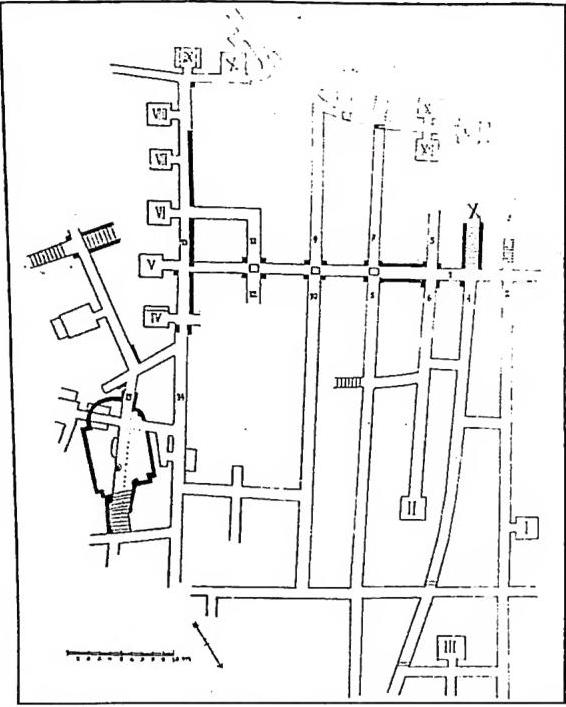
In 1936 a remarkable cubiculum, already reported by Bosio, was discovered, with an isolated tomb beneath a canopy, of the characteristic type in use in Sicily and Malta (E. Josi, Cimitero ad duas lauros. Il cubicolo 20 della pianta Bosio, in Riv. di arch. crist., 13 [1936], pp. 220–30). — Vedi tav. IX.
tenente scoperte nel cimitero dei SS. Pietro e Marcellino, ibid., 6 (1900), pp. 85-97; id., Affreschi inediti del cimitero «ad duas lauros», ibid., 4 (1898), pp. 117-21; id., Pitture, pp. 508-12; R. Kanzler, L'ultima scoperta di Augusto Bevignani. Graffiti storici nel cimitero dei SS. Marcellino e Pietro, in Studi romani, 1 (1913), pp. 189-96; id., Scoperte nel cimitero dei SS. Marcellino e Pietro sulla Via Labicana, in Nuovo bull. di arch. crist., 20 (1914), pp. 65-77; O. Marucchi, Osservazioni sulla cripta storica recentemente scoperta nel cimitero dei SS. Marcellino e Pietro sulla Via Labicana, ibid., 21 (1913), pp. 5-11; E. Josi, Scoperte nel cimitero dei SS. Marcellino e Pietro, ibid., 26 (1920), pp. 77-87; F. Fornari, Relazione sul lavoro eseguito nel cimitero dei SS. Pietro e Marcellino «ad duas lauros», in Riv. di arch. crist., 3 (1926), pp. 31-39; I. P. Kirsch, Die Märtyrer der Katakamben ad duas lauros in Rom, in Die Ehrengabe der deutschen Wissenschaft, Friburgo in Br. 1920; id., Pitture inedite di un arcosolio del cimitero dei SS. Pietro e Marcellino, in Riv. di arch. crist., 7 (1930), pp. 31, 46; id., Un gruppo di pitture inedite di un arcosolio del cimitero dei SS. Pietro e Marcellino, ibid., pp. 203-234; id., Cubicoli dipinti del cimitero dei SS. Pietro e Marcellino sulla Via Labicana, ibid., 9 (1932), pp. 17-36; id., Un cubicolo con pitture profane inedite nella catacombe dei SS. Pietro e Marcellino, ibid., 10 (1933), pp. 263-85; C. Cecchelli, E. Persico, SS. Marcellino e Pietro, la chiesa e la catacomba (Le chiese di Roma, 36), Roma 1938; J. De Witt, Spätrömische Bildnismalerei, Berlino 1938; H. Leclercq, Catacombe des Ss-Pietro et Marcellin, in DACL, XIV, 1, coll. 981-1018 (l'iscrizione 4) «Clementinus fossor mansionarius» [col. 1016] dell'a. 508, non esiste in questo cimitero ma in quello in Catacombas). Enrico Josi