
JOB. -
I. THE AUTHOR
A wealthy and wise Idumean, a perfect worshiper of the true God, the type of the suffering righteous man, and the protagonist of the book bearing his name.The name occurs in the letters of el-‘Amārnah: A-ia-ab; the Hebr. 'Ijōbh could mean “persecuted,” if it derived from a Hebrew root. His country is ‘Uš, a region between Edom and northern Arabia, as may be inferred from Jer. 25:20-24; Lam. 4:21, and as is explicitly stated by the addition in the Greek version of Job 42:17; the indications concerning G.’s friends (Job 2:11) likewise agree in this respect: Eliphaz (v.) of Theman, a certainly Idumean region (Gen. 36:11-15; Jer. 49:7), and Baldad of Sue in northern Arabia (Gen. 25:2). But the traditions diverge; Gen. 10:23, which names ‘Uš among the sons of Aram, contributed to the search for it in Syria and especially in the Hawrān.
Ezek. 14 recalls G. for his justice (v. 20; cf. Job 12:4; Gen. 6:9 concerning Noah), together with Noah and Daniel (cf. Eccl. 49:9); Jas. 5:11 recalls him rather for his patience: cf. Tob. 2:12-15 (only in the Vulgate). These references do not resolve the question of whether G. is a real or fictitious personage. Nothing prevents one from proposing as a model (Ezekiel, James) a purely literary character, just as Jesus does when he recommends to his interlocutor that he imitate the good Samaritan (v. GIONA). Did the author draw inspiration from some real episode, from some traditional personage? Catholic exegetes are inclined to admit a historical basis for the great poem. This is probable.
II. THE BOOK OF G
The book is “one of the most marvelous poems in the world” (Vaccari); it has been compared with Dante’s Divina Commedia and Goethe’s Faust (Dennefeld). “A compelling theme, a drama at once profoundly human and divinely sublime, is treated in it with such richness of color, such emotional power, and such variety of forms, that one may well say that language has exhausted its eloquence and art its palette” (Vaccari).The book consists of three parts: introduction and prologue (chaps. 1–2); the poem proper (chaps. 3–41); and the epilogue (42). The central part is in verse of exquisite workmanship; the other two, very brief, are in prose.
Part 1 (1–2): G., irreproachable in conduct, enjoys great prosperity; he has a large family, flocks and fields, and a multitude of servants. God permits him to be struck by calamity: he loses his possessions and his children; and, worn down by a loathsome illness, he is driven from his home and subjected to the contempt and mockery of the people and of his wife... Yet, despite his profound suffering, G. submits to the divine will. Three of his friends, Eliphaz, Baldad, and Sophar, come to console him, and with them begins the dialogue that will be concluded by God’s intervention.
Part 2: there are three disputes between them and G., beginning with an outpouring in which he laments his sufferings (3). The friends always speak in the following order: Eliphaz, Baldad, Sophar, and G. replies to each in turn. The thesis upheld by the three is the traditional conception: every suffering presupposes a fault, just as every favor presupposes a good action; God is neither served nor offended without cause. Therefore, instead of lamenting and boasting of his innocence, G. should acknowledge himself guilty and do penance so as to obtain mercy.
In the first dispute (4–14), Eliphaz (v.) expounds this thesis abstractly, in order to avoid explicitly condemning G., and grounds it in a supernatural revelation so that it may be accepted more readily (4–5). Although G. accepts his sufferings, he cannot doubt his innocence; and when his gaze turns toward the Lord, it remains bewildered, unable to understand the reason for his condition (6–7). Baldad intervenes, invoking the authority of tradition and applying the same thesis more directly to G. The sufferer who displays his innocence offends divine Providence, as though it were unjust (8). G. sees even more clearly the opposition between the theory and the indisputable fact of his innocence, as well as the mystery of God’s activity (9–10). These words scandalize the young Sophar, who supports the same theory with the dictates of reason and experience (11–12, 6). But experience, G. replies, demonstrates the other disconcerting fact: the prosperity of the wicked. His faith in the sovereign justice of God is unquestioned and profound; the mystery therefore remains all the more vivid (12, 7–14, 21).
In the second dispute (15–21), the three friends openly accuse G. of impiety, for which he had deserved so many evils. It is impossible, they say, that he should suffer while innocent. Eliphaz sees only pride in G.’s protests; he adduces his own experience and the doctrine of the wise (15, 1–18). The other two add nothing new, except the violent tone and acrimony of their replies (chaps. 18–20). Weary of these speeches, which adduce nothing new (15, 17–35), G. no longer hopes for understanding or comfort from men (16, 1–5); he places his hope solely in God, invoking his just judgment before he descends into šē'ōl (16, 6–17, 16), and expresses his profound disgust with such a doctrine, contrary to the evidence of experience (21); God will be his vindicator, and not even the proximity of death can make this hope doubtful (19).
In the third dispute (22–28), the friends display their helpless irritation by heaping insults upon G., to whom they impute the gravest sins. The doxologies do not compensate for the poverty of their arguments (22–25). G. replies with irony; the happiness of the wicked is evident, and insults are not arguments. It is true that God delays in rendering him justice, but he does not cease to invoke his supreme judgment (27, 1–6). Sophar’s speech is missing from the present text; and expressions are attributed to G. that one would rather expect on the lips of his opponents. The following arrangement has therefore been proposed, assuming a typesetting error (Dhorme): 24, 18–25; 25, 2–26, 4; 26, 5–14; 27, 2–12; 27, 13–23. G.’s reply to Eliphaz would end at 24, 17. Baldad would then speak (16, 5–14 + 25, 2–6), followed by G.’s reply (26, 2–4 + 27, 2–12). Finally, Sophar (27, 13–23 + 24, 18–25), or, better still, G. himself, without giving him time to speak, would formulate Sophar’s thought, already expressed in 20, 29 (= 27, 13); and before splendidly describing divine power in the hymn to wisdom (28), he develops, not without irony, the false thesis of his opponents. The hymn, already foreshadowed in 27, 11, concludes the bitter discussion with the three friends, who have become fierce accusers.
At this point G. skillfully constructs his defense (29–31). He emphasizes the justice and prosperity of his past (29), which therefore does not merit the disgrace with which they wish to cover him, and his present sufferings (30); finally, he reasserts his innocence and invokes God’s judgment. In that judgment, G. proposes to confront God, whom he believes to be angry with him, and to refute his accusers (13, 18; 31, 35b–37). He therefore desires an arbiter, an advocate who will take up his defense (9, 33; 31, 35a). Eliu (v.), who intervenes (32–37): G. should not say that God persecutes him; God sends evils not only to punish but also to preserve and purify. Thus he prepares for God’s intervention (38–41). God appears in a cloud that veils his majesty and sets forth his omnipotence and wisdom in the creation and governance of the universe. Can G. then speak concerning these marvels of the physical order? And how, therefore, can he presume to judge God’s work in the moral world? G. prostrates himself in the dust and confesses his ignorance.
Part 3: in the epilogue (42), God pronounces (42, 42) the sentence; G. has humbled himself; the three wise men are condemned, and G., declared innocent, is restored as many and greater possessions than he had before.
We have before us a didactic poem; among other things, the scene of the angels with Satan (imitated by Goethe at the beginning of Faust) is entirely symbolic. The author, a learned and versatile Jew, treats in it the most human and most debated of problems: the origin and teleology of suffering. He demonstrates the complete fallacy of the theory then commonly held, according to which only those who have sinned suffer, by means of two simple facts of experience: the prosperity of the wicked and the suffering of the just. The problem is not fully resolved, but the essential points are set forth of what would become the complete solution preached by Christianity: a) sufferings test the just for the honor of God (cf. prologue); b) they preserve him from pride and sin and purify him (Eliu’s speech); c) man must entrust himself to divine Wisdom and its inscrutable designs, without the audacity to question them, humbly submitting to its providence (God’s words).
This reveals the marvelous unity of the beautiful composition. Some sought to deny the prologue and epilogue to the author, on account of their prosaic form; others denied the theophany (38–42). But the prologue is required as the foundation and the epilogue as the completion of the entire poem; there are identities of concepts and expressions; cf. the angels = sons of God (1, 6; 2, 1 and 38, 7). Thus God’s intervention is closely connected with G.’s invocation (31, 35–37), with Eliphaz’s own (5, 8), and with Eliu’s announcement (37, 14–24). Indeed, it is the culmination prepared for and anticipated throughout the poem. The prologue itself requires II.
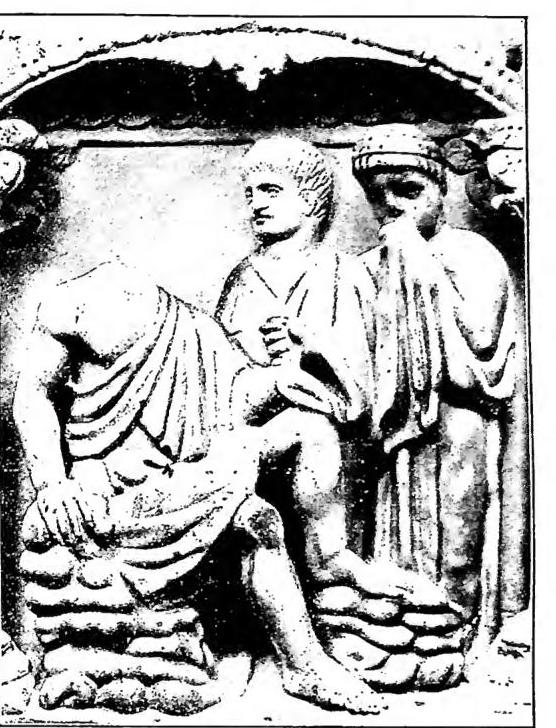
(from F. Gerke, Der Sarkophag des Junius Bassus, Bertino 1938, pp. 10)
GIOBBE - G. with his wife covering her nostrils and a friend. Detail of the sarcophagus of Junius Bassus (A.D. 359) - Vatican Grottoes.
is G.’s advocate and aptly heralds God’s verdict, he should not have entered into this; his intervention is prepared by G.’s twofold invocation); b) Eliu says nothing that the friends have not said or that God will not say (but his speeches were precisely intended as an examination of what had been said thus far and as preparation for the divine verdict [37, 14-24]); c) difference of style and vocabulary (but a careful examination ultimately establishes that Eliu’s vocabulary is generally that of the other speakers [Szczygiel, Peters, Dennefeld]; nor can an artist be condemned to vary neither according to the character and task of the personage, nor to remain always highly lyrical, without pauses or decreases in tone).
The author of the book was an unknown Jew from Palestine, a perfect knower of the law (Iob 24, 2-11; Ex. 22, 21; etc.), of sacred literature, of Jewish social conditions, of the sciences, and also of the customs and literatures of foreign countries.
Pfeiffer and Dhorme consider him an Edomite sage, others (Jastrow) an imitator of the Babylonian poem of the “suffering righteous man,” others an imitator of Egyptian literature (cf. Iob 31 and the Egyptian negative confessions). It is out of place to speak of imitation: no valid proof can be adduced; this is confirmed, besides by the content, by the sublime poetry of G. The common stock of forms and motifs in the wisdom literature of the Orient is sufficient to explain the analogies.
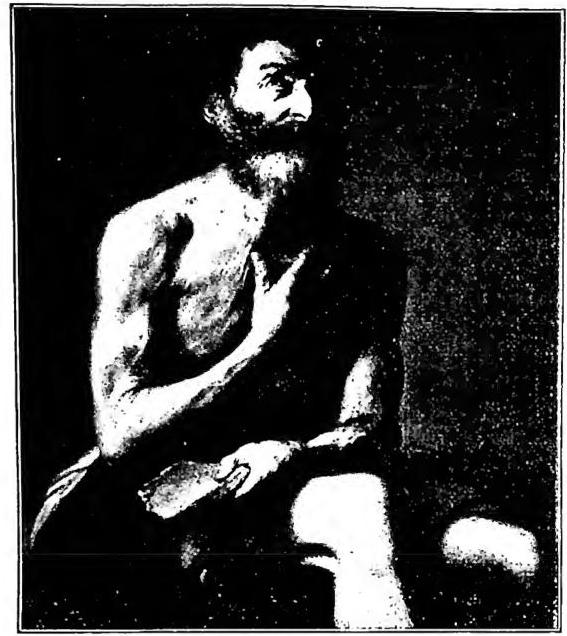
(fol. Alinari)
GIOBBE - G., painted by Murillo (1617–82) - Parma, Pinacoteca.
Bigot, Driver-Gray, Buhl, and Dhorme place it after the exile: Job 12:13–15; 37:7–12 contains an evident allusion to the exile; and it seems still to depend on the second part of Isaiah, on Zechariah, and perhaps on Malachi (Dhorme). But the earlier Assyrian deportations of the Israelites of the north (II Reg. 15:29; 17:6) suffice to explain G.’s emphasis.
Peters dates its composition as late as the fourth century, on the basis of an alleged influence of Greek culture on G. Among the ancients, some assigned it to the time of Moses (the description in the prologue presents G. as a patriarch), while others attributed it to Solomon.
The Hebrew text, contrary to the prejudices of Merx, Torczyner, and Ball, is better preserved than that of other books (e.g., Jeremiah), as Budde, Dhorme, Peters, and Vaccari have demonstrated. The Greek version is rather free and must be used with caution; at times it departs too far from the meaning of the text; it contains some additions (e.g., the historical appendix at the end); but in general it tends to abbreviate, and approximately one-sixth of the Hebrew text is lacking in it, supplemented by the version of Theodotion. The Syriac is faithful and useful for textual criticism, less so for exegesis. More useful Targum (v.). Of all the versions, that of St. Jerome (the Vulgate) excels in its understanding of the text, clarity, and elegance (Vaccari).
With the exception of Theodore of Mopsuestia, no one ever questioned the divine authority of the book of G., cited as Sacred Scripture in I Cor. 3:19; Jas. 5:13; cf. Rom. 11:35.
A complete theology of the Old Testament can be drawn from II. The entire book is dominated by the thought of the one God (5:9; 9:10; 37:5), designated by various names as in Genesis. G. sings of his glory, in the style of the Prophets and the Psalms (9:6 = Is. 13:13; 9:8 = Am. 4:13...), in creation (9:4–13) and in the reversals that he brings about in society (12:13–25; cf. Ps. 106 [107]:40). Creator and sovereign of all things (28:24–27; 38:4–7; cf. Prov. 8:22–31), God preserves and governs them (12:13; cf. 3:4; 31:2). Inaccessible to our gaze (23:8 ff.), it is impossible to know his nature (11:8 ff.). He is surrounded by angels (1:6; 37:7), his servants (5:1; 33:23 ff.), in whom his purity finds blemishes (4:18). The “adversary” is not a fallen being like our Satan, but one of his ministers (Job 1:2), like the “spirit of falsehood” seen by Micaiah (I Reg. 22:19–23; cf. L. Desnoyers, Histoire du peuple hébreu, I, Paris 1922, p. 161 n.; II, ibid. 1930, p. 72 ff.). Opposed to God stands the wretched and fleeting existence of man, who, however just, is impure before him (9:28–31; 25:4–6). His duties are founded on “the fear of God” (28:28; 1:1–8; 2:3), which includes piety and the practice of religious duties (4:6; 15:4) and moral duties (23:11 ff.; 21:7 ff.; 29:14; especially 31:13, 16–21, 29–32). Alongside the righteous live sinners, who are wicked (8:20) and foolish (5:2 ff.). God’s principal attribute in relation to man is justice.
The entire Old Testament perceives the strict connection between human actions and their reward or punishment, realized here below in a four-term pragmatism: sin and punishment—penitence and deliverance (cf. Job 4:7 ff.; 5:6). In G. this pragmatism is transcended, although no solution is offered to replace II. In reality, the concept of the afterlife remains in G. the traditional one of tē’ōl, a dark dwelling (17:13–16), in opposition to that of the living (14:21; 21:21), from which no one ever returns (7:10; 10:21; 14). In G., death is no longer regarded as a sign of divine judgment (16; 19; 21), and G. desires it as the beginning of his repose (5:17 ff.); but he places no hope in the hereafter (17:13–16). He hopes that God will intervene before he dies; he is certain that he will see him with his own eyes, so great is his faith in divine justice (16:18–20; 19:25 ff.). Thus, in chap. 16, although he has one foot in the grave (17:11–16), G. is certain that God will intervene before the earth covers his blood.
Thus, in 19:25–27, G. would like a record of his case to be drawn up in indelible writing (v. 23 ff), because he is certain that God himself is about to rise there on the dunghill against his accusers (v. 25); and he, with his skin restored and his eyes reddened by tears, will witness his vindication and the confusion of his friends (26 ff.). “Ah, I know; my gō’ēl is alive, and at last upon this dust he will stand; and from behind my skin, and in my flesh, I shall see God...” (25 ff.): the most probable rendering of the Hebrew text, partially confirmed by the Syriac version and by Theodotion. It always concerns the same hope that the Lord will intervene before he dies. The Greek version, omitting wē’ōhar (v. 26) and placing jāqām before it (v. 25), introduces the concept of the resurrection of the body: “I know that he who will deliver me is eternal; on earth my skin will rise again...” This concept was perceived by some Greek Fathers, denied by St. John Chrysostom (PG 53, 565; 57, 396), and, with the support of the Vulgate, disseminated in the Latin Church by St. Augustine (e.g., PL 41, 793).
III. ARCHAEOLOGY
The example of the prophet G., resigned in the sufferings of poverty, was already held up to the faithful by Pope Clement toward the close of the first century (I Cor. 26, 3). He was represented in the cemetery frescoes toward the end of the second century (Wilpert, Pitture, 351 ff.); three others discovered in the Cemetery “ad duas lauros” after that publication must be added, the most expressive being the one published by Kirsch (Un gruppo di cripte dipinte inedite del cimitero dei SS. Pietro e Marcellino, in Riv. di arch. crist., 7 [1930], p. 225, fig. 13). In the paintings the prophet is always alone. A group of sarcophagi—namely, five Roman, one from Brescia, and three from Gaul, all dating from the fourth century—instead depict the prophet while his wife comes to visit him (Wilpert, Sarcofagi, t. 14, 2, 159, 2, 187, 6); in some cases she holds out a flat cake to her husband, as in a sarcophagus from Arles, or covers her nostrils, as in the sarcophagus of Giunio Basso (F. Gerke, Der Sarkophag des Innins Basins, Berlin 1936, fig. 10). In some cases the friends also appear.In ancient prayers of the ordo commendationis animae, the prayer is addressed to the Lord “sicut liberasti Iob de passionibus suis”. The famous passage “scio quod Redemptor meus vivit” (Iob. 13, 25) of G. himself was incorporated into funeral liturgies and also repeated in Christian funerary inscriptions, such as that of Bishop Flaviano of Vercelli, and others from Naples, Rimini, and Comacchio.
G. is a symbol of the resurrection according to St. Girolamo (Contra Iohannum Hierosolymianum, 30); St. Ambrogio points to him as one who patiently knew how to overcome all the injuries and adversities of life, looking forward to a reward in the future resurrection. He thus comes almost to symbolize the soul of the deceased, delivered by God from eternal punishments. The tribulations of G. were also represented in the fifth century in the basilica of S. Felice in Nola (s. Paolino di Nola, Carm., 28, 25: PL 61, 663).
The prophet G. is also represented on gold-glass vessels, for example, on one discovered at Neuss, near Cologne; and in manuscripts, such as Cod. Syriac 341 of the National Library of Paris, dating from the seventh or eighth century.
Enrico Josi
IV. ICONOGRAPHY
In a symbolism of Christus patens, G. appears in the south portal of the cathedral of Amiens and in the north portal of the cathedral of Chartres, seated upon a heap of dung. The cycle of episodes from the life of G. also appears in the fragments of a Book of G. in the Library of Naples; it receives rich illustration in the Catalan Bibles of S. Maria de Ripoli and St-Père-de-Roda, in the National Library of Paris, as well as in another Bible of the Salzburg school. G. in misery is represented, as usual, in attitudes that attest to his sufferings, whereas, before and after his misfortune, he seems to possess royal rank and majesty.Fresco painting likewise contributes to the iconography of G.: in 1356 Bartolo di Fredi frescoed Stories of G. in the collegiate church of S. Gimignano, and a few years later, in 1371, Francesco di Volterra repeated the cycle in now-lost frescoes of the cemetery of Pisa, with the episodes of the Feast, the Colloquy of God with Satan, the Destruction of G.’s Palace, his misfortune, and his return to prosperity.
V. TESTAMENTO DI G
Apocryphal, proscribed in the Decretum pseudo-gelasianum. It is a midhrās on the Book of G. In part, it rests upon the amplifications of the Greek version of G. (after 2:9 and 42:17).Thus G. is identified with Iobab (a confusion arising from Gen. 36:33 ff.); he has a brother, Nachor, to whom the «Testament» is attributed; G.’s wife is called Sitis, and a long discourse is attributed to her. More restrained is the legend concerning G.’s sons and daughters, who gather around their dying father. G. recounts how he suffered greatly at the hands of Satan for having destroyed an idolatrous temple; but the Lord restored everything to him. As the daughters sing heavenly hymns, the angels come to take G.’s soul; he is said to have lived 255 years.
It was probably written in the 2nd century A.D. by a Jew; Tertullian (De patientia, 13: PL 1, 1270 ff.) alludes to the Testament of G., 20.