
JUDGES. — Designation of the leaders of Israel (Heb. Ἰόρβες, plur. Ἰόρβεξῶ; cf. the sūfētes of the Carthaginians: Liv., 28, 27, 2; 30, 7, 5), in the period after Giosuè up to Samuele, whose deeds are narrated in the biblical book bearing this title.
At the death of Giosuè, for the continuation of the work of settling in the land of Canaan—firmly begun but far from completed—Israel did not feel the need to provide itself with a leader.
From the time of the conquest under Giosuè, the various “tribes,” as they gradually occupied their settlements, began to govern themselves, occupied with problems
that for each of them in particular arose from the occupation itself and from the new forms of life that were replacing the single form followed until then, that of pastoral nomadism. Under Giosuè each tribe had been assigned its territory; but in practice the conquest was for the most part still to be carried out: each group had to secure effective possession for itself, subduing the Canaanites who inhabited the territory, or forcing them to withdraw into a few centres. Moreover, not all areas had the same value with regard to pasture, irrigation, and fertility: rivalries of interest arose, while the characteristic jealousies of such a fragmented form of government certainly continued—resentments among those who believed they had contributed more to the common cause or received less; the pride of the more numerous or powerful tribes (Ephraim), and consequently contempt for the smaller ones, which reacted with boasts based on particular historical memories (Beniamin).
The higher unit is constituted by the “tribe,” a unit not of effective government (among other things, it has no leader), but of an ethical nature: the patriarchal groups belong to it insofar as they preserve the memory of a common origin, and perhaps are distinguished by particular customs (including linguistic ones?) and traditions. The tribe, however, is always liable to become once more an organizational and functional unit: these are the moments that may be called “emergencies.” Does the population suffer a common injury (or have a common aspiration) at the hands of an external enemy (the “oppressor”), who occupies a region, blocks a line of communication, usurps the benefit of springs or pasturelands, establishes himself at strategic points that enable him to carry out raids and incursions with impunity? Then the tribe gathers its forces and undertakes to shake off the “oppression.” In this way it recovers what was lost or simply conquers: the work of penetration is extended and perfected. Often not just one, but two or more tribes had a common interest in the same action, which was carried out jointly.
In such circumstances, the need for a leader was evident; one was sought (cf. Iudc. 10, 18; 11, 6.8), or accepted when offered by circumstances, so that he might be the defender, the “deliverer” (Iudc. 3, 9; cf. Nah. 9, 27) of Israel.
The latter seems to be the oldest name by which such occasional commanders were designated—essentially dictators, with military and civil powers, in reference to the particular objective to be achieved. The name “judge” (from Ephra, “to judge”) reflects the religious reflection concerning the authority of such leaders: they were
(for the courtesy of Sen. G. Treccani)
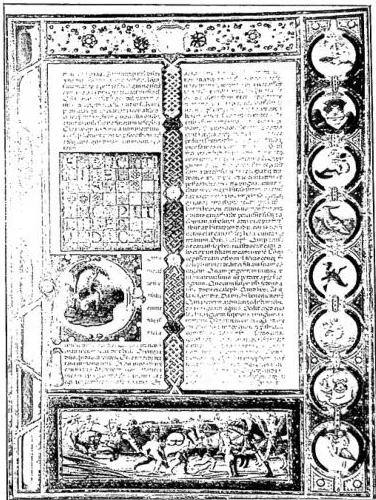
GIUDICI - Incipit of the book of G. Illuminated page of the Bible of Borso d’Este (1455–61), vol. I, fol. 99r — Modena, Biblioteca Estense.
21) concerning the tragic events from which the tribe of Benjamin emerged almost destroyed.
The central part (the 3rd) is called the “history” of the g.: but the expression must be understood in a very particular sense. The book does not present itself as a complete and orderly history, in annalistic form, but as a selection of detached events judged to be noteworthy, especially such as could serve to inculcate the religious-moral teaching which the author professes in the introduction (part 2) and repeats several times at the conclusion of individual episodes. If the nation turns away from God, especially through idolatry, it is punished by falling into the hands of “oppressors.”
The names handed down are 12: only 6 of them are briefly mentioned (the so-called “minor” g.), while 6 are presented with an account of their deeds at some length. This round number, 6+6 (there are also 12 Israelite tribes), likewise shows the schematic character (also for aesthetic purposes) of these memories; and similarly the fact that the duration of the individual g. (and in part also of the “oppressions”) is for the most part fixed at 40 years (the conventional duration of a generation and a penitential number), or half of that, or twice 40.
The g. are as follows (the “minor” ones are indicated in parentheses):
Othoniel (Hebr. 'Orhnī'el), of the family of the Cenezites, which had been incorporated into the tribe of Judah: under him the country “had peace for 40 years” (3, 7-11), having been delivered from the oppression of the Aramaean (or Edomite) king Chusan Rasatham.
Aod (Hebr. 'Ehūdh), of the tribe of Benjamin, who established peace “for 80 years” (3, 12-30); he repelled the oppression of Eglon, king of Moab.
(Samgar, Hebr. Samgar, against the Philistines: 3, 31).
Barac (Hebr. Bārāq), of the tribe of Benjamin, together with the prophetess Debora, for 40 years: against Iabin, king of Azor, and his general Sisara, who oppressed them for 20 years (4, 1-5, 32).
Gedeone (Hebr. Gidh'ōn), of the tribe of Manasse, 40 years (chaps. 6-8), against the Midianites. After his death, his son Abimelech attempted to usurp power as king (chap. 9).
(Thola, Hebr. Tōlā', of the tribe of Issachar, 23 years: 10, 1-3).
(Iair, Hebr. Jā'ir, a Gileadite, for 22 years: 10, 4-5).
Iephth (Hebr. Jiphtāh), a Gileadite, for 6 years (10, 6-12, 7), frees Israel from the oppression of the Ammonites, which lasted 18 years.
(Abesan, Hebr. 'Ibhān, of Bethlehem, 7 years: 12, 8-10).
(Ahialon, Hebr. 'Elōn, of the tribe of Zabulon, 10 years: 12, 11-12).
Abdon (Hebr. Abhdōn, of Pharaton near Sichem, 8 years: 12, 13-15).
Sansone (Hebr. Šimfōn), of the tribe of Dan, 20 years: he fought against the Philistines, who exercised an oppression over Israel lasting 40 years (chaps. 13-16).
The first chapters of the books of Samuel recall two figures of “g.”, Eli and Samuel, but they differ from their predecessors in various respects; even the particular features of their authority anticipate the monarchy.
For the historical-literary problems raised by modern criticism concerning the origin of the book of G., V. GIOSUÈ; PENTATEUCO.
The work is a compilation: individual episodes may have been incorporated into it without alteration, as is shown by the fact that some of them preserve their own peculiarities (the relative pronoun fe- in the story of Gedeone-Abimelech, chaps. 6-9; characteristic phrases, e.g. for Sansone 14, 6, 19; 15, 4, etc.).
The author-compiler, unknown, produced his work when the age of the g. had already ended and Israel was governed by a king (cf. 17, 6; 19, 1; 21, 25); a Jewish tradition (Bābhā' bāthrā, 152), which gives the name of Samuel, may be regarded as supported by a certain correspondence of ideas between the book’s second introduction (chaps. 2, 6-3, 6) and Samuel’s speech at the laying down of his office (I Sam. 12, 8-20). From the historical-literary standpoint, the book of G. is particularly important for preserving the beautiful and very ancient “Song of Debora” (chap. 5).
Giovanni Rinaldi
ICONOGRAPHY. — Christian art has depicted the scene of Samson killing the lion and capturing 300 foxes (Judg. 14–15). It was represented in a 5th-century basilica in Spain, in separate scenes for which Prudentius composed the illustrative couplets (Prudentius, Dittochaeon, nos. 19–20).