
CAGLIARI, ARCIDIOCESI di. – The principal city of Sardinia, with approximately 60,000 inhabitants, situated on the southern coast, it is the provincial capital and metropolitan see, with the dioceses of Iglesias, Nuoro, and Ogliastra as suffragans. It has 85 parishes with 185 priests of the secular clergy. Numerous religious families of both sexes also work there.
Already at the beginning of the Christian era, C. was the island’s principal center, where a section of the Roman fleet was stationed. Considering the manner in which Christianity spread, it may be held that in
A passage in a letter from St Atanasio of Alexandria to Lucifero of C., champion of orthodoxy against Arianism, refers to the latter’s predecessors in the see of Cagliari, without, however, giving either their number or their names (cf. CSEL, XIV, p. 324). The first historically established bishop is Quintasius, present at the Council of Arles in 314 as one of the principal bishops of the West. Later, beginning in the 5th–6th century, the incumbent of C. was accorded the dignity of metropolitan, with rights not only over the dioceses of Sardinia but also over those of the Balearic and Pityusic Islands, as is gathered from the testimony of Vittore Vitense (MGH, Auctores, III, I, p. 71). After Quintasius, no other bishop is known before Lucifero of C., the determined adversary of Arianism, exiled to Syria for refusing to sign at the Synod of Milan in 355 the decree of the Arian emperor Costanzo. A second Lucifero appears in 484, mentioned together with other bishops of Sardinia who, on the orders of Unnerico, took part in the events at Carthage. Another known name is that of Ianuarius, a contemporary of St Gregorio Magno, and often the object of the holy Pontiff’s reproaches. During the 7th century, Giustino was present at the Roman Synod that condemned Monothelitism under Martino I, while Citonato, forty years later, subscribed to the acts of the Third Council of Constantinople in 680. The history of the 7th–10th centuries is obscure:
this was a period characterized by fierce attacks against the island, which had been left to fend for itself, but during which a form of autonomous government slowly matured, one that has not yet been fully elucidated. These were the Giudicati sardi, in which the island appears clearly divided by the end of the 11th century. During this period the Sardinian Church suffered serious damage, and of the seven episcopal sees of the 6th century, only four remained standing in the 9th century, among them the metropolis of C.
After 1016, the year of the Pisans’ victory over the Genoese, Sardinia, drawn into the sphere of activity of the maritime republics, began another period of existence that involved it in the struggles of that time.
The diplomas of the 11th century speak of the donations made by the judges of C. to the diocese, but also of the ruins left from earlier times, which Vittore III urged them to restore in a letter to the archbishop Giacomo, designated as primate of Sardinia. During this period the metropolitan jurisdiction coincided with the boundaries of the four Giudicati, and C. had Sulcis, Dolia, and Suelli as suffragan sees.
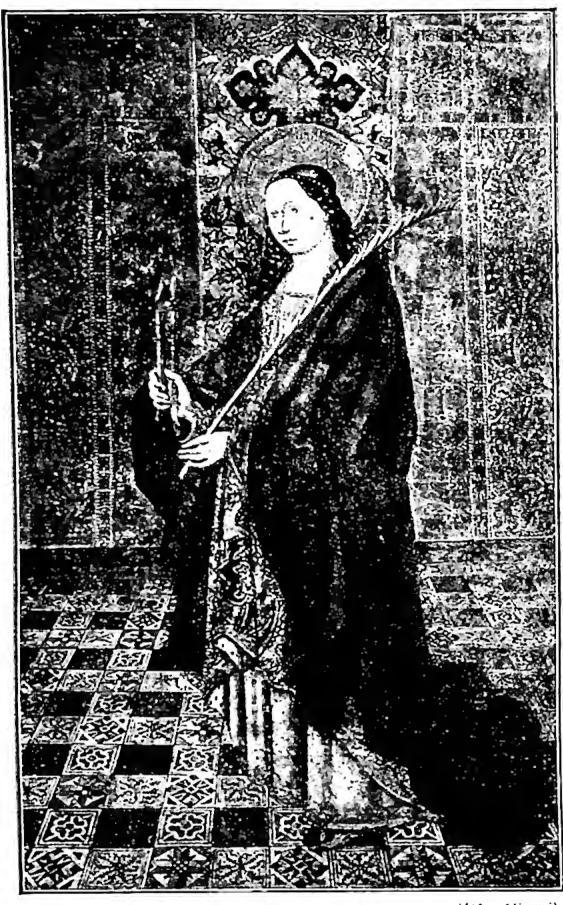
CAGLIARI - S. Apollonia. Detail of the altarpiece of the Visitation, painted by G. Barcès (15th century) - Museum of Cagliari
foreign lordships. And in this sense one must interpret the interventions of Innocent III and Honorius III, intended to place a limit on the predominance of Pisa. This did in fact decline, but through the action of the Aragonese, who in June 1324 occupied the castle of Cagliari. The city was then declared caput et praesidium, and the archbishop, placed at the head of the city most favored by the new government, considered himself, in fact, the successor to the privileges enjoyed until then by the archbishop of Pisa, later assuming, in the 15th century, the title of primate of Sardinia and Corsica. To strengthen his own authority on the island, King Peter of Aragon resolved to convene the first Parliament, to which the archbishop of Cagliari was summoned to participate together with the other members of the Sardinian higher clergy, his ecclesiastical branch. With the primate of Cagliari, the king concluded an agreement concerning the goods of the episcopal mensa in 1335. Later, under the pontificate of Martin V, in 1420 the archdiocese was considerably enlarged following the suppression of the suffragan church of Suelli, which had declined and become impoverished. The same fate later befell, under Ferdinand the Catholic, the bishopric of Galtelli in 1496, and that of Dolia in 1501, likewise incorporated into Cagliari. Iglesias too was united to Cagliari in 1514, but ad tempus, for as long as the archbishop Giovanni Pilares, formerly
bishop of Iglesias, should live. At that time Cagliari encompassed as its territory one quarter of all Sardinia. Having become lord of many lands and possessing a very extensive territorial jurisdiction, the primate of Cagliari had acquired political importance. He inaugurated the parliamentary sessions in the cathedral of S. Cecilia, and received from every viceroy the oath of fidelity to the rights of the island’s representation.
Nevertheless, no act of the Holy See had conferred upon him any superior rights in the spiritual sphere, and the title of primate of Sardinia and Corsica, assumed during the 16th century, had only political importance.
In the 18th century, however, the question of primacy became a source of disputes between Cagliari and Sassari.
During the period of Catholic restoration, the bishops of Cagliari took an active part in the work of reform; among them, the Dominican Baldassar Eredia, who took part in the Council of Trent, was especially distinguished, as was later Antonio di Gastilleyo, promoted to Cagliari in 1558, who, having returned to his see in 1653, zealously applied himself to ensuring observance of the council’s decrees.
The newly founded Society of Jesus gave valuable support to the revival of religious life; in 1587 it opened a novitiate in Cagliari, as well as schools and colleges, among which the Canapoleno College (1621), later called that of the Nobles, is particularly notable. It was established at the wish of Archbishop d’Esquivelle and also assumed direction of the seminary, whose creation had been decided at the diocesan Synod of 1576–77. Other religious houses were opened later by the Minims (1628), the Brothers Hospitallers (1636), and the Piarists (1640) for the education of children. During this period diocesan synods for ecclesiastical discipline were also frequent. Particularly important were those of 1628 under Archbishop Bernardo de la Cabra. The last diocesan synod of the Spanish period was that of 1715, when the archdiocese was governed by Bernardo di Carignena; its ordinances show the condition to which Sardinia had been reduced by the long Spanish domination.
In the first decades of the 18th century, Sardinia had to suffer the consequences and hardships of the War of the Spanish Succession. In August 1708 the Anglo-Dutch fleet appeared before Cagliari, which opened its gates to the enemy. The following year Sardinia proclaimed the Archduke of Austria king. In 1717, through Alberoni’s action, the Spanish fleet was directed toward Sardinia, which once again returned to Spain, but only briefly, because following the anti-Spanish coalition, by virtue of the Treaty of London of 1718, Sardinia was assigned to Vittorio Amedeo of Savoy, who took possession of it in 1720.
The reform movement that characterized 18th-century life in Italy under the impetus of the Enlightenment also had repercussions in Sardinia, especially during the years 1759–73, when the affairs of the island were entrusted to Count Gian Lorenzo Bogino. He concerned himself with the revival of learning, entrusting responsibility for it to the archbishop of Cagliari, Tommaso Natta (1759–63). The latter obtained the partition of his excessively extensive archdiocese, establishing Iglesias as an autonomous diocese.
A university was established at Cagliari with the regulations of the Turin Athenaeum; the Canapoleno College was reorganized, and the seminary received new premises that made it possible to increase the number of its students. During the French Revolution, following the invasion of Piedmont, Cagliari became the capital of the Savoy state. But when the court
returned to Turin, Cagliari renounced its privileges and conformed to the political directives of Piedmont.
Among the illustrious men of Cagliari we note the cardinals: Benedetto Cao, created cardinal by Gregory VII in 1073; Diego Gregorio Cadello, promoted by Pius VII in 1813; Luigi Amat di S. Filippo e Sorso, raised to the purple by Pius IX in 1837.
Benefactors of culture were: Nicolò Canyelles, a native of Iglesias and later vicar of Archbishop Paragues, who introduced the first printing press to Cagliari, from which numerous works intended to promote religious reform were issued; Andrea Baccalar, who ended his career as bishop of Alghero in 1578 and translated the De Fide Orthodoxa of Damascene into Latin (PG 94). Also the poet Sebastiano Sugner (1643–75); the canon Paolo Nyri (1659–1711) and the Capuchin Father Giorgio Aleo, historians; and the Mercedarian Pietro Andrea Accorrà, who died in 1698, a sacred orator.