
SASSETTA, STEFANO di Giovanni di Consolo, detto il. — Sienese painter, born in 1392, died on 1 April 1450.
His first documented work, executed between 1 July 1423 and December 1426, consisted of a large triptych bearing at the center the Triumph of the Blessed Sacrament, surmounted by the Coronation of the Virgin, and on the side panels S. Anthony the Abbot and S. Thomas Aquinas, surmounted by the Annunciation; the whole was connected by pilasters bearing the Four Holy Patrons of Siena and the Four Doctors of the Church, by pinnacles, and was provided with a predella containing the Last Supper and Stories of S. Anthony and S. Thomas. The ensemble was dismantled and dispersed in 1816, and only some secondary parts are preserved in Siena, Budapest, the Vatican, and Barnard Castle. Between 1430 and 1432 S. painted for the cathedral of Siena the Madonna of the Snows, later transferred to Chiudino and then (1936) to the Contini Bonacossi collection in Florence; from 1433 dates the Crucifix for the church of S. Martino in Siena, destroyed in 1826, of which the cross terminals and the little story at the base are preserved in the Chigi Saracini collection in Siena. To this period, or shortly thereafter, belong the Polyptych for the church of S. Domenico in Cortona and various Madonnas (Grosseto Museum, Siena Pinacoteca, etc.). The masterpiece of S.’s final period is the large polyptych executed for the Franciscans of Borgo S. Sepolcro (1444); dismantled in 1752 and dispersed in 1810, it could be reconstructed in imagination with absolute certainty only after the very recent (1951) discovery in a private French collection of three panels: a Madonna with Music-Making Angels, a S. Anthony of Padua, and a S. John the Evangelist, which were flanked by the figures of the Baptist and Blessed Ranieri Rasini in the Berenson collection, to which also belongs the central panel of the reverse, with S. Francis in Ecstasy, originally flanked by eight Stories of S. Francis (one now in the Musée Condé at Chantilly and the others in the National Gallery in London). The Coronation of Mary above the Porta Romana of Siena, a work completed at S.’s death by Sano di Pietro, was destroyed in 1944, but its autograph portion was saved, namely a Glory of Music-Making Angels in the underside of the arch. Various works, including the very well-known Birth of Mary in the Collegiate Church of Asciano and a triptych (1436) in the basilica of the Osservanza in Siena, which were once considered among S.’s most significant works, have recently been attributed to an unknown personality akin to S., known as the “Master of the Osservanza.”
(photo Enit)
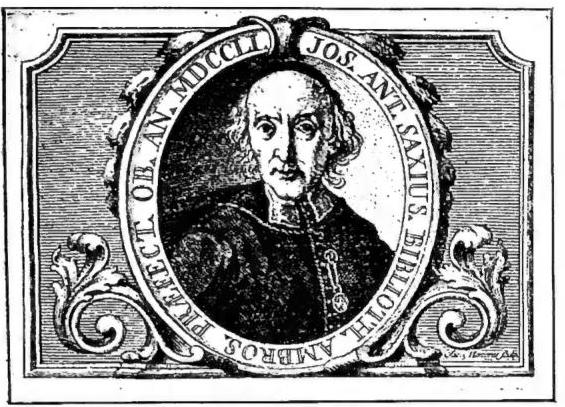
(from B. Oltrocchi, Archiepiscoporum Mediolanensium series historico-chronologica, I, Milan, 1935, p. 2) SASSI, GIUSEPPE ANTONIO – Portrait – Specimen of the Vatican Library.