
UGOLINO di VIERI di UGOLINO. – Sienese goldsmith, died between 1380 and 1385; he was trained in the art by his father, together with his brothers Luca and Domenico, who were also goldsmiths.
(photo Enc. Catt.)
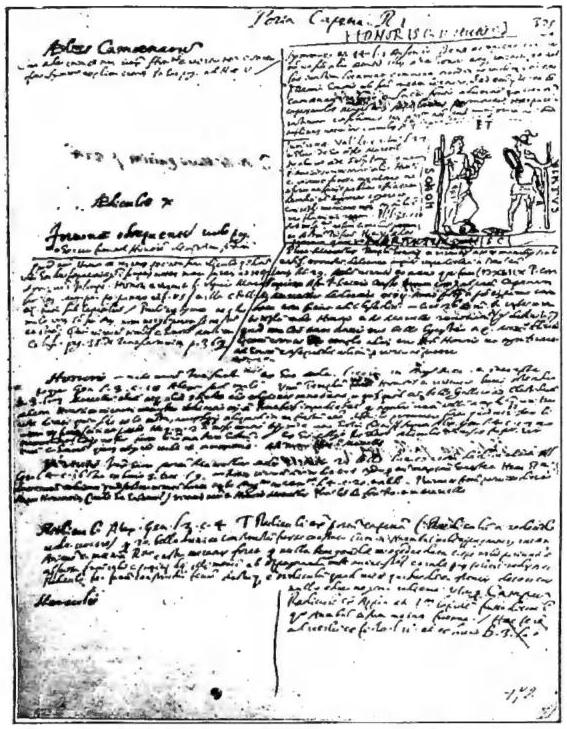
UGONIO POMPEO — Page with autograph notes concerning the quarter of Porta Capena; the sketch reproduces the figures of Honor and Virtue — Vatican Library, cod. Barb. lat. 1994, f. 325.
width 0.63 m., weighing more than a hundredweight), with two tripartite façades that vaguely draw inspiration from the façade of Orvieto Cathedral, with tall pinnacles between the gables, the central one surmounted by a cross: statuettes adorn the base and the tops of the pinnacles and cusps. The concave base and the two façades are decorated with panels executed in the technique of translucent enamel: they represent scenes from the life and Passion of Christ, together with a complete illustration of the miracle of Bolsena and the events surrounding the Most Holy Corporal. It also bears two inscriptions, one of which contains the artist’s name. In Orvieto Cathedral, coming from S. Giovenale, there is another reliquary, in gilded copper, in the form of a hexagonal little temple with silver and enamel plaques, intended to contain the head of S. Savino: on the crown of the dome it bears an inscription with the signatures of U. and Viva. A chalice signed by the same artists is in the church of S. Domenico in Perugia. Other works of goldsmithery are attributed to U., among them the remarkable silver reliquary with enamels from the abbey of S. Galgano, now preserved in the parish church of Frosini (Siena); a rock-crystal cup with enamels illustrating the legend of Tristan and Isolde in the Poldi Pezzoli Museum in Milan; and an enamel plaque depicting the Nativity in the British Museum. — Vedi tav. LXXI.