
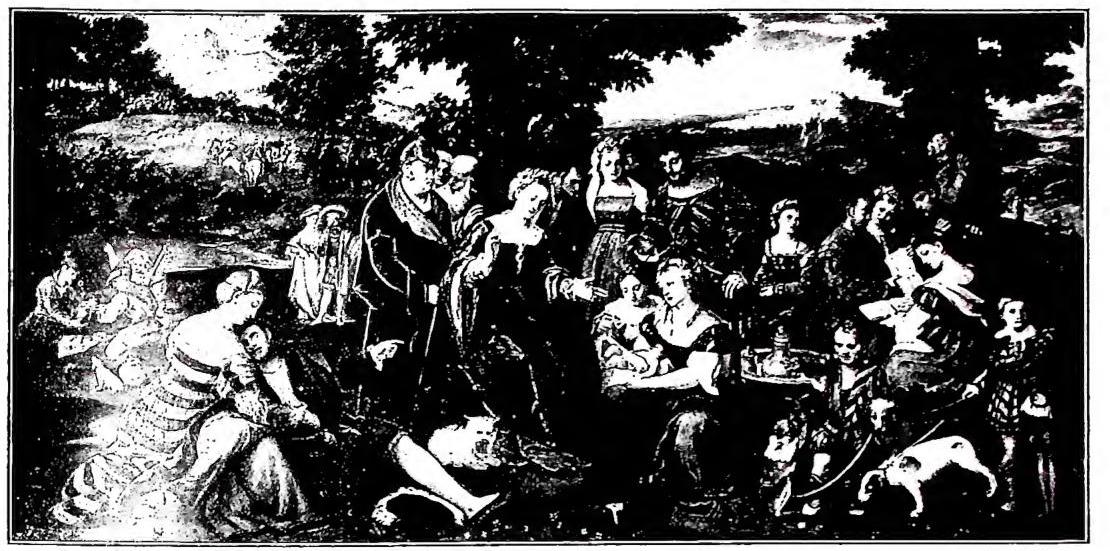
BONIFACIO VERONESE (BONIFACIO DE' PITATI). - Painter, b. in Verona around 1487, d. in Venice in 1553. Dated works are scarce; none is known with certainty earlier than 1530, the period in which B. already reveals himself as a mature artist; on the other hand, the works of his workshop are extremely numerous, and in them it would be difficult to define the part due to the master; it is therefore difficult to reconstruct his personality.
He derives directly from the Venetian milieu, above all from Titian and from Palma il Vecchio, whose tonalism he refines with a greater richness of luminosity, as is proved by the works usually ascribed to the period before 1530 (The Holy Family with Saints in the Louvre, The Holy Family with Tobias and the Angel in the Ambrosiana in Milan, The Holy Family with Saints in the Boston museum, where the Titianesque prototype of the saint is clear, The Holy Family in the Hermitage in Leningrad, where likewise the foliage of the background recalls Titian's landscapes). From 1530 to 1533 new motifs intervene, thanks to a more rigorous drawing; this evolution can be traced in the series of paintings for the Palazzo dei Camerlenghi, for example in the Judgment of Solomon (1533), and in the Madonna and Saints of the royal palace of Venice (1533), with draperies more rigid than usual and with a diminished richness of color. Subsequently the darker color range and a greater elasticity in the figures demonstrate the influence of Tintoretto; but in B. one never notices dramatic accents, because every figurative motif acquires in his painting a narrative and decorative value, so much so that his biblical and Gospel scenes are merely occasions for the description of sumptuous settings and for the representation of scenes of elegant Venetian life (most famous being the Finding of Moses in Brera and The Rich Glutton in the Accademia of Venice [1545-50]).
BIBL.: sources