
BRAMANTINO (BARTOLOMEO SUANDI). — Milanese painter and architect. The year of his birth is unknown; the documents show that in 1503 he was called in for consultation on the construction of Milan Cathedral; in 1508 he was in Rome to execute paintings in the Vatican; in 1508 he was again in Milan, where he designed the Trivulzio Chapel at S. Nazaro (whose construction he directed at least until 1520); in 1513 he painted at Chiaravalle, for the Cistercians, an altarpiece to be sent to S. Saba in Rome; in 1525 he was appointed ducal architect and painter; he died around 1536.
At first closer to the old tradition of Foppa and Butinone and to the nervous, incisive manner of Mantegna and the Ferrarese painters, he subsequently drew from Bramante (of whom he was very probably a pupil, as the nickname B. seems to indicate) and, through
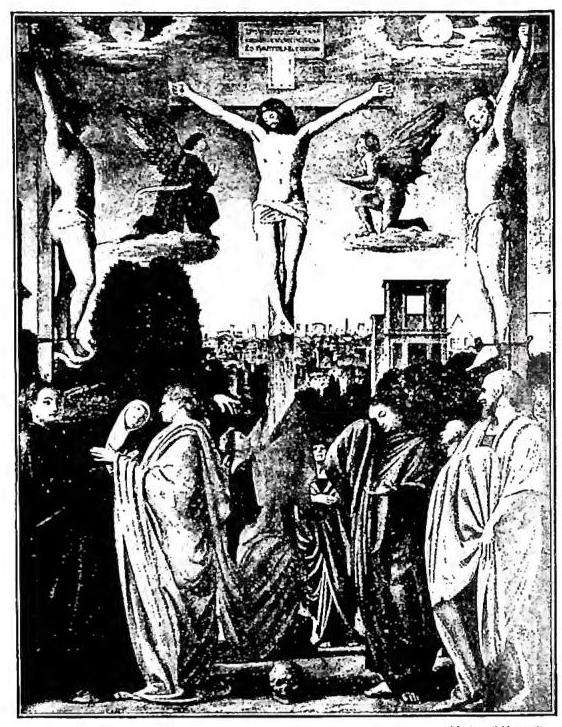
The chronology of his works is much debated; certainly youthful are the Nativity in the Ambrosiana of Milan and the Ecce Homo in the Soranzo collection, where setting and figures are fantastically distorted and the hard, harsh line possesses a singular constructive force. Slightly later, perhaps subsequent to the Roman sojourn that undoubtedly exerted a strong influence on the artist, are the Legend of Philemon and Baucis in the Cologne Museum and the Adoration of the Magi in the National Gallery in London, more solemn and monumental in conception; close to these is the remarkable ceiling of the Carafa chapel in Naples, executed in 1511, where perspectival skill never gives way to virtuosity or mere decoration, but, through foreshortenings, creates values of tension and impetus. Subsequently, the search for monumentality led B. to inflate his forms and burden his draperies, at the expense of the earlier movement and vigor; the line, from incisive, became soft and vaporous, while strong contrasts of light gave way to a more diffuse luminosity. Examples of this manner are The Holy Family in the Brera Gallery, the Triptych in the Ambrosiana, and Lucretia in the Sola-Busca collection.
Architectural constructions frequently appear in the fantastic backgrounds of his paintings, but the only documented work of architecture is the Trivulzio chapel at S. Nazaro. Devoid of every ornamental detail, and therefore remote from the ornamentalism of the Lombard architectural tradition, it reflects Bramante’s influence in its taste for geometric rigor, which is nevertheless animated by a vertical impetus particularly perceptible in the interior; the hypogeum of S. Maria della Fontana (Mezzanotte) and the old sacristy of S. Maria delle Grazie (Gengaro) have also been attributed to him.