
AMBROSIANA, PINACOTECA. — The A. Pinacoteca was established by Cardinal Federico Borromeo and attached to the library he founded. As soon as the library came into being, Federico carried out another of his plans: that of establishing an Academy of Fine Arts as well, to which he would provide, as an aid, an abundant and select collection of artistic works for the cultivation and education of taste in that period. In fact, Federico established the Academy, appointing the painter Giov. Batt. Crespi, known as il Cerano, as its first president, and placing at its disposal the collection of paintings he had already assembled and of which he himself compiled an annotated catalogue in the volume Museum, where he discusses, with profound artistic insight, the individual works offered for the Academy’s use, as he also did in De pictura sacra. It was a collection rich in works by the most celebrated artists, such as Raffaello, Leonardo and his pupils, Tiziano, Luini, Botticelli, Pinturicchio, Bergognone, Bramantino, Caravaggio, Dürer, Brueghel, and Brill. Architects, painters, and sculptors of considerable renown were immediately enrolled in the Academy, including Andrea Biffi, il Mangone, il Buzzi, Leone Leoni, Ercole Procaccini, Daniele Crespi, Francesco Nuvoloni known as il Panfilo, as well as il Cerano himself, who, among other things, was the author of the design for the colossus of S. Carlone at Arona, which Federico also incorporated into the A. For the Academy Federico had arranged
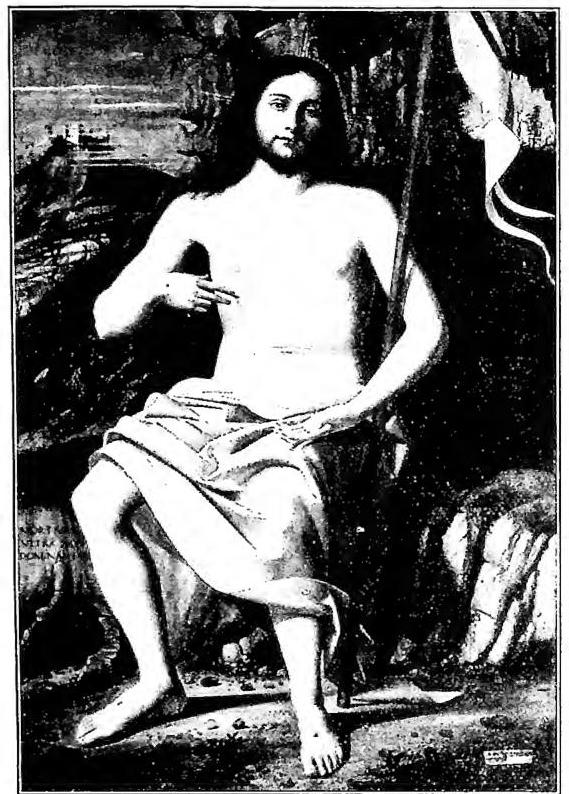
The p., however, remained and developed ever further, having already been envisaged by Federico in 1607 and 1611; he perfected his intention in this regard with a document of 1618, by which the p. was decisively constituted and the very premises of the Academy assigned to II.
Like Federico’s library, the p. grew through new acquisitions and donations. Flaminio Pasqualini and the abbot Piatti made donations in that same century. The most important donations, however, belong to the first half of the nineteenth century, such as those of Edoardo de Pecis and Maria de Pecis Parravicino, Federico Fagnani, Gaudenzio di Pagave, Felice Donzelli, Countess Teresa Dugnani, G. B. Bonsignori, formerly a doctor of the A. and later bishop of Faenza, Antonio Ronchetti, Baron Pietro Custodi, and Carlo and Giuseppe Casati.
In the second half of the nineteenth century, mention should be made of the donations of Alessandro Galimberti, Lorenzo Balestrini, the marquis Litta Modignani, the duke Gallarati Scotti, and the duke Melzi d’Eril; in the twentieth century, those of Luca Beltrami, the banker Ponti, the goldsmith Alfredo Ravasco, and Lodovico Pogliaghi, who, by an act of 1937, while Pope Pius XI was still alive, transferred to the A. the distinguished artistic complex of the Ludovicianum, assembled by him in his splendid villa arranged as a museum, which itself was also donated to the A., on the Sacro Monte of Varese. The p. was enriched with paintings by Luini, by the school of Giorgione, by Schiavone, and by Serodine; an entire collection by Mosè Bianchi; works by Induno; thirty paintings by Londonio, through the donation of Countess Jeannette Dal Verme; and works by Juan Bernasconi, Edoardo Silvestri, and Ambrogio Bertarelli. The musician Leone Sinigaglia supplied ceramics and the entire precious new room of miniatures on ivory and parchment.
The Settala museum forms part of the p.; it had already been assembled in the seventeenth century by the Milanese Manfredo Settala, called the Milanese Archimedes and son of that Ludovico whom Manzoni portrayed in his capacity and office as proto-physician, or chief director of public health, at the time of the famous plague in Milan. It is a museum of the history of science, but it also contains objects of art, such as furniture, vases, worked glass, and ivories. It was added to the A. in 1751, where it was first installed in the library rooms.
Attached to the p. is an extensive collection of original drawings by celebrated artists, begun by Federico himself and subsequently enriched through the work of patrons. We may mention the Resta gallery, a sumptuous collection of drawings by celebrated artists, including Raffaello, donated by Canon Count Resta of Milan; the collection of Dürer’s drawings; and a collection of four thousand drawings by excellent artists donated by Marquis Federico Fagnani. The collection of original drawings is followed by the great collection of engravings and prints, numbering approximately 40,000 pieces, 16,000 of them donated by Marquis Fagnani. The noble competition in giving recently enriched the A. with fine etchings: among them are those by Faruffini, Mosè Bianchi, Colombi-Borde, Pompeo Mariani, Uberto dell'Orto, Luigi Conconi, Luca Beltrami, Vittorio Grubicy de Dragon, Antonio Grandi, and Enrico Vegetti.
It is hardly necessary to recall Leonardo da Vinci’s Codice Atlantico, which alone would suffice to constitute the glory of the A.
The art treasures thus accumulated remained until 1836 in two large ground-floor rooms, which Federico himself had built for the Academy on the site of the Taverna school, adjoining the already constructed library palace. But when the Ambrosian palace was enlarged that year, the p. was installed with greater dignity in the upper rooms of the two wings of the new building, raised and modified by Moraglia, with its façade facing what was then Piazza della Rosa. Thus a clearer distinction was created between the library and the p.: the latter took up permanent residence on the upper floor, where, since 1829, the collection of paintings, marbles, and bronzes donated by Count Edoardo de Pecis had also been awaiting it, so that it might be united with it more organically. A special room had been built and decorated for these works under the direction of Moraglia himself.
The prefect Achille Ratti reorganized the p. with the assistance of Luca Beltrami, Antonio Grandi, and the painter Luigi Cavenaghi in 1905–1906; the event was commemorated by an inscription on marble dictated by Ratti himself. Some attempt at architectural expansion was made by Luigi Gramatica in 1923. But the p. A. acquired a much broader scope and greater splendor of form when, in 1928, under prefect Giovanni Galbiati, it definitively took possession of the temple of the Holy Sepulchre and its adjoining buildings. This annexation not only made extensive adaptations to the library possible, but also brought about a profound and radical reorganization of the entire artistic treasure assembled in the p. A., increasingly distinguishing the p. from the library. The seven traditional rooms of 1836 became thirty-seven, marked by great nobility and beauty, arranged partly in the premises of Moraglia’s old building and partly along the airy sixteenth-century loggias, in two receding tiers, running around the courtyard of the fountains or lapidary courtyard, called that of the Great Spirits because of the monumental bronze statues of the universal geniuses of thought recently placed there as a suggestive embellishment of the palace. Among the rooms thus created, we may mention the following: the room of engravings and prints, the Dante gallery, the Medusa room, the porcelain room with the adjacent magnificent collection of miniatures, the Virgilian exedra, the room of Niccolò da Bologna or of the Bramantini, the Pariniano, the German room, the Flemish room with the Brueghels, the Venetian or Titian room, also containing the celebrated cartoon for Raffaello’s School of Athens, the Lombard and Italian rooms, the sixteenth-century or Luini room with the fresco of the Crowning with Thorns, and, finally, the most imposing of them all, the Leonardo hall, where the Codice Atlantico stands with its 2,000 original drawings, as well as, in an adjoining room, the other paintings and drawings by the same artist possessed by the A., together with the collection of works by his pupils. This last room, opened in June 1938, crowned the general reorganization of the A., renewed during the five-year period 1925–1932.
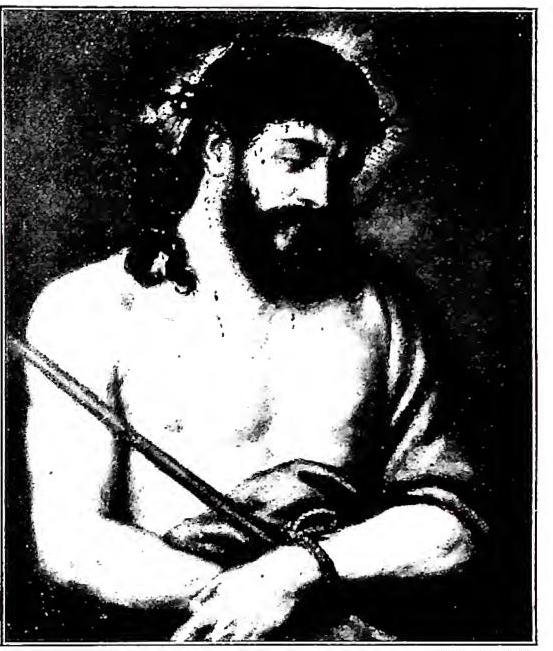
AMBROSIANA, PINACOTECA - Ecce Homo, by Tiziano.
Like the library, which suffered serious damage to its building complex as a result of the Anglo-American bombardments on the night of 15–16 August 1943, the gallery too was riddled with projectiles in nearly all its rooms, though to a lesser extent. But all the artistic contents were saved because they were promptly transported elsewhere, just as the book collection was saved (apart from a portion), having likewise been removed in time and placed in appropriate shelters in the Lombardy and Piedmont regions. The restoration of the gallery was completed in 1948, so that from this year it has once again shone in its full beauty. The works of art are arranged according to the customary principles of museography, that is, organized by schools and periods; it is well known that the drawings and paintings forming this precious collection are predominantly Lombard-Venetian, from the fifteenth, sixteenth, seventeenth, and eighteenth centuries; nevertheless, other works, albeit in smaller measure, belong to earlier and later periods and to other schools, especially German-Flemish ones. The prints, on the other hand, belong to the most diverse Italian and foreign schools. Raffaello and Leonardo constitute the collection’s greatest distinction. - Vedi Tav. LXXXIII.
(phot. Ambrosian Library)
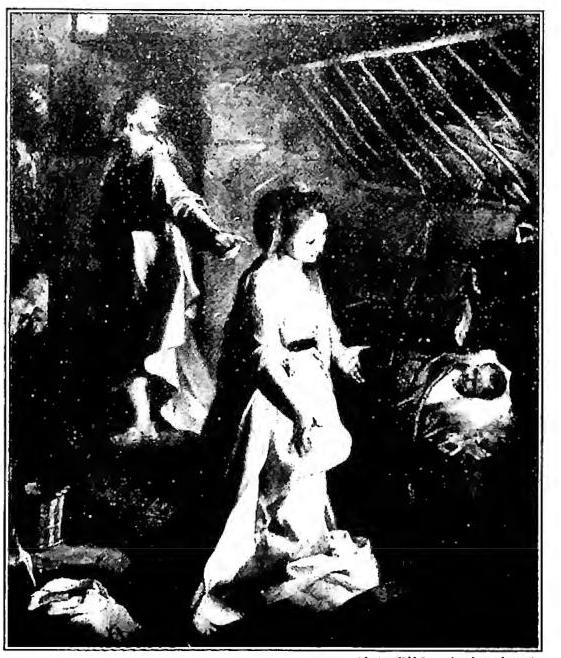
AMBROSIANA, PINACOTECA - La Natività, canvas by F. Barocci.
1920; G. Galbiati, Antichità Sudamericane del Museo Settola, in Atti del XXII Congresso Americanista, Roma 1926; id., Il tempio dei Crociati e degli Oblati, S. Sappiero dell'A., Milano 1930; id., Come l'A. celebra il III Centenario di F. Borromeo, in Rendiconti del R. Istituto Lombardo di Scienze e Lettere, fasc. XI-XV (1931); id., Il Convegno degli Spiriti Magni, il Monumento a Goethe nell'A., Milano 1939; L. Grassi, Ricerche intorno al padre Resta e al suo codice di disegni all'A., in Rivista del Reale Istituto di Archeologia e Storia dell'Arte, fasc. II-III (1941), pp. 151-88; G. Morazzoni, Le miniature dell'A., Milano 1943; G. Galbiati, L'A. dopo la seconda guerra mondiale, Milano 1948; id., Itinerario per il visitatore della biblioteca e p. dell'A., Milano 1948.