AMBROSIANA, BIBLIOTECA

AMBROSIANA, LIBRARY. — The Ambrosian Library belongs to the number of great libraries established as a manifestation of learned patronage. Founded in 1607 by Federico Borromeo, Archbishop of Milan (1594–1631), a cousin of St Charles, it was definitively opened on 8 December 1609. It is among the first libraries intended for public use, a high and broad merit of the founder for the benefit of studies in the weary period following the Italian Renaissance.

From the volume of Statutes, written in Latin by the founder himself and still in force, the character and purpose of the library are evident. Federico Borromeo’s intention was indeed to establish, under the shield and insignia of St Ambrose, more than a library in the strict sense, but rather a kind of universal academy of sciences and letters to elevate general culture, particularly that of the clergy, placing it at the service of religion and scientific progress in an era when culture itself, after the splendours of the Renaissance, seemed to have declined. To this end, Borromeo established a college of fifteen learned men, chosen from the best elements of the ecclesiastical estate, including foreigners, entrusting them with the office of cultivating the various sciences with special attention to history, philosophy, classical literatures, and Oriental languages in general. For the support of the college, he provided, through the institution of five-year conservators, with material means and the devolution of landed property, which at first were sufficient to maintain the fixed number of chosen scholars, but which over the centuries proved less adequate, so much so that that initial number subsequently dwindled, though the obligation remained for the chosen scholars, whom he officially termed *doctores*, to devote themselves exclusively to a single branch of learning (*singuli singula*) and to publish the results of their scientific research, maintaining contact with scholars in Europe and neglecting any other commitments not pertaining to scholarship. The cardinal would have provided even greater material subsidies for the maintenance of the library had the events of life and the circumstances of the times been more favourable. The conservators, to whom was entrusted the office of administering the patrimony and providing the *doctores* with every opportunity for their studies, were six in number: to them belonged, by perpetual right, the eldest member of the princely Borromeo family.

The Ambrosian Library arose from its foundations in the centre of Roman Milan, near the Duomo, on a strip of land parallel and almost contiguous to the church of the Holy Sepulchre. The building was erected, as the monk wrote, with bold magnificence, and we might say regal, in the period of Spanish rule in Milan. Borromeo had previously consulted five architects on this matter: Tesauro, Trezzi, and especially Lelio Buzzi, Fabio Mangone, and Francesco Richino. Yet, since the library did not satisfy the refined taste of its founder, in 1618 he added, on the site of the demolished Taverna School, a vast picture gallery or pinacotheca (v. AMBROSIA, Pinacoteca). Another important accession was the Settala Museum, which was incorporated into the Ambrosian Library, though in a mutilated and less complete state, in the 18th century: one of the first museums founded in Europe, containing an ethnographic, historical, and archaeological collection that demonstrates the high scientific genius of the Milanese patrician who had assembled II. To the library, Borromeo also wished to add the administration and possession of the Colossus (the so-called St Charles), and the adjoining hill, near Arona, on the Piedmontese shore of the lower Verbano.

The library, in its entire architectural complex, continued to expand in the following centuries. At the beginning of the 19th century, after the spoliation of art treasures and Ambrosian manuscripts by the Napoleonic army and the subsequent restitutions following the Congress of Vienna in 1815, the library was further enlarged by the definitive cession of adjacent premises previously used by the suppressed Dominicans of Santa Maria della Rosa, the Oblates of the Holy Sepulchre, and the hospitaller institution of Santa Corona. Thus, after the ancient church of Santa Maria della Rosa was demolished and a new façade for the library building, with a new reading room and new rooms for the pinacotheca, was erected by the architects Moraglia and Cagnola on its site, the institution appeared considerably enlarged in 1836. In 1923, the internal courtyard was transformed into a large consultation hall, dedicated by Prefect Gramatica to Pope Pius XI (with a bronze statue of him by Quattrini, 1927); and, after the annexation of the church of the Holy Sepulchre and its dependencies in 1928, following the extensive reforms of 1927–32 and 1938 (architects Moretti, Minali, and Annoni, Prefect Giovanni Galbiati), the Ambrosian Library quintupled its original extent and architectural expression, now confined within an independent quadrilateral between Piazza del Santo Sepolcro and Piazza della Rosa, today called Piazza Pio XI.
The Ambrosian Library is renowned for its collection of ancient manuscripts and codices, gathered for the most part by the founder himself through learned commissioners whom he sent in the first decade of the 17th century to acquire books in various European countries, such as Germany, the Low Countries, France, Provence, Spain, as well as in the countries of the eastern Mediterranean, particularly the Ionian Islands, Greece, the Aegean basin, Syria, Turkey, Egypt, and North Africa. These commissioners assembled a vast and multifaceted supplementary collection.

The library’s manuscript collection is of immense value for its content, antiquity, and provenance: a collection that immediately brought fame to Cardinal Federico’s library and still constitutes its most important nucleus today. In all, including miscellanies, the collection comprised about 35,000 manuscripts, parchment or paper, of every type and paleographic school, containing nearly all the knowledge of the time and, by reflection, the ancient heritage of learning. The most significant part of it consisted of Greek and Latin manuscripts, both classical and Byzantine and medieval; followed by those on history, patristic literature (both Greek and Latin), biblical versions, commentaries and exegesis, homilies, rhetorical works, liturgical codices, legends, and precious documents from remote times. Of particular importance was the collection of Oriental codices, notably Semitic, among which the Arabic nucleus, predominantly Muslim, stands out, together with the group of Hebrew, Samaritan, Syriac, Ethiopian, and Persian manuscripts. All this immense and precious patrimony the cardinal had gathered by exercising his high influence with churches, monasteries, bibliophiles, and notable humanists of the time, or by directly purchasing individual manuscripts or entire manuscript collections. The Duke of Savoy, Charles Emmanuel, sent a collection of ancient inscriptions. Among the monasteries, that of Bobbio provided the oldest and most valuable Latin nucleus. A large and singularly fine Greek-Latin collection, assembled by the bibliophile Gian Vincenzo Pinelli (d. 1601), came to Cardinal Federico by purchase from Naples in 1609. Antonio Olgiato, who was the first prefect, was also the first organiser of the codices arriving at the library.

But the Ambrosian collections continued to grow further through donations of notable richness: in 1637, through the gesture of Galeazzo Arconati, a relative and admirer of the cardinal, the manuscripts and drawings of Leonardo da Vinci entered with the Codex Atlanticus, and during the prefecture of Achille Ratti, the Trotti-Bentivoglio bequest, the block of original manuscripts of Parini, as well as the substantial Arab-Yemeni collection in 1909 through a city subscription and at the initiative of the Islamologist Eugenio Griffin. Another Arab collection arrived from Tripolitania in 1927 through the offices of G. A. Noseda. A copious selection of notarial parchments was provided by Cav. Reschigna of Cannobio. G. Martelli donated the archive and manuscripts, along with the exploratory notes, of Cesare Cantù.

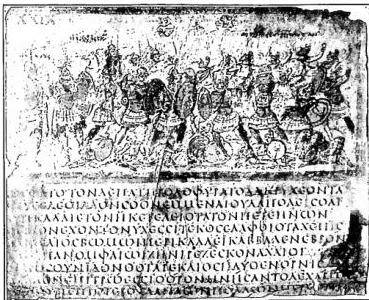
The Ambrosian collection contains numerous ancient illuminated manuscripts from every school, and famous are the palimpsests, parchments, nautical charts, and portolans. Certain manuscripts and palimpsests, such as the Painted Homer of the 3rd century A.D., the Syriac Pesciitto Bible of the 6th century, the Gothic Ulfilas palimpsest, the Septuagint version, the illuminated Terence, the palimpsests of Fronto and Plautus, the semi-uncial of Symmachus and Pliny, the Muratorian fragment, Josephus in a splendid papyrus volume, the Apocryphal Gospel of St. John (Arabic), the Cufic codices of the Qur’an, the Greek-Latin Virgil in an Arabic palimpsest, the Irish codex, the Divine Comedy of 1353, the Provençal codex, the tachygraphic palimpsest, the superb Greek codices with or without miniatures, Petrarch’s Virgil, the Book of Hours by Cristoforo de Predis, and many others, are of world renown. Notable is the collection of autographs and correspondence of humanists, Lucrezia Borgia, Manzoni, and many others. General or partial catalogues exist for all Ambrosian manuscripts and codices for research purposes, some printed, others for in-house consultation.

As for printed books, the Ambrosian Library holds about 2,000 incunabula in Greek and Latin, with unique and highly important subjects. It is also rich in 16th-century books and rare editions from every European country, partly acquired by Federico Borromeo but augmented through subsequent accessions and donations by patrons, including the Scotsman David Colvill, Stefano Rampini, Teodoro Osio, Giovanni Pasquali, G. B. Rusca, Count Abbate-Forieri, Donna Talenti of Florence, the Oblates of the Holy Sepulchre, as well as the Simonetta, Migliavacca, and Lambertenghi bookshops, Marelli with works from the Napoleonic-French period in Milan, A. Bonelli, Baron Custodi, Marquis Fagnani, William Currie with choice incunabula, G. Cerutti, F. Agnelli, the Bohemian C. Menzingher, Cristoforo Bonavino, C. Nardi, P. Tosi, Tullo Massarani, Duke Tommaso Gallarati-Scotti, Counts Giulio and Porro Lambertenghi with a series of incunabula, the Villa-Pernice, Polli, Osnago bookshops, the astronomer Giovanni Schiaparelli, Antonio Ceriani, Poma, Vitali, and more recently Gioconda Ellero, Amilcare Piccioni, Maria Pedetti-Ponchielli, Duke Giordano Orsini of Naples, Enrico Casanova, Carlo Giussani with his Japanese collection, Giuseppe Marietti with Teubnerian classics and the great De Vries paleographic reproductions, the Arab-Muslim library of Eugenio Griffin (1926), augmented with additional Arabic manuscripts, the Glottological library of Carlo Salvioni (1929), the bookshops of Luca Beltrami and Achille Ratti, the monumental cartographic reproductions of the Cairo prince Yūsuf Kamāl for the Dutchman F. C. Wieder. By the will of Count Giacomo Mellerio (1847), the library of the Certosa of Pavia was annexed to the Ambrosian Library but remained in that location. In 1937, another significant bibliographic acquisition occurred with the annexation of the entire Ludoci-cianum, or Museum of Lodovico Pogliaghi, on the Sacro Monte above Varese.

Article illustration

Thanks to these acquisitions, the printed collection also became impressive, without quantity compromising quality; the Ambrosian collections are rich not only in incunabula but also in Aldine, Elzevir, Cominian, Bodonian, Giolito, Giunta, and Robert Estienne editions, as well as numerous illustrated works, bibliographic rarities, and large collections—everything that can make an institution of this kind invaluable. There are also numerous and varied ancient artistic bindings. This wealth continues to grow across every branch of knowledge (linguistics room, paleography room), as well as modern technology, although the library’s purpose is retrospective in nature, and its greatest merits particularly pertain to fields that serve the reconstruction of the past. In 1947, the library was enriched by the vast and precious deposit of the Historical Archive of the Archdiocese of Milan, consisting of 1,340 miscellaneous folders containing a total of 4,000 unpublished manuscript volumes.

The Ambrosian Library houses an archive with threefold documentation of the institute’s internal development; a large collection of notarial parchments with medieval imperial diplomas; the correspondence of St. Charles Borromeo and Federico Borromeo, dense with 60,000 pieces; a lapidary museum with Roman and medieval inscriptions on marble; a medal cabinet and a numismatic cabinet rich with about 15,000 pieces, including a collection of ancient Roman coins and particularly more recent Italian coins; and a recently established laboratory for the restoration of manuscripts and parchments. From its very beginnings, the Ambrosian Library had its own printing press, which, after fruitful activity, ceased to function around the mid-19th century.

The Ambrosian Library was fortunate to receive a solemn encomium from Alessandro Manzoni, who in Chapter XXII of *The Betrothed* devotes entire pages to describing its origins, development, and operations; and indeed, over three centuries of existence, it has produced men of singular value, beginning with its founder Federico Borromeo; from the first librarian Antonio Olgiato of Lugano, to Antonio Giggi, the foremost scholar of Arab studies, to the historians Ripamonti, Sassi, Oltròchi, to Ludovico Antonio Muratori, to Angelo Mai, to the Orientalist and paleographer Ceriani, to Giovanni Mercati, to L. Gramatica, to Achille Ratti, who became Pope Pius XI.
The Doctors of the Ambrosian Library have also been awarded several honorary titles, recognized civilly, and in religious-ecclesiastical functions, they proceed with the chapter of St. Ambrose in the city — V. Tavv. LXXX-LXXXI.

BIBL.: The bibliography on the Ambrosian rite is too vast to allow even an approximate list to be given here. We limit ourselves to indicating the following general works: Constitutiones Collegii ac Bibliothecae Ambrosianae, Milan 1609; Documenti per la donazione dei manoscritti di Leonardo fatta da Galeazzo Arconati, Milan 1637; Fr. Rivola, Historia del card. Federico Borromeo, Milan 1636; P. Terzaghi, Museum Septalium Manfredi Spalae, Tortona 1664; P. P. Bosca, De origine et statu Bibliothecae Ambrosianae, Milan 1672; G. A. Sassi, De studiis litterariis Mediolanenses antiquis et novis, prodromus ad historiam typographicum Mediolanensem, Milan 1729; B. Montfaucon, Bibliotheca Bibliothecarum, Paris 1739; S. Lattuada, Descrizione di Milano, IV, Milan 1738; C. Amoretti, Osservazioni sulla vita e disegni di Leonardo da Vinci, Milan 1784; A. Ceruti, La b. A., Milan 1881; A. Ratti, Pio XI], La b. A., in Statistica delle Biblioteche per il Ministero dell'Agricoltura, Industria e Commercio, I, 1, Rome 1893; Ch. Quesnel and A. Piedagnel, Le cardinal Frédéric Borromeo, Lille 1890; L. Beltrami, La b. A., cenni storici descrittivi, Milan 1895; A. Ratti, Pio XI], Guida sommaria per il viatico delle b. A. e delle collezioni annesse, Milan 1906; A. Scuola medica, La b. A., Milan 1911; G. Galbiati, La b. A., e recenti lavori di ordinamento, in Atti del I Congresso mondiale delle Biblioteche e di Bibliografia, Rome-Venice 1929; id., Come l'A. celebra il III Centenario di Federico Borromeo, in Rendiconti del R. Istituto Lombardo di Scienze e Lettere, fasc. 1-15 (1931); id., Federico Borromeo studioso, umanista e mecenate, in Atti della XX Riunione della Società Ital. per il progresso delle Scienze, I, Milan 1931; C. Castiglioni, Il card. Federico Borromeo, Turin 1931; A. Saba, La b. A. (1609-1912), Milan 1932; G. Morazzoni, L'A. nel III centenario di Federico Borromeo, Milan 1932; G. Galbiati, Die Ambrosiana in Mailand, Widerhall einer Jahrhundertfeier, Cologne 1935; F. Meda, Papa Pio XI e le costituzioni della b. A., in La Scuola Cattolica, 1939.

Among the printed catalogues of manuscripts, we note the following for their scope: G. De Hammer-Purgstall, I codici Arabi, Persiani e Turchi della b. A., in Bibl. Ital., Milan 1839; A. Reifferscheid, Bibliotheca Patrum Latinorum Italica, Vienna 1871; Catalogus codicum hagiographiarum Latinorum bibliothecae Ambrosianae, Brussels 1892; O. Seebass, Handschriften von Biblio 1896; in der Vatikanschen und Ambrosianischen Bibliothek, Leipzig 1896; D. Bassi and E. Martini, Catalogus codicum Graecorum Bibliothecae Ambrosianae, 2 vols., Milan 1906; R. Beer, Bemerkungen über den ältesten Handschriftenbestand des Klosters Bobbio, Vienna 1911; G. Cesari, Catalogo delle opere musicali mss. della b. A., Parma 1911; E. Griffin, Catalogo dei mss. arabi di nuovo fondo della b. A., I, Rome 1910-1919; P. Revelli, I codici geografici della

The theory of P. Revelli, which is essentially correct in outlining the origin of the Ambrosian rite as a Roman liturgy, does not exclude the possibility that many Oriental and Gallican influences contributed to the formation of the Ambrosian rite. The studies and discussions conducted by F. Cabrol, H. Leclercq, G. Morin, A. Wilmart, G. Mabilon, L. Duchesne, C. Callewaert, A. M. Ceriani and others on its origin lead to this conclusion: the Ambrosian rite is composed of a core that is essentially Roman, with Gallican, Oriental and medieval influences—some of which are difficult to identify—up to the 16th century, which, however, do not obscure its genuinely Latin character.

The name "Ambrosian rite" should not lead one to believe that St. Ambrose was its inventor or that he introduced innovations sufficient to justify attributing paternity to him. It was only after the Roman reform of St. Gregory the Great that the distinction between the Roman rite and the Milanese rite—which had previously not been very marked—led to the latter being classified under the name "Ambrosian liturgy." In reality, St. Ambrose found in Milan a rite that was well-ordered in traditional forms, with some differences from Roman usages (e.g., in fasting), which already indicate influences not originating from Rome. The state in which St. Ambrose found the liturgy in Milan and what can be deduced from his works have already been the subject of study by M. Magistretti, later corrected and refined by A. Pareide and E. Cattaneo; their conclusions are more concise but critically more reliable. However, since St. Ambrose is the only source for knowledge of the Ambrosian rite in the 4th century, and since the Milanese elevated the Saint to the dignity of religious, moral and civil representative of Milan, it is understandable that from the 7th century onwards the liturgy itself was also called the "Ambrosian liturgy." In his works, but especially in *De mysteriis* and *De Sacramentis*, he deals with all aspects of the liturgy, from Eucharistic and psalmodic synaxes to the Sacraments, from the hierarchy to the liturgical year, from funerals to the washing of the feet. However, he usually speaks of these matters in passing, as if referring to things well known to his listeners. Today we can observe that, despite the corruptions and corrections it has undergone over the centuries, the Ambrosian liturgy has preserved much of what St. Ambrose describes, even though he himself introduced some innovations.

Apart from various disciplinary reforms of minor importance, only three have so far been proven: the vigils, the antiphons, and the hymns. To these can be added the chant, for which we refer to the entry AMBROSIANO, CANTO.

a) The Vigil. — It is a nighttime vigil that begins on the evening of the preceding day. The first vigils were domestic; the second were those of the dies natalis of the martyrs. From these vigils, which were called *vigiliae stationales* because of the place of gathering (*statio*), there were distinguished the daily vigils, which probably originated in Alexandria and which mark the beginning of the *officium lucernare* (vespers) and *nocturnum* (matins).

St. Ambrose found these vigils already in place in Milan and did no more than better organize them, establishing rules to counteract the sense of disorder and fatigue that pervaded the faithful during the long vigil. It was during one of these vigils (when Justina attempted to occupy the Basilica Porzia) that St. Ambrose instituted the antiphonal singing.

b) The Antiphon. — "Duobus choris alternatim concinentibus quasi duo Seraphim... Apud Latinos autem primus idem beatissimus Ambrosius antiphonas constituit Graecorum exemplum imitatus" (Isidore). Previously, the singing of the psalms, like the reading of the lessons, was done by a lector and the people responded at the end with an acclamation (cf. in the Hebrew liturgy the conclusion of Psalm 105, or the entire Psalm 135). This practice has remained in the Ambrosian rite in the Canticle of the Three Children; in the Roman rite, it has remained at the end of the procession on Palm Sunday and in the Improperia of Good Friday (to cite just a few examples). St. Ambrose's innovation was to have it sung as it is now done, with two choirs alternately performing a verse of the psalm. According to the beautiful expression of the same holy Doctor (*Explan. ps. XII, 1, 9*), previously one person sang and everyone disturbed, but now everyone sings and no one disturbs. This innovation, which originated in Syria, subsequently spread to Antioch, Caesarea, and Milan (cf. ANTIFONA).

It should be noted that, in order to make it accessible to the masses, the melody of the psalms was simplified, leaving the antiphon with its original melody.

c) The Hymn. — St. Ambrose was a poet, but a popular poet, not in the sense of lyrical poverty that is attributed to this word, but in the sense of a composer capable of making himself understood by the people for whom he wrote exclusively. The heretics Arius and Apollinaris had used hymns for the propaganda of heresy. St. Ambrose, to oppose new means of defense against heresy, created a new type of hymn (iambic dimeter in strophes of four verses with a melody predominantly syllabic) so widely diffused and enthusiastically accepted by the people as to be accused of magic for this reason. From Milan, his hymns spread to the Italian and Gallic Churches; they were imitated in other places, so much so that even Rome (the most reluctant to innovation) accepted them, calling every hymn made in the style of those of St. Ambrose "Ambrosian." He thus remains the founder, in the West, of Christian lyric poetry, which may be said to have been born by chance during the famous siege of Portius. The hymn, however, is not occasional or improvised, but the fruit of long study in condensing sublime truths into easy verses.

The purpose, eminently apostolic rather than merely literary, practical and dogmatic, and the effect of teaching given in this manner, are explained by St. Ambrose himself in his explanation of Psalm 1 (Explan. psalmi. XII, 1, 9). For the number of hymns composed by St. Ambrose himself, V. AMBROGIO, santo.

2. THE MILANESE LITURGICAL BOOKS

a) Missal. — The earliest document that can be cited dates back no earlier than the 9th century, the first of which is probably that published by A. Wilmart under the title: *Expositione Missae Canonicae*. This is followed immediately by the Missal of Biasca and the Bergamo Sacramentary of the 10th century. A. M. Ceriani published an Ambrosian Canon of the 11th century. After these, we have many other manuscripts up to the first incunabula of 1475. The official editions, however, number only 9, from 1594 to 1936. The first scholar of the Ambrosian Missal was Giovanni Bartolomeo De Guerci with his *Liber Celebrationis Missae Ambrosianae*, from the early years of the 13th century. The most important critical edition is

Article illustration
(Isd. Bibl. Ambrosiana)
Ambrosiana Library - Drawing for a self-moving machine from Leonardo da Vinci's Codex Atlanticus.

the *Missale Duplex* prepared by Ceriani and published by Achille Ratti (later Pius XI) in 1913.

The Ambrosian Missal contains 236 prefaces. Another 77, now no longer in use but preserved in ancient Ambrosian sacramentaries, may be added. The Roman Missal, which with its Leonine Sacramentary had 267, now has only 15.

b) Breviary. — In the Milanese rite, the book that began to gather the material from which the other books were to arise and derive was called the *Manuale*. It was particularly used not only for psalmody but also for public functions. It contained various rubrics, the parts of the Mass that pertained to the choir, and in some editions even the Orations, and the first words of the readings for the Mass and the Office; it even included texts and rubrics for the administration of Baptism and Extreme Unction.

The oldest *manuales* that remain date from the 10th century. The most important of these is the *Beroldus* (from the name of the compiler, superintendent of lights and lamps) and the *Mila* (from the name of the Duomo of Milan) of the 12th century. This *manuale* includes rubrics, ceremonies, texts, a calendar, and the distribution of alms as they were then in use in the cathedral of Milan. Around the 1500s, the *manuale* eliminated everything that was not Office material and took on a more exclusively breviary form. The word "breviary" appears for the first time in 1443, then in an incunabulum of 1475. Much contributed to its formation as a composer of masses, officially and hymns, Olrico Scaccabarozzi, who lived in the 13th century. Dreves published part of his output. There have been 32 editions of the Breviary so far, from 1475 to 1902; the first edition, however, seems to be nothing more than a copy of a 13th-century manuscript. The Benedictine monks of Maria Laach are studying the most complete critical revision possible of the Ambrosian Breviary. Regarding the use of Holy Scripture, Radolfo De Rivo (14th century) already noted that the Ambrosians followed the Septuagint version. This is true now for the Psalter, because for the scriptural readings St. Charles wanted to introduce the text of the Vulgate. The complete Psalter is recited during the year over the course of two weeks. The Ambrosian Breviary comprises 78 hymns, not counting the *De Deum*.

c) The Pontifical. — M. Magistretti published a 9th-century codex and other excerpts from codices up to the 15th century with various *ordines* for the consecration of the church and sacred furnishings, for the sacred orders from simple clerics to bishops, for the consecrations of virgins and widows; various blessings for fruits, for brides; exorcisms; consecration of holy oils, and even a Canon of the Mass and the consecration of the King of Italy.

The Ambrosian Pontifical is no longer in use, and the Roman Pontifical is now in force. Still distinctly Ambrosian are the ritual for the Sacraments and a special ceremonial for the Duomo.

Also to be added are: the *Collettario* (for blessings with the Blessed Sacrament), the Calendar, published every year as a guide for Masses and the Office, and the chant books: the *Antifonale* for Masses, the *Vesperale*, and the *Processionale*.

3. THE LITURGICAL YEAR

As in the Roman rite, the great cycles of Christmas, Easter, Pentecost, and the Sanctoral are distinguished.

a) Christmas Cycle. The Ambrosian Advent begins on the Sunday after the feast of St. Martin; it thus has the same duration as Lent with six Sundays. In the last week of Advent there are the ferias *De Exceptato*, whose meaning, much debated, must depend on the etymology (*excipere* "to receive") in relation to the imminent coming of Christ. In the octave after Christmas, we have the unique example of mixed Office between the feasts of the saints and the Christmas octave. It also happens that two Vespers are recited on the same day. On Epiphany, the day of Easter is announced. Epiphany, a more ancient and solemn feast, has an octave. The Sundays after Epiphany should be seven. The Office of the sixth Sunday is always celebrated even when a very low Easter obliges the suppression of some. Lent begins on the first Sunday, not on Wednesday as in the Roman rite. On this first Sunday, the Alleluia is laid aside, except at Vespers, and it is taken up again on Holy Saturday.

b) Ambrosian Lent is austere: Mass is not said on Friday, all altar frontals are covered (never the Crucifix), and no feast of saints is celebrated (St. Joseph on March 19 is a recent exception) except that of the Annunciation. Worth noting for their antiquity (11th century) are the litanic prayers of the Mass on Sundays. The Saturday before Palm Sunday is called *in traditione Symboli* in memory of the Creed, which was once solemnly delivered to the catechumens.

Holy Week is called the *In Authentica* week because it is the prototype of the weeks in the liturgy. On Wednesday of this week, as the Preface indicates, it is reserved for confessions for the paschal communion of the following day. In the octave of Easter, there are two Masses, one for the neophytes and one for the faithful. The paschal cycle ends on Ascension Day. The triduum of the minor litanies is celebrated after Ascension because "one does not fast while the bridegroom remains" (cf. Mt 9:15), unlike the Roman Rogations of Gallican origin.

c) The Pentecost cycle also includes the octave of Pentecost with two Masses (the vigil of Pentecost resembles Holy Saturday with regard to the Baptism of new Christians), the octave of Corpus Christi, and the Sundays after Pentecost; these also vary in number according to the date of Easter.

After 29 August begin the Sundays after the Beheading (of St John the Baptist), no more than five; then the Sundays of October until the Dedication of the Duomo. These are followed by the Sundays after the Dedication until Advent. On 25 April the Greater Litanies are observed, which date back to St Gregory the Great.

d) The sanctoral cycle. All the feasts of the Lord are distributed in the cycle of Christmas and Easter and Pentecost, except for the Transfiguration, fixed for 6 August. There are twelve feasts of the Blessed Virgin Mary, arranged in the following order: Purification, Annunciation, Visitation, Our Lady of Mount Carmel, Our Lady of the Snows, Assumption, Nativity, the Holy Name of Mary, the Seven Sorrows, Holy Rosary, Presentation, Immaculate Conception. These are followed by the three feasts of the Archangels: 29 September, St Michael; 24 October, St Raphael; 5 December, St Gabriel; and 2 October, the Guardian Angels. The twelve Apostles, either individually or in pairs, follow the Roman rite, except for St Matthias and St Thomas. It should be noted that St James, formerly on 29 December, was moved to make way for St Thomas of Canterbury; St Joseph, once on 12 December, was transferred to 19 March to conform to Roman usage. St John the Baptist has two feasts as in the Roman rite: 24 June (his birth) and 29 August (his death). St Ambrose occupies a special place with four feasts: Holy Thursday (his death), 14 May (translation of his body), 30 November (his baptism) and 7 December (his episcopal ordination), which is the principal feast. Very recent additions are the feasts of the patronage of St Joseph, the patronage of the Blessed Virgin Mary and the feast of the Holy Family, connected with certain Sundays for the people but celebrated on the following day.

All other saints are for the most part those of the first four centuries, with some added but none later than the 17th century. Saints of the 16th and 17th centuries also occupy a prominent place.

The only saint of the 18th century is St Alphonsus de’ Liguori. Some saints were introduced (without any connection to Milan) by the devotion of the various rulers who succeeded one another in the Duchy of Milan, for example the kings St Henry, St Louis IX, St Casimir, etc.

4. COLOURS AND VARIOUS PARTICULARS

The Ambrosian colours are five:

White: for all feasts of the Lord except the Circumcision (which uses red), for all feasts of the Blessed Virgin Mary except the Purification (which uses morello), for virgins who are not martyrs, and for confessors.

Red: from the Saturday in Traditionis Symboli to Good Friday (being formerly a colour of mourning as it is still used by the Easterns and the Supreme Pontiff); for the Apostles and Evangelists, except St John; for the feasts of Pentecost, Corpus Christi, and the Sundays from Pentecost to the Dedication; for everything pertaining to eucharistic worship; and for all martyr saints.

Green: on the Sundays after Epiphany, after Easter, after the Dedication, and for the feasts of saintly abbots.

Morello (also called violaceous): for the feasts of saintly matrons, on the Sundays of pre-Lent and Lent, on the Sundays of Advent, on the vigils of saints and at the funerals of children. The Archbishop uses it in place of black.

Black: in the office for the dead, on the ferias of Lent and during the three-day litanies.

The authentic Ambrosian altar is the basilican type, facing the people (which explains why, on the assumption that the altar already faces the people, Ambrosian priests never turn to say the Dominus vobiscum, even when they actually celebrate on non-Ambrosian altars), and surmounted by a ciborium as at Milan in the basilica of St Ambrose and at Rome in the basilica of St Paul Outside-the-Walls.

B) The Ambrosian Mass, which has many similarities to the Roman, has the Kyrie after the Gloria, the Creed after the Offertory, and the washing of hands before the Qui pridie; after the elevation the celebrant extends his arms in the form of a cross, in the ancient attitude of the Orantes; the Pater noster comes after the breaking of the Host. When preparing for Mass the priest places the amice over the alb; the deacon wears the stole over the dalmatic, not draped across the chest but almost straight. The alb and amice bear gold embroidery which later, becoming separate items, were called cappini.

C) Among the most characteristic features of the Duomo we may note the school of the Vecchioni and Vecchione (v. OBLAZIONARI DI SANT'AMBROGIO. AMBROGIO). On the greatest solemnities the archbishop begins vespers vested in the planeta. Other distinctive features are the fruits which the archbishop distributes on the morning of Christmas and Epiphany and the original gifts of the Epiphany vespers. On 2 February the procession of the Idea (an ancient painted panel) depicting the Blessed Virgin is held. Notable too is the long white stole worn by the deacon on the first three days of Holy Week, which is crossed over the chest and back; and the folded planeta worn by the ministers on the Sundays of Lent.

D) Extent. The Ambrosian rite is used in all the parishes of the archdiocese except the vicariates of Monza, Trezzo and Treviglio and the churches of religious orders. Outside the diocese there are thirty parishes in Bergamo, some in Novara and fifty-five in the Canton of Ticino that maintain the Ambrosian rite, corresponding roughly to the ancient fief of the Borromei and the sphere of influence of St Charles in the Duchy of Milan.

5. HISTORY OF THE AMBROSIAN RITE

Before St Ambrose only St Mirocles is cited as a bishop who took an interest in the rite. After him we note St Simplician, St Lazarus and St Eusebius, to whom recent studies attribute various texts of Prefaces; Theodore; St Eugenius (a much studied and debated figure). Charlemagne failed to abolish the rite of Milan in his attempt to unify the liturgy within the Holy Roman Empire. In the 11th century (a sad century of heresy and corruption) the Nicolaitan priests clung to the authority of St Ambrose and the rite to maintain their schism and independence from Rome. This explains why the Popes sought to unify the rite to remove the pretext. But the good offices interposed showed the Roman legates the holiness of the Ambrosian rite, which it would therefore have been unjust to involve in the sad Ambrosian parenthesis. This is a chapter of the greatest interest, in which outstanding figures from Rome and Milan stand in opposition to the subversive elements of the time. We may recall among those who succeeded to the Ambrosian see before St Charles the archbishops Franco of Parma and Piccolpasso.

S. CARLOW (v.) after collaborating in Rome on the compilation of the Caeremoniale episcoporum also began a vast liturgical work in Milan. He fought against Spanish governors who wanted the Roman rite out of personal spite against the archbishop; he fought for the observance of the first Sunday of Lent, indeed removing the last Alleluias to bring it into line with the other Sundays of Lent; he fought against the people of Monza who, having abandoned the patriarchal rite, would have had to adopt the Ambrosian rite; he did not succeed because of a subtle opposition with political overtones in which priests were not uninvolved; he fought to restore the non-liturgical character of the Fridays of Lent; he surrounded himself with able collaborators (such as Galesino) for the study and revision of liturgical books. He worked hard to remove abuses in the various parishes he visited; he published instructions for priests on the celebration of Mass, the book of litanies and a Breviary. After his death the Ritual and the Missal he had prepared were published. Cardinal Federico Borromeo took up the legacy of his cousin and made many editions of liturgical books, including the Caeremoniale and rubrical instructions. Other archbishops felt it their duty to take the rite to heart, of which they are the natural custodians and responsible parties. With varying success, Archbishops G. Pozzobonelli, G. Gavrusch, B. Romilli, A. C. Ferrari and I. Schuster took up the task. The latter, already known as a scholar of the Roman liturgy, gave new impetus to Ambrosian studies to which he contributed widely with his publications. He entrusted the revision of the Breviary to the Benedictines of Maria Laach, and that of the chant to Abbot G. M. Suñol.

BIBL.: a) Texts. — Breviarium Ambrosianum. Milan 1902; Caeremoniale Ambrosianum, 1919; Ambrosianum, 1936; Ambrosianum, 1935; Missale Ambros., Milan 1936; Vesperale, 1939; b) Sources. — Beroldus, ed. M. Magistretti, Milan 1894; Manuale Ambrosianum, ed. M. Magistretti, 1895; Pontificale, ed. M. Magistretti, 1896; Missale Ambrosianum Duplex, ed. A. Ratti-M. Magistretti, 1913; Expositio Missae Canonicae, ed. Wilmart, Munich-Aschendorff 1922.

c) Studies. — A. M. Ceriani, Notitia Liturgiae Ambrosianae, Milan 1895; P. Lejay, Ambrosien (nt.), in DACL. I, cols. 1373-1442; Ambrosius, Bollettino liturgico ambrosiano, Milan 1925; A. Paredi, I Prefazi ambrosiani, 1917; E. T. Moneta Caglio, Intendere la Messa, 1919, with good bibliography; A. Paredi, La liturgia di s. Ambrogio, in S. Ambrogio nel XVI Centenario della nascita, 1914, pp. 69-158; E. Cattaneo, Il Breviario ambrosiano, 1914; Atti del Congresso Liturgico Ambrosiano (the papers by E. Cattaneo and Borella), Milan 1948. Ferdinando Longoni