
ROSSELLINO, FAMILY. - ANTONIO, sculptor, son of Matteo Gamberelli, b. at Settignano in 1427, d. at Florence in 1479.
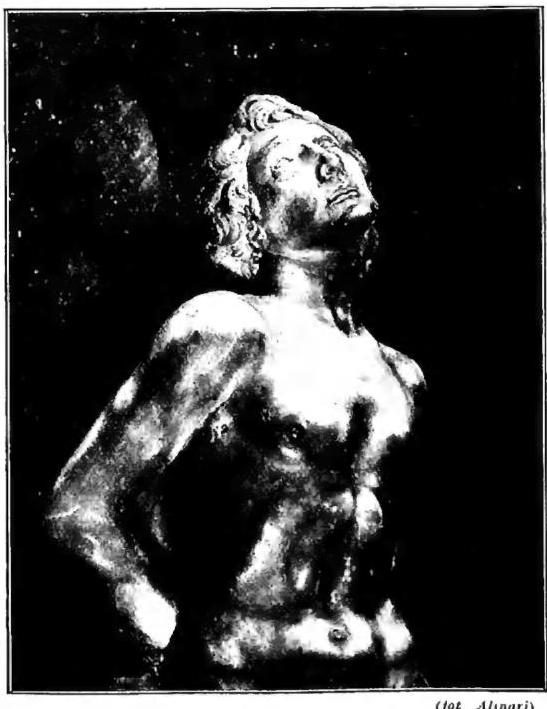
The following works may be attributed to him: several capitals in the church of S. Lorenzo in Florence (1449); the bust of Giovanni Antonio Chellini, signed and dated 1456, and the tabernacle of S. Chiara (c. 1465), both in the Victoria and Albert Museum in London; the tomb of the cardinal of Portugal in S. Miniato al Monte in Florence (1461–66), and the bust of Matteo Palmieri (1468) in the Museo nazionale del Bargello in the same city; the S. Sebastiano of Empoli (Museo della Collegiata, c. 1470); the altarpiece with the Natività in S. Maria di Monteoliveto in Naples (c. 1475); the pulpit erected in the form of a holy-water stoup in the cathedral of Prato, in collaboration with Mino da Fiesole (1473); the Madonna del latte, in S. Croce in Florence (before 1478). This list must be supplemented by many undated works, among which it will suffice to mention the S. Giovannino of the Compagnia Vanchetoni in Florence, now in the Museum in Washington; the other two in the Bargello and the Museum of Faenza; the marble reliefs with the group of the Madonna e il Bambino in S. Clemente at Sociana, in the Kaiser Friedrich Museum in Berlin, the Hermitage in Leningrad, and the Metropolitan Museum in New York (replicated in a great number of stucco and terracotta copies). Finally, two works must be added in which R.’s participation was limited: the Mazzari monument in the cathedral of Pistoia, after a design by his brother Bernardo, and the tomb of Maria d'Aragona in S. Maria di Monteoliveto, for which R. provided only the design, subsequently executed by Benedetto da Majano. Trained by his
elder brother Bernardo, with whom he had a workshop in 1457, he soon began to undertake researches of his own, evolving rapidly from a meticulous, incisive manner, defined more by contours than by masses (the Chellini bust in London), toward a soft pictorialism made up of delicate transitions and surface refinements, which clearly reveals an affinity with the manner of his contemporary and fellow-countryman Desiderio; with him he competed in the delicate and sensitive representation of childhood (the busts of S. Giovannino, for some of which the attribution still remains uncertain between the two artists). Entirely antithetical to the style of Bernardo, who in the Bruni monument had provided a solemn prototype of the wall tomb, is the tomb of the cardinal of Portugal, dissolved into an imaginative and free pictorial rhythm. In subsequent years R. alternated the broad pictorialism of the Matteo Palmieri, a masterpiece of lively portraiture, and of the pathetic S. Sebastiano of Empoli, with the somewhat worn and overloaded manner of the Monteoliveto altar in Naples (which has also suggested the intervention of an assistant); and he concluded with the plastic solidity of the Madonna del latte, perhaps executed under the influence of Benedetto da Maiano.
BERNARDO, architect and sculptor, b. at Settignano in 1409, d. at Florence on 23 Sept. 1464, brother of Antonio.
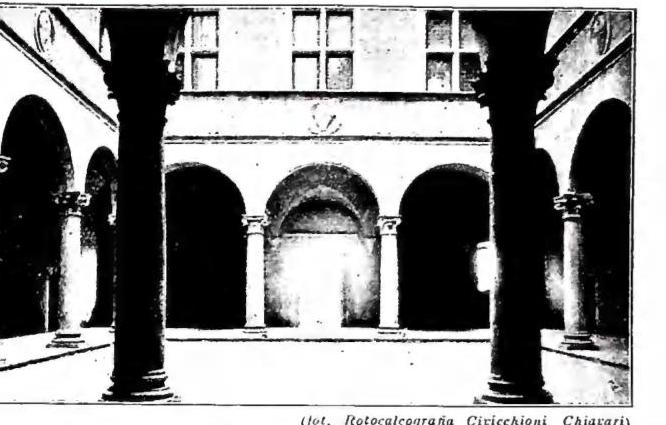
ROSSELLINO, FAMIGLIA - Courtyard of the Palazzo Piccolomini, designed by Bernardo R. - Pienza.
Of his activity as a sculptor, while his participation in the works for the chapel of Eugenio IV in the Vatican, for which the documents mention among others a “Magister Bernardus,” remains uncertain, securely attributed works are, besides the aforementioned lunette at Arezzo representing the Madonna della Misericordia, the Monument to Leonardo Bruni in S. Croce in Florence (1444-51); the Annunciation in S. Stefano at Empoli (1447); the tabernacle in S. Egidio in Florence (1450); the tombs, likewise in Florence, of the Blessed Villana in S. Maria Novella (1452-53) and of Orlando Medici at the S.ma Annunziata (1455); the tomb of Giovanni Chellini in the church of S. Miniato al Tedesco (1461); and the design for the monument of F. Lazzari in the cathedral of Pistoia (1462), executed after B.'s death by his brother Antonio. His style, rather than Donatello's sensitive dynamism, reflects the solid modelling and the ingenuous, somewhat awkward classicism of Michelozzo, though enlivened from time to time by Ghibertian curvilinear rhythms.
In Florentine sculpture of the fifteenth century, R.'s work is important for its example of a firm and organic connection between plastic and architectural elements, such as characterizes, with severe composure, the Bruni tomb, a work more of an architect than of a sculptor, which brilliantly renews, in an openly Renaissance spirit, the scheme of wall monuments. - See pl. LXXXV.
Quattrocento, Roma 1942, passim; G. Galassi, La scultura fiorentina del Quattrocento, Milano 1949, p. 138 ff. Amalia Mezzetti