
ACQUASANTIERA. — This is the vessel intended to contain holy water. When placed near the entrance doors of churches, it generally takes the form of a basin or bowl, supported by a stem and permanently fixed to the floor. As a rule, it is carved from stone or marble and sometimes, in the larger churches, assumes artistic and monumental forms. If, on the other hand, it is used to carry holy water from place to place as needed, it consists of a metal bucket fitted with a handle. The water is then sprinkled on the persons or things to be blessed by means of an instrument called an aspergillum.
The a. in churches is not, as some have claimed, a substitute for the cantharus (v. CANTARO) or fountain that in ancient times stood in the middle of the basilican atrium, where the faithful, for the purpose of inner purification, washed their hands and faces with unblessed water before entering the church for prayer.
It instead arose from the desire to provide those who had been unable to attend the Sunday sprinkling with a means of making the sign of the cross with holy water and taking some for their private devotions. Indeed, the use of the a. in churches does not predate the tenth century and is therefore only slightly later than the introduction of the solemn Sunday sprinkling. Around this same period, the synodal letter attributed to Leo IV (PL. 96, 1376) stipulates that every church rector must have a special vessel for preserving holy water. We have a magnificent example of these portable a. in the ivory bucket of Archbishop Gottofredo (tenth century), preserved in the treasury of Milan Cathedral. Several ancient vessels in metal or wood, bearing Christian emblems or inscriptions, cannot properly be called a., since they were intended to preserve water specially sanctified for use in baptism. Such are the so-called “bucket of Tunis” and other similar vessels, a list and illustration of which may be found in DACL, I, cols. 758 ff. Diocesan synods recommend that the a. be kept thoroughly clean and that the holy water in them be renewed frequently, at least once a week, and even more often. As for methods of ensuring the necessary disinfection of the a., V. the study by A. Gemelli, Il problema igienico nelle Chiese, in Scuola Cattolica, 1 (1908), pp. 375 ff.
Mario Rubietti
ART. - The forms of holy-water stoups (a.) have varied over the centuries. Some examples in a Byzantine style, such as those in the cathedral of Torcello and the cathedral of Atri, feature basins adorned with rampant animals. During the Gothic period, the stem of holy-water stoups often lost its architectural simplicity, becoming animated with figures, as in the one at S. Giovanni Fuorcivitas in Pistoia, attributed to Giovanni Pisano.
In the Renaissance, architectural simplicity in the support returned, variously enriched with fruits and garlands, as in the holy-water stoup in the cathedral of Lucca by M. Civitali and the even richer one by A. Federighi in the cathedral of Siena.
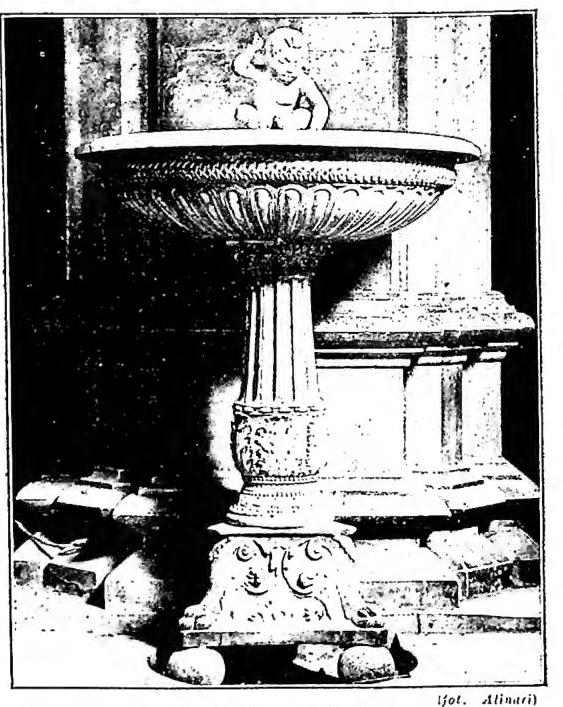

(fot. Alinari) HOLY WATER STOUP – Holy water stoup by Matteo Civitali (second half of the 15th century). Lucca, Cathedral.
(propr. B. Degenhart)
Miniature examples, which variously repeat stylistic forms proper to the minor arts and are part of furnishing accessories, are intended for private use. - Vedi Tavv. XIX-XX.