
VIATICUM. – From the liturgical point of view, the term was initially adopted to designate all the religious assistance or consolation provided to the dying (cf. can. 13 of the Council of Nicaea [325]; can. 3 of the Council of Orange [441]; Hefele-Leclercq, I, 436, 593; Gratian, Decr., 6–89; XXVI, q. 6); but it was soon restricted to designate exclusively the Eucharist and, more precisely, the Eucharistic Communion given as the final nourishment to the dying, without the obligation of fasting.
I. OBLIGATION. – By both divine law (cf. Io. 6, 54; Summ. Theol., 3ª, q. 80, a. 11) and ecclesiastical law (can. 864 § 1), in danger of death there is a grave obligation to receive the V. Nicaea, already cited, speaks of an “ancient and canonical law” (cf. Hefele-Leclercq, I, 436). Such is the urgency of this precept that, in order to provide the V. person, a priest who has no consecrated hosts at his disposal may not only celebrate without fasting and at any hour of the day or night, but may also use, for the consecration, leavened bread if he is of the Latin rite, or unleavened bread if he is of an Eastern rite (cf. can. 851 § 2).
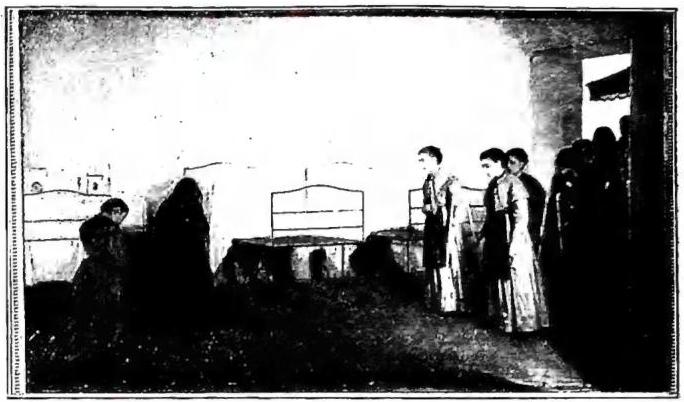
(phot. Gab. fot. naz.)
VIATICO - Viatico all'orfana. Painting by G. Toma (1836–91) – Rome, National Gallery of Modern Art.
Canon 864 § 2 settles an old question (cf. s. Alfonso, Theol. mor., 1, VI, n. 285, dub. 2, ed. L. Gaudé, III, Rome 1909, pp. 259 ff.), namely, whether someone who has received Communion for devotion on the same day is obliged or permitted to receive the v.; and it prescribes that reception of the V. is not obligatory, but highly advisable. According to some modern authors (Cappello, Coronata), the same would seem to apply when Communion was received a few days before the danger of death arose. Throughout the danger of death, it is lawful, indeed appropriate, in the judgment of the confessor, to receive the v., even without fasting, on several separate days and even daily (can. 864 § 3). Indeed, the V. death. The v., therefore, may be administered on any day, including Good Friday, and even in the event of a local, general, or particular interdict (cf. cann. 2270–71), and at any hour of the day or night.
II. SUBJECT. – Every member of the faithful who is in danger of death is obliged to receive the V. (can. 864), provided that he is capable and worthy of doing so. The obligation is not fulfilled by sacrilegious Communion (can. 861), nor is one required to observe the Eucharistic fast (can. 864 § 3).
Strictly speaking, children too are bound by the precept of the v., even if they have not been admitted to First Communion, provided that they know how to distinguish the Body of Christ from ordinary food and how to adore it reverently (can. 854 § 2). Confession itself is not required if the child is not judged capable of sin. But if there is sufficient discernment, the child should first, insofar as possible, be instructed in the truths necessary by a necessity of means, and subsequently absolved from his sins. Adults who are ignorant of the truths of religion and find themselves in danger of death are to be considered in the same way as children. Perpetually insane persons, according to the current ecclesiastical discipline, may not receive the V. The situation is different for the intellectually deficient, senile persons, and the insane with lucid intervals: these may and must receive the V. children.
III. MINISTER. - The administration of the v., whether publicly or privately, is reserved to the Ordinary of the place and to the parish priest, within the limits of their respective territories, both for their own subjects and for outsiders, except for the cases provided for by law and except in cases of necessity (cann. 848–50).
A gravely ill bishop is administered the V. Chapter, according to the order of precedence. For those residing in a religious house, it is administered by the superior (cf. can. 848, Comm. pontif. per l'autentica interpretazione del CIC, 16 giugno 1931; AAS, 23 [1938], p. 353). In a monastery of nuns, it is administered by the ordinary confessor or his substitute. In lay religious institutes or pious houses exempt from the care of the parish priest, by the respective chaplain; in a seminary, by the rector or his substitute (cf. can. 848 § 1; 850; 397, n. 3; 514; 464 § 2; 1368). In an urgent case, with at least the presumed permission of the parish priest or the Ordinary of the place, any priest may administer the v., whether publicly or privately; however, one who has already received the V. once during the same illness may receive it from any priest without requiring the permission of the parish priest or of the Ordinary of the place when the administration is performed privately: in this case, in fact, it is V. in the broad sense; provided, however, that this is done within the limits and according to the norms indicated by cann. 847, 849 § 1.
In a situation of general necessity (persecution, war, epidemic), if no priest can be found (even one under excommunication vitandus, or after a condemnatory or declaratory sentence: can. 2261 § 3) or deacon, and it is impossible to apply to the Ordinary for authorization, it is commonly taught today, in conformity with the primitive custom of the Church, that any layperson, presuming the permission, may administer the v., evidently taking into account the skill or aptitude of the ministering person. With even greater reason, in a case of particular necessity, a layperson may administer the v., provided there is no danger of irreverence or profanation.