
OTTATO of MILEVI in Numidia (Optatus Miletianus), saint. — Bishop of this city in the fourth century, known for his polemical work against the Donatist Parmenianus.
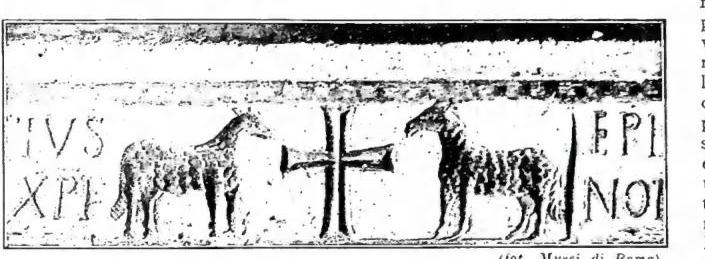
(photograph: Musci of Rome)
OTRICOLI — Detail of the inscription on the altar erected by s. Fulgenzio in honour of the martyr s. Vittore: «Tubante Deo Fulgenius episcopus invenio corpore: Beati Martyris Victoria in xpi nomine super altarem construxit». Otricoli, church of S. Maria.
perhaps also somewhat earlier, that is, a short time after the death of Giuliano l’Apostata, the condemnation of Fotino pronounced by Italian bishops in 363, and Parmeniano’s own writing (in that case, the name of Pope Damaso would also have been added to the list of the Roman pontiffs in II, 3; cf. 4). In the second edition, in response to new attacks by the Donatists, O. added Book VII and introduced, as mentioned, further revisions, after 384. The work has come down to us in this form, but certainly before receiving the author’s final revision; it was therefore disseminated after his death.
O.’s writing is important not only for the information it provides on the origin and history of Donatism, and even more for an interesting appendix of documents (Gesta apud Zenophilum, etc. [V. DONATISMO]; in the sole Paris manuscript 1711, eleventh century, formerly Colbertinus 1951), probably collected by O. himself; and because, in the face of an entire Donatist literature, it is the only pre-Augustinian Catholic work, which s. Agostino made extensive use of; but also from a theoretical point of view. O., in fact, while also accepting in part principles already admitted by his opponent and developing (as did Parmeniano as well) ideas already expressed by s. Cipriano, endeavours to define clearly and precisely what the true, Catholic Church is: rationabilis et ubique diffusa (II, 1, cf. 2), characterised by the unitas animorum and by possession of valid Sacraments (I, 11), as well as being the true bride of Christ endowed with the mystical dotes, of which Parmeniano also speaks (I, 10; II, 2; 9; etc.). He therefore sharply distinguishes «heresy» from «schism» and asserts with equal clarity that sacramenta per se esse valida, non per homines. For these reasons O.’s work was read attentively by the Anglicans of the «Oxford Movement» in the last century and exerted a certain influence on the future Cardinal Newman.
A sermon relating to a feast in the Christmas cycle has survived (it speaks of the Incarnation and birth of Christ, the adoration of the Magi, and the Massacre of the Innocents). It was published by G. Morin (1917) and by A. Wilmart (1922), who attributed it to O.; various conclusions concerning the history of the liturgy have been drawn from II. It instead expresses (an argument not so far contradicted) ideas too closely akin to those of the Donatists for it to be attributed to the defender of the Catholic Church; it could be the work (and this would explain the title of the Floriscense manuscript) of that other O., who was a fanatical Donatist bishop of Thamugadi, a contemporary of s. Agostino, and regarded by his own followers as a martyr.
p. 268 ff.; A. Ferrua, I più antichi esempi di « basilica » per « aedes sacra » (nell'append.: prima del 330), in Arch. glottol. ital., 25 (1931-33), p. 142 ff.; V. DONATISMO. Alberto Pincherie