
CHAIR OF SAINT PETER, FEAST of. - It is not a question of the material chair or seat, but of the magisterium of s. Pietro. Here c. is synonymous with sedes.
Typical is the statement of s. Cipriano, inspired by s. Paolo (Ephes. 4, 5): «Deus unus est et Christus unus et una ecclesia et cathedra una super Petrum Domini voce fundata» (Ep., 43, 5); a concept found again in the anonymous poem Adversus Marcionem (III, 9: PL 2, 1077): «hac cathedra, Petrus qua sederat ipse...»; and still more clearly in Ottato di Milevi: «in urbe Roma Petro primo cathedram episcopalem esse conlatam, in qua sederit omnium apostolorum caput Petrus, unde
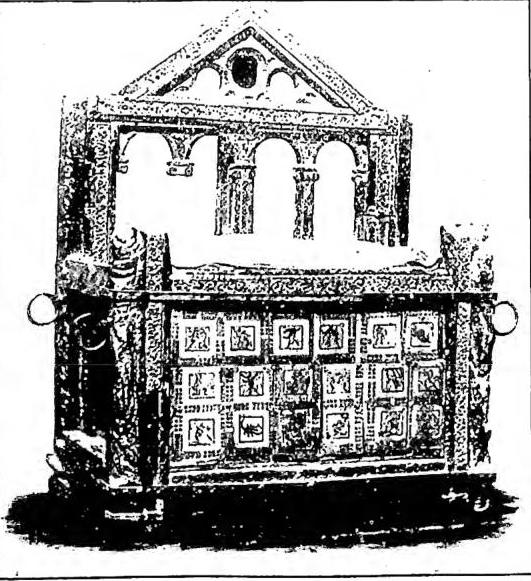
Thus the cathedra Petri is the chair of the primacy and unity of the Church’s doctrine.
As for the institution of the feast of the cathedra Petri (22 February), the natale Petri de Cathedra is already found in the « Depositio martyrum » (4th century). This solemnity is explained as follows by St Augustine (d. 430): « institutio solennitatis hodiernae a senioribus nostris cathedra: nomen accepit ideo quod primus apostolus Petrus hodie episcopatus cathedram suscepisse referatur. Recte ergo Ecclesiae natalem sedis illius colunt, quam Apostolus pro Ecclesiarum salutem suscepit » (Serm. 190, 1: PL 39, 2100).
The date of 22 February is therefore that of the beginning of St Peter’s Roman episcopate. This is also confirmed by the catalogue De vigiliis et ieiunii of Perpetuus of Tours (460), in which we read: Natale s. Petri Episcopatus (Gregory of Tours, Hist. Franc., X, 31); by canon 22 of the Council of Tours of 567 (Hefele-Leclercq, III, 1, p. 191); and by the marble Calendar of Naples (9th century), which, on the date—notice carefully—of 12 February, records: Dies quo electus est s. Petrus Papa.
In the Hieronymian Martyrology, on the other hand, there is a second solemnity of the Cathedra Petri on 18 January. This feast is of Gallican origin and does not appear to be earlier than approximately the middle of the 6th century. Interesting in this connection is the notice found in the Martyrology of Gellone, cited by Mabillon (PL 72, 181): XV Kol. Febr. secundum Gallos Cathedra s. Petri apostoli.
The text of the Hieronymian Martyrology compiled at Auxerre gave the title Cathedra romana to the feast of 18 January and the title Cathedra Antiochema to that of 22 February; this distinction has no value, either historical or liturgical.
The introduction of the solemn Lenten stations and their importance in the Roman liturgy from the 6th century onward caused the feast of 22 February to fall into disuse at Rome, because it almost always occurred during Lent, to such an extent that it is not found in the ancient Gelasian and Gregorian sacramentaries. This feast nevertheless continued to be celebrated in the Gallicias and in Spain, as is attested by the various manuscripts of the 8th-century Gelasian Sacramentary, the Lectionary of Silos, and the Mozarabic Sacramentary. After the year 1000, the observance of 22 February again began to appear in liturgical books of the Roman type, and it is not uncommon to find in manuscripts either both feasts (18 January and 22 February), or only one or the other. On 6 January 1558, Paul IV decreed that both feasts should be celebrated throughout the universal Church, with double rite (cf. Bullarium Rom., VI, Turin 1860, pp. 531–32). On the two occasions, the liturgical formularies are identical, except for the lessons of the second and third Nocturns.