
CATTEDRA. — From the Greek καθέβρα: a seat with a more or less high sideboard or backrest, often provided with a cushion. The c. could be made of stone, masonry, or tufa and thus be fixed, or of wood or wicker and therefore movable; it was often covered with fabric; in the biography of s. Cipriano written by the deacon Ponzio, the sedile linteo tectum is mentioned (ch. 16), and Paciano of Barcelona recalls the sedes linteata (Ep., 2, ad Symphonianum: PL 13, 1059). The c. is the privilege of the bishop (Ep., 67, 2); it may be an attribute of dignity of the teacher, the judge, or the philosopher; it is sometimes also found carved in certain Christian cemeteries of Rome. As an attribute of dignity, it is given first of all to God the Father, to Jesus Christ, to the Madonna, to the Apostles, and to the saints.
God the Father is seated on a veiled c. in the act of receiving the offering of Cain and Abel (Wilpert, Sarcofagi, pl. CXCI, 5 and 9). Sometimes both Jesus Christ and the apostolic college are seated on a c.; in cemetery paintings, examples are found in Bassilla, Domitilla, and Marco e Marcellino (Wilpert, Pitture, pl. CLII; CXLVIII, 2; CLXXVII, 1-2); likewise on sarcophagi, as, for example, on that of Rignieux-le-Franc (v. APOSTOLI); in Domitilla, besides the Lord, the apostles Pietro and Paolo are also seated (Wilpert, Pitture, pl. CXCIII); other examples, however, show only the Lord seated on a c. (Wilpert, Pitture, pl. CXXV, 1-2; Sarcofagi, pl. CXXVIII, 3; XXXIV, 2, 3; XLII, 3; XLIII, 3, 5).
Christ teaching from a c. with the evangelists: a typical example is provided by the fragment of a sarcophagus lid
found at Spoleto, now in the Lateran Museum (Wilpert, Sarcofagi, p. 107, fig. 52); Christ is seated on a c. in the boat, precisely according to the text of s. Luca sedens docebat de navicula turbas (5, 4-6).
In paintings, the scene of Christ teaching among the evangelists is found in the cemetery called that of Marco e Marcelliano (Wilpert, Pitture, pl. CLXII). Jesus Christ on a c. and martyrs in gold glasses (R. Garrucci, Vetri ornati di figure in oro, Roma 1864, pl. XIV, 4).
Christ on a c. among saints in Callisto (Wilpert, Pitture, pl. CCXLIII, 1) and in Ponziano (ibid., pl. CCLXI); among saints and the dead (ibid., pls. CXXIV-XXVI).
Christ as judge. — The most expressive scene is that on a marble funerary slab in which the deceased Teodulo is depicted before Christ the judge (θεανάτης ἡμῶν) in the cemetery called that of the SS. Marco e Marcelliano (Wilpert, Pitture, p. 434, fig. 41); other scenes of Christ as judge on a c. in cemetery paintings are found in Wilpert, Pitture, pls. LXXV, CXCVI, CCV, CCXLVII.
Madonna on a c. in the scenes of the Epiphany, in paintings such as those in Domitilla (Wilpert, Pitture, pl. CXLI), in Callisto (pl. CXLIV, 1), at the Maius (cf. E. Josi, Coemeterium maius, in Riv. di archeol. crist., 10 [1933], pp. 7-16), in Marcelliano e Pietro in several examples (the finest in Wilpert, Pitture, pl. LX); on sarcophagi: the veiled c., as at the Lateran (Wilpert, Sarcofagi, pl. CCXXIII, 5), wicker (ibid., pls. XXVI, CCXIX, 2 and 3; CCXXII, 2 and 7; CCXXIII, 11; CCXXIV, 5); simple c. (pls. CCXIX, 1; CCXXII, 6).
The apostles Pietro and Paolo are shown on a c. in gold glasses (R. Garrucci, Vetri ornati di figure in oro, Roma 1864, pl. XIV, 4).
S. Pietro is represented twice on a wicker c. in Christian sarcophagi.
Saints seated on a c. are found in cemetery paintings (Wilpert, Pitture, pls. CCV, CCXLIII, 1).
The bishop or presbyter is on a c. in the marriage scene in Priscilla, in the cubiculum called that of the veiled woman (Wilpert, Pitture, pl. LXXXVI).
The judge who orders the three Hebrew youths to worship the statue of Nabuchodonosor is also on a c., in the cubiculum of the martyr Crescenzione in Priscilla (Wilpert, Pitture, pl. CXXIII); likewise the judge seated at the trial of the two elders of Susanna in the reliquary of s. Nazario (Venturi, I, pp. 446, 549-50), just as a merchant is depicted on a c. in the sarcophagus of Lambrate, now in the ca-
Wilpert recognizes as scenes of teaching from a c. those on marble slabs found in Pretestato (Wilpert, Sarcofagi, p. 193, figs. 114 and 115). An isolated c. carved in marble is in the cemetery of Pretestato (ibid., p. 194, fig. 116). Finally, the mother with the child is on a c. in the aforementioned cubiculum of the veiled woman in Priscilla (Wilpert, Pitture, pl. LXXIX).
Regarding the c. as an attribute of a teacher, one should recall
(fol. Alinari)
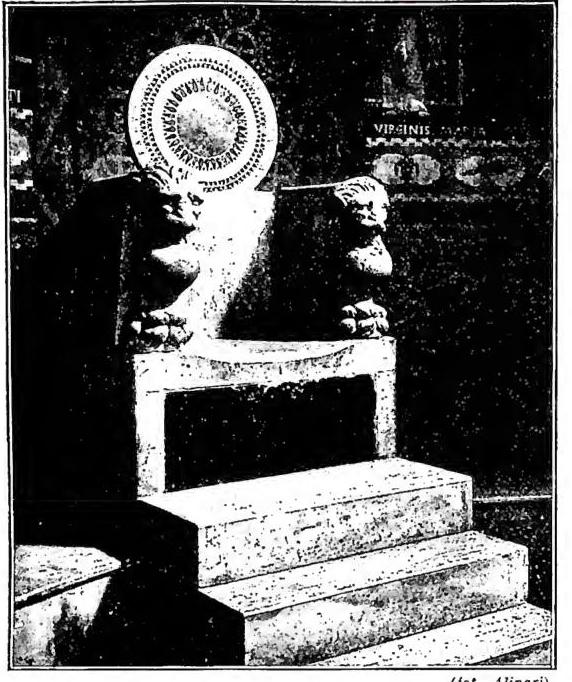
CATTEDRA - Reliquary c., so-called of St. Mark, in Eastern cipollino marble with sculptures from the 6th–7th centuries - Venice, treasury of St. Mark.
that in the well-known statue of St. Hippolytus, now in the Lateran Museum (a work of the 3rd century found near the Via Tiburtina), the martyr is represented seated in a c., as in other philosophical images. On the sides of the c. (with a low backrest) were engraved the list of the master’s works and his computation of Easter. The bronze statue of St. Peter in the Vatican may also be considered a representation of a teacher in a c.; some continue to regard this work as belonging to the late Middle Ages and as the work of Arnolfo di Cambio, whereas it is probably to be attributed to the late Empire. The apostle makes the gesture commonly interpreted as a blessing, whereas it is an allocutionary gesture. Needless to say, the figure of the Lord in the scene of Christ’s Teaching is also seated. But in the mosaic of S. Pudentiana (early 5th century), rather than a teaching scene, there is truly the Maiestas Domini, and in this case the c. is genuinely the throne.
As regards episcopal c., mention should be made of the wooden c. venerated as an illustrious relic near the confession of the Apostle in the Vatican. Its present form is certainly not the primitive one. Its ivory coverings are relatively late. But it seems to contain remains of a much more ancient c., as was thought when Bernini’s bronze casing was opened in 1876 and the chair was publicly exhibited. A definitive judgment is reserved for a further examination. The Church of Jerusalem boasted of possessing the c. of the apostle James: so Eusebius states (Hist. eccl., VII, 19). Not usable, however, but purely a reliquary c., is the marble one in the treasury of S. Marco in Venice. The cavity visible in it indicates the setting of a relic, now lost. The strange reliefs visible upon it (the Agnus Dei on the mountain, symbols of the evangelists with cherubic wings, etc., and then the images of the four evangelists asleep, in a separable roundel) indicate an imported Eastern work of the 6th–7th centuries. A curious graffito in possibly Eastern characters on the seat has not yet been satisfactorily explained. It would be erroneous to think of a cult of the c. This proves that Christianity possessed an idea of what the c. represents in relation to the Church; but there was no adoration of the c., as could occur in antiquity, in Asia and Greece (v. W. Reichel, Über vorhellenische Götterkult, Vienna 1897, pp. 3 ff. and 88 ff. and cf. also certain connections, not always adequately substantiated, in P. Durand, Etude iconographique sur l'Etim Asia, etc., Paris 1867). Even when a relic of a c. was possessed, the respect shown to it did not, in the intentions of the Church, exceed ordinary veneration.
The place of the episcopal c. in the pre-Theodorian domus ecclesiae at Aquileia is marked by a trapezoidal mosaic panel with sparse decoration at the rear of the presbytery (Anon., La Basilica di Aquileia, Bologna 1933, pls. XVII and CV). Evidently a wooden c. was to be placed there during the synaxes. Later, in basilicas, the place of the episcopal c. was ordinarily at the rear of the apse, in the middle of the clergy’s benches, and most often in an elevated position. The cemetery basilica of the cemetery of Domitilla on the Via Ardeatina (390–95) has at the rear a niche marking the place of that c. from which St. Gregory the Great delivered a famous homily (Hom. in Evang., II, hom. 28: PL 76, 1210–16; O. Marucchi, Catac. rom., posthumous ed., Rome 1933, pp. 148–51 and 158). The association of St. Gregory the Great with a classical sella curulis at S. Gregorio al Celio is merely legendary.
It would be lengthy to list the various episcopal c. of basilicas and Christian churches, often adorned with mosaics and coloured and enamelled stones; marble c. on which cushions were to be placed. It seems interesting, however, to recall the Lateran papal c. (not the present one, which is modern, but the remains of the medieval one preserved in the cloister). There, on the first step, is a representation of demonic animals, with the intention that they should be trodden underfoot by the Pontiff. The c. is of ancient form. Above it there is also the detail of a Gothic tabernacle. It is known that there was an inscription in Leonine verse exalting the sublime presidential function of the Vicar of Christ and the legitimacy of the Roman See. The inscription ended: « Nec debet vere nisi solus papa sedere. Et quia sublimis alii subduntur in imis » (O. Marucchi, Basiliques et églises de Rome, 2nd ed., Rome 1909, pp. 88–89). The verses must have belonged to an earlier phase of this c. (perhaps the 11th or 12th century).
A grand idea of Byzantine splendour is expressed in the c. of the Euphrasian basilica at Poreč. It is made of Greek marble. Above the backrest, the inlay forms a field decorated with mother-of-pearl crosses; at the sides are two candlesticks (B. Molajoli, La basilica eufrasiana di Parenzo, Parenzo 1940, p. 44). The c. standing at the rear of S. Vitale in Ravenna is modern and is inspired by the type at Poreč. Of considerable historical importance, on the other hand, is the 11th-century c. in the cathedral of Salerno. Pope Gregory VII certainly must have sat upon it (the work has been carefully analysed by the architect A. Schiavo). Remains of an c. with “barbarian” sculptures from the 8th century were used to encase a tomb in the presbytery of the oratory of the Lombard nuns at Cividale del Friuli (the so-called “Lombard Temple”; V. in C. Cecchelli, Monumenti del Friuli, etc., I, Cividale, Milan–Rome 1943, pl. LXII and p. 275, fig. 69). The episcopal c. of the basilica of S. Clemente in Rome (12th century) is distinguished by a broad rota on the backrest (C. Cecchelli, S. Clemente, Rome n.d., pp. 96–98 and 166). This is a type that would be repeated several times in the late Middle Ages (for example, in the cathedral of Anagni). It is curious that the backrest is an Early Christian marble reused for the purpose. It bears the inscription: martyr (it comes from a dedication dating from the time of Pope Siricius, 384–98). The high-backed c. of S. Lorenzo extra muros and S. Balbina are exceptionally rich in “Cosmatesque” work (A. Muñoz, Roma di Dante, Milan–Rome 1921, pp. 126–27).
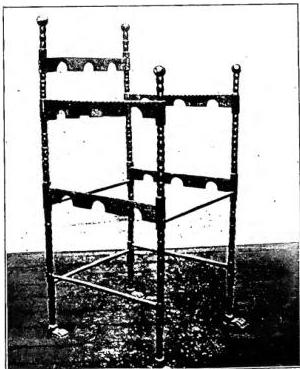
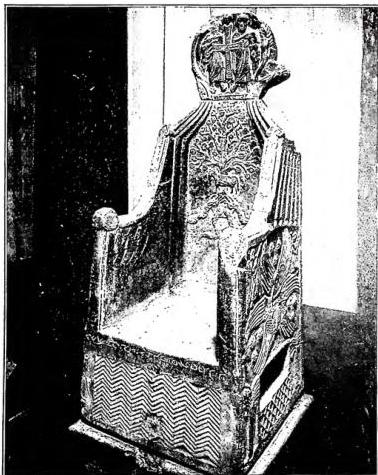
Moving forward several centuries, one notes that a rare example of a wooden episcopal chair (still preserving its cushion) from the end of the Duecento is found in the cathedral of Anagni. It has Gothic arches (A. Muñoz, op. cit., p. 327). A Romanesque abbey chair stands in the monastery of Montevergine (12th–13th century), but it has been completed with lateral parts (fig. in P. Toesca, Storia dell'arte italiana, I, Turin 1911, p. 1101). It displays wooden carvings with animal figures which, although the work of southern craftsmen, are inspired by northern subjects. In iron is the so-called “c. of St. Barbatus” in the cathedral of Benevento; it is a tall seat, perhaps from the 11th century (P. Toesca, op. cit., p. 1103). Advancing several more centuries, mention should be made of a fine piece of furniture from the end of the 16th or beginning of the 17th century, namely the c. of St. Robert Bellarmine preserved in Rome in the sacristy of S. Maria in Via (C. Cecchelli, S. Maria in Via, Rome n.d., pp. 54–55). Of another great saint (St. Philip
CATTEDRA – Wrought-iron framework of the so-called chair of s. Barbato (11th century) – Benevento, Cathedral.
CATTEDRA – CATTEDRA DI S. PIETRO
(Alinari photograph)
CATTEDRA - Episcopal c. with Alfano’s dedication to the Virgin (early 13th century) - Rome, church of S. Maria in Cosmedin.
Neri) is attributed (though it is a modest object) the c. which in the Chiesa Nuova in Rome still serves today for certain catechetical instruction.
In the Coemeterium maius of Rome (Via Nomentana), several c. can be observed, sometimes with a high back, at other times with a low back rounded at the top, carved out of tuff and located near tombs. They have also been found in the cemetery of Panfilo (on the Via Salaria) and elsewhere. Bosio and Marangoni saw some within the hypogea of the Agro Verano on the Via Tiburtina. It was believed that such c. had served as liturgical furnishings; but the fact remains that various circumstances make them unsuitable for this purpose. Their use by an adult seems impossible. The idea that they were carved in memory of the c. of s. Pietro has also disappeared. A certain analogy has therefore emerged with pagan funerary monuments, in the sense of a reference to the condition of the deceased in the afterlife. At bottom, this is also the conception underlying the funerary banquet. The survivors banquet beside the tomb, mindful of the departed, who thus enjoys refreshment in the hereafter. It is therefore an assimilation and a propitiation.
There are various representations of the deceased in c. in antiquity (e.g., the relief from Chrysapha near Sparta preserved in the antiquarium of Berlin; the relief from the Villa Albani in Rome, etc.). At times the deceased, seated, raises the vessel of libation, while before him stands the table of offerings (e.g., the Hittite relief from Zengirli, which passed into the Kais. Friedr. Mus. of Berlin). Subselli, c. are found inside tombs (the funerary chamber near Eretria in Euboea; the Etruscan tomb of the “Chairs and Shields” near Cerveteri; the Roman burial chamber at Weiden, near Cologne, etc.). Certain Christian scenes in which the deceased makes a libation while seated, or standing, do not differ from pagan ones (e.g., a figurative titulus in the catacombs of Ciriaca, and then another from Anagni originating in a Roman catacomb). Here, however, one must distinguish between the simple expressive means and what is instead the spiritual content. Jesus too said that he would drink wine with his Apostles in the kingdom of his Father (Mt. 26:29), and mention is made of twelve thrones on which the Apostles would judge the twelve tribes of Israel
(Mt. 19:28). Who would seriously dare to assert that Jesus was speaking of a real banquet and material thrones? The pagan tendencies of the people translated beatitude into material manifestations. Already in Jewish usage the funerary banquet assumed a moral character. Among the salutary admonitions given by Tobit to his son is this: “Place your bread and your wine upon the tomb of the righteous, but do not eat of it together with sinners” (Tob. 4:18). Thus, if the c. served in connection with the funerary table, they were intended to indicate that there was a person there who was regarded as a “righteous one.” The c. was the place of the deceased, felt to be present and placed in the same dignity in which he was contemplated in heaven. - Vedi Tavv. LXVI-LXVII.