Machine translation of the 1948–1954 Italian original. The original text is authoritative.
VAN DYCK, ANTON. - Painter, born in Antwerp on March 22, 1599, died in London on Dec. 9, 1641.
He attended Rubens's workshop in Antwerp, but as early as 1616 he opened a studio on his own account; three years
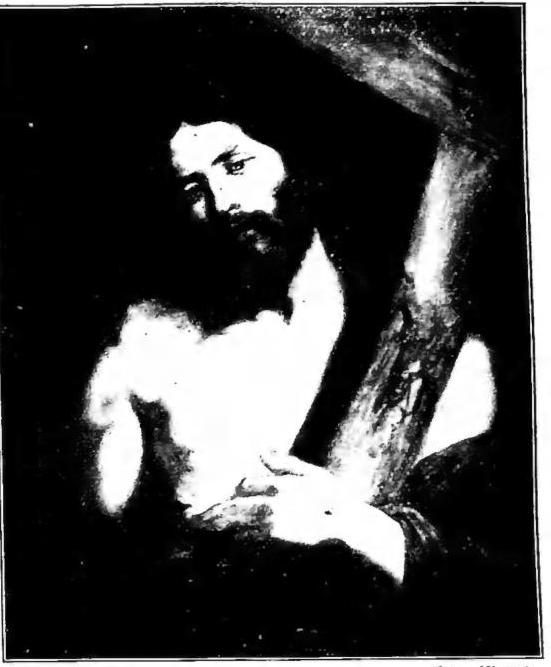
(phot. Alinari) VAN DYCK, ANTON - Risen Christ with the Cross - Genova, Palazzo Rosso, Galleria.later he began an effective and valued collaboration with that great master. In 1620-21 he worked in Londra for Giacomo I and the Count of Arundel; toward the end of 1621 he was in Italia, staying successively in Firenze, Roma, Venezia, Mantova, Parma, Napoli, and Palermo; but especially in Genova (1623-27), where, greatly admired, he portrayed the likenesses of the city's patricians and exerted a beneficial influence on local painters, especially in portraiture. After the years 1628-32, spent in Anversa, in 1632 he was summoned to Londra by Carlo I and appointed painter to that Court. There he spent almost all his final years, amid a ceaseless demand for portraits for the sovereign and the aristocracy, which were often executed with the assistance of workshop hands, revealing the substitution of clever virtuosity for what had been the prodigious vein of an exceptionally personal and refined colorist. It will suffice to mention, among the male portraits, the superb Carlo I d'Inghilterra (Louvre Museum), in hunting dress, with the pawing horse behind him in the shade of an emerald tree; the young Lord Filippo Wharton, known as "the gentleman of the spade" (Ermitage of Leningrado); the equestrian Duke Tommaso di Savoia Carignano (Pinacoteca of Torino); the pensive and forthright Marchese Cattaneo (National Gall. of Londra); and the pale, bald Card. Guido Bentivoglio (Pitti Gall. in Firenze). No less perspicuous and evocative among the female portraits appear his wife Maria Ruthven (Gall. of Monaco); the dark-haired Princess Maria Luisa di Turn e Taxis (Liechtenstein Gall. in Vienna); the austere Princess Isabella Clara Eugenia di Spagna, superior of the Poor Clares (Gall. of Parma); and the Princess of Orange, Amelia di Solms (Pinac. di Brera in Milano).
While the pupil of Rubens does not assume in his sacred production the historical and aesthetic importance of the master of Anversa, and in the youthful cycle of the Twelve Apostles does not depart significantly from the master's realistic forms, imitating his passionate fervor in several Flagellations, Pietàs, Crucifixions, and Ecstasies of Saints, absolute originality and profound elegiac feeling must instead be attributed to the Dead Christ of the Museum of Anversa, with the dark Nazarene stretched out upon the dazzling, pure white shroud. The influence of the
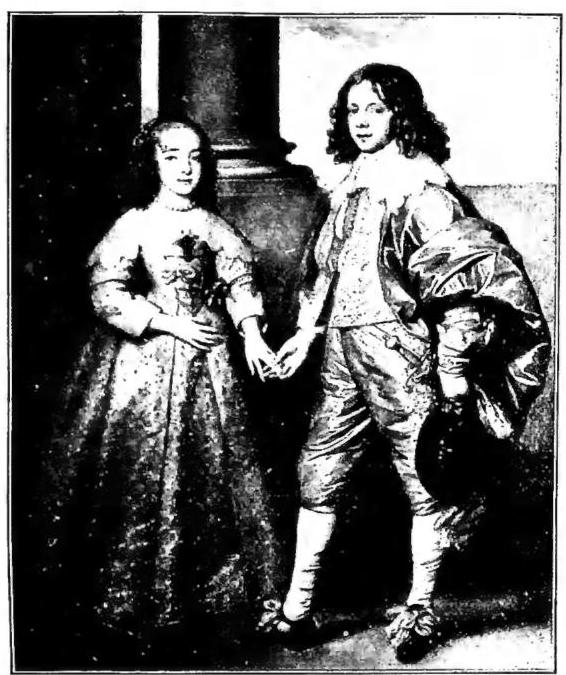
(photo of the Museum) VAN DYCK, ANTON - Portrait of William II of Orange and Mary Stuart - Amsterdam, Rijks Museum.The influence of the Italian schools, from Titian to Andrea del Sarto, is visible above all in the monumental Madonna del Rosario (oratory of the same name in Palermo); more expressive are the Madonna col Bambino (Gall. naz. di Arte antica in Rome); the Riposo nella fuga in Egitto (Munich); the Vergine fra gli angeli adoranti (Accademia di S. Luca). Reaching the pinnacle are Sansone e Dalila (London); S. Martino che divide il suo mantello (Windsor); and finally, the Cattura di Cristo (Prado Museum), where one can see how even elements derived from Rubens are employed in an emotional order, without the phantasmagoric effect of the torches among the gloomy foliage detracting from the radiant serenity of Christ, set upon from all sides amidst the tumult of outstretched arms and vociferous, demoniac masks. - See pl. XCII.
BIBL.: J. Guiffrey, A. V. D. Sa vie et son oeuvre, Paris 1882; F. M. Haberditzel, Dyck, in Thieme-Becker, X (1914), pp. 263-70, with previous bibl.; R. Oldenbourg, Studien zu V. D., in Münchener Jahrb. d. bild. Kunst, 9 (1914-15), pp. 224-240; W. Bode, A. V. D. als Mitarbeiter von Rubens, in Holländische und vlämische Meister, Leipzig 1917; A. L. Mayer, A. V. D., Munich 1923; D. Redig de Campos, Intorno a due quadri d'altare del V. D. ecc., in Boll. d'arte, 30 (1936-37), pp. 150-65; C. Mercenaro, Opere ined. di A. V. D., in Bull. de l'Inst. hist. belge de Rome, 19 (1938); L. V. Puyvelde, V. D., Brussels-Amsterdam 1950; W. L. Valentiner, V. D.'s character, in The Art Quarterly, 13 (1950), pp. 97-104. Alberto Neppi
Cite this article
“VAN DYCK, ANTON.” Enciclopedia Cattolica, vol. XII (1954), p. 629. Azione Romana digital edition, https://azioneromana.com/article/van-dyck-anton.