
VETRO. — The most remote examples of glassmaking with an artistic character in the Mediterranean basin date back to the Eighteenth Dynasty of the Egyptian Pharaohs (1550 B.C.) and are represented by tiny polychrome balsamaria, in which the decoration was obtained by pouring a thread of molten enamel over the vessel in spirals.
But this art subsequently underwent a more substantial development in the centers of Phoenicia, and particularly at Sidon, with glass vessels blown within clay molds; from there, vases, cups, and bottles were imported into Etruria (as attested by the tombs dating between the 7th and 5th centuries B.C.), while at Pompeii and in Augustan Rome blown glass vessels of considerable size were produced under the influence of Syrian and Sidonian artists. During the subsequent imperial period, glass in the Greco-Egyptian style was produced at Alexandria, in which technical virtuosity displayed every kind of streaking, winding motifs, milky spirals, stars, rosettes, tiles with masks and flowers, as well as scratching and grooves obtained through the use of the wheel, and gilding by applying thin sheets of metal. There were no technical innovations during the early Christian and Byzantine periods, which saw the art of glassmaking transferred to the East, enriched with chromatic motifs, especially in the pastes used for goldsmithing and in mosaic tesserae, and then into the Arab world. After the 11th century, Western Europe revived forms and methods of execution, and substantial production arose at Altare, in the province of Savona, and at Venice. From there, in the later 13th century, these industries became concentrated on the island of Murano, where the fourteenth-century master Giovanni Fioler became renowned, and, in the following century, the workshop of Angelo Barovier and his son Marino, who produced characteristic blue vases and “lattesini,” as well as enamelled works of splendid colors, such as the nuptial cups in the Museums of Murano and Bologna, the glass in the National Museum of Florence, depicting the Triumph of Justice, and the large dish in the Civic Library of Trento with a purple background patterned like jasper and a
wind, also of Constantina, daughter of Constantine the Great, was acclaimed emperor at Sirmium (March 350).
Constantius II, before marching against Magnentius, deemed it advisable to eliminate V.; he therefore proposed an alliance to him and invited him to a conference. But, taking the floor, Constantius, who had already distributed rich gifts to the soldiers, succeeded, by recalling his father’s merits, benefits, and wishes, in having the principle accepted that all usurpers should be eliminated. V., seeing himself abandoned, threw himself at Constantius’ feet and asked forgiveness; he was stripped of the purple and relegated to
a Byzantine-style frieze of vine leaves and bunches of grapes, birds in flight, and peacocks. For more than three centuries, the Murano artisan dynasties bestowed upon blown glass an incomparable prestige through slender, elongated forms, with applications of filigree sheets (in a latticework pattern), opalescent effects, engravings, and imitations of precious stones, as well as with margarite, or pearls, obtained by cutting the polychrome glass rods used to form the vessels known as millefiori. But the most artistically evocative expression of fifteenth-century Italy in this field is that of gold glass with graffiti, in which the thin metal leaf was fixed with egg white and scratched with the point of a needle. The oldest work of this type is a very refined Madonna in the Civic Museum of Turin, attributed to Lorenzo Monaco, in which various hues show through beneath the graffiti. Also in the 15th century, a characteristic production began in Germany and especially in Bohemia, where crystal, with its brilliant reflections and suitability for cutting, came into prominence. During the Baroque period, France, which had held supremacy in the 14th century through its stained-glass masters, developed, through the Parisian Lucas de Nehon (second half of the 17th century), the manufacture of sheets by casting and rolling; at the same time, in England, lead crystal, called flint, was becoming fashionable. Eighteenth-century production appears to have been dominated by the German factories of Nuremberg and Augsburg, with their work carried out by wheel and diamond point, and by those of Bohemia, whose methods were adopted by Giuseppe Briati of Murano for his large mirrors, alforni of flowers in relief. The industrial progress of the last century made the manufacture of glass objects mechanical and mass-produced, and only in recent decades have the furnaces of Murano regained their prestige, placing their traditional craftsmanship at the service of the new decorative aesthetic.

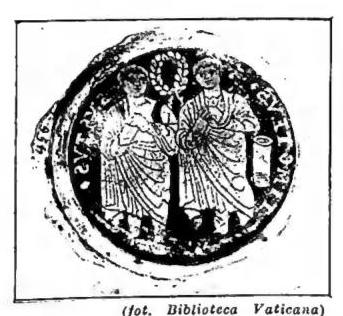
(Vatican Library photograph)
GLASS – Portrait of a certain Eusebius. Gilded glass of the 3rd century – Sacred Museum of the Vatican Library.
as might be demonstrated by a glass vessel from the cemetery of Callistus, in which, among the other representations, one is thought to be recognizable that displays the iconographic type characteristic of this Emperor. Similarly, one of the oldest examples, bearing the inscription « Potita propina », comes from the same cemetery. In general, archaeologists agree in assigning the gilded glasses to the 3rd century and, especially, to the 4th.
The glasses are for the most part the bases of cups, whose figures or inscriptions had been executed so that their obverse corresponded to the inner part of the cup itself, so as to be more easily seen or read by whoever used II. Their size ranges, for the largest, from 8 to 10 cm and more; the smaller ones are less than this, some measuring 3 cm. The inscriptions are almost always in Latin; those in Greek or in Greek-Latin are not lacking; at times they display orthographical errors and the interchange of letters (Critus - Zeus). According to some, cups of glass with Christian subjects served for the celebration of Mass, or at least for the distribution of Communion, or finally for agapes over the tombs of the martyrs. Regarding the Eucharistic use of glass vessels, especially of the patenae (glass disks, not cup bases; particular mention should be made of the two patenae known as those of Cologne), in the 6th century the author of the Liber Pontificalis attributes to Pope Zephyrinus (199-217) the order to use glass patenae during the celebration of Mass, and writes that Pope Urban (222-30) prescribed the use of silver patenae (Lib. Pont., I, p. 139, n. 3 and p. 143, n. 2). In conclusion, as regards cups with gilded bases, it may be said that they served every purpose of civil and family life, not only for Christians but also for pagans, as can easily be inferred from the subjects represented on them, which are highly varied: mythological (Achilles and Deidamia, the labors of Hercules, Minerva, Pluto, Serapis, Ceres, etc.), theatrical, gymnastic, hunting, domestic, rural scenes, and occupations.
Placed over the tombs, the cups suffered very serious damage and destruction at the hands of the looters of the cemeteries, who broke them up in order to sell the fragments, with the base often remaining fixed in the mortar of the burial niches. This practice is traced back even to the earliest times, and the blame is laid on the Jews, itinerant vendors, especially in Trastevere, who used broken glass vessels for small-scale commercial exchanges, with reference being made to a passage of Martial: «... transtiberinus ambulator / qui pallentia sulphurata (« zolfanelli) fractis / permutat vitreis... » (Epigrammi, I, 41 [edd. antiche, 42], vv. 3-5), or also to one by Statius: « hic plebs scenica quique communitis / permutant vitreis gregale sulphur » (Silvae, I, 6).
as properly hagiographical: the Good Shepherd, the Madonna, SS. Peter and Paul, often together with Christ, sometimes indicated by the letter X, the Evangelists, saints, pontiffs, SS. Lawrence, Hippolytus, Timothy, Cyprian, Agnes, and others, in groups or individually; there are also those with scenes from the New Testament: the wedding at Cana, the resurrection of Lazarus, Moses, Peter striking the rock
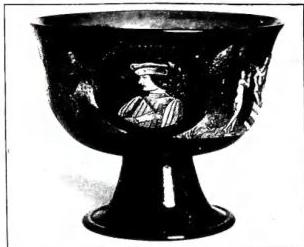
(photo by Fiorentini) VETRO - Nuptial cup known as that of the Barovier, with the portraits of the spouses painted in enamel (15th century) - Murano, Museo vetrario.
In the engraved inscriptions, the concept of drinking and living recurs almost always, often in Greek written with Latin letters: « bibe et propina, pie zeses, vivas cum parentibus tuis, pie zeses cum Donata, piete zesete - propinate, refrigeris in pace Dei, spes hilaris, zeses cum tuis, dignitas amicorum vivas cum tuis feliciter, hodor suavis »; or in Greek: ΠΙΕ ΖΗCΑΙC ΕΝ ΑΓΑΘΟΙC, ΕΥΟΔΙ ΓΑΥΚΥΤΑΤΕ. ΖΗCΑΙC ΑΝΙΜΑ ΒΟΝΑ. ΚΟΝΙΑΙΑ ΚΑΙ ΑΕCΤΙΝΑ ΠΙΕ ΖΗCΕC.
Important is the glass cup with deep engravings, depicting Christ with the monogrammed Cross and an open book in his right hand, and at the sides a palm and a basket of loaves (4th–5th century), recently found in a drain of a house in ancient Ostia.
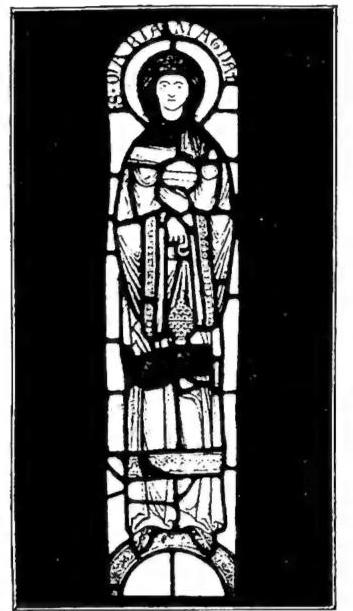
(from F. Kieslinger, Glasmalerei in Österreich, Vienna 1917, plate 1)
VETRO — S. M. Maddalena. Stained-glass window of 1150. Chapel of the Maddalena. Weitensfeld near Gurk.
Among the colors selected, blue, green, red, and orange predominated. In the late Romanesque period, the most substantial and finest production was found in France, particularly at Cluny and St-Denis, from which it spread to Chartres, Poitiers, Rouen, and subsequently to England. Also noteworthy in that period are certain examples from the German lands, such as the hieratic, elementary figure of the prophet Moses in Augsburg Cathedral and the later Madonna (12th century) in the Museum of Zurich. But the highest development, especially with regard to the mystical edification of the faithful, came with the advent of the Gothic style in religious buildings. This is demonstrated, in the mid-13th century, by the works carried out in Paris, and especially by the superb, large windows of the Sainte-Chapelle, as well as by those in the German lands, in Bamberg Cathedral and the choir of Regensburg. In Italy, the oldest production center seems to have been Siena, where in 1262 a certain Dono, a painter of stained glass, is mentioned, and then, around 1330, an Andrea di Mino who worked for Orvieto Cathedral, where shortly afterward Giovanni di Bonino di Assisi, trained by the Sienese, executed the admirable stained-glass window of the tribune. The most important Gothic ensemble produced in Italy from designs by Sienese masters, among them Simone Martini, is that of the lower church of S. Francesco in Assisi (chapels of S. Caterina, S. Martino, S. Ludovico, and S. Pietro d'Alcantara). Toward the end of the 14th century and in the first decades of the following century, a clear distinction emerged in Florence between the creative work of the painters and the technical execution by the glaziers. For the decoration of that Cathedral, designs were supplied first by Agnolo Gaddi and subsequently by Lorenzo Ghiberti (The Assumption, on the central portal; S. Lorenzo and angels, on the right-hand portal; the Presentation in the Temple, the Prayer in the Garden, and the Ascension, in three large round windows of the dome). To adorn the other oculi, Andrea del Castagno (the Deposition) and Paolo Uccello also worked, the latter producing the Annunciation, the Nativity, and the Resurrection, in which he seems to have wished to restore the unrealistic enamels of Romanesque stained-glass windows. With the emergence of Renaissance ideals throughout the Peninsula, naturalistic effects of relief, chiaroscuro, and perspective were also pursued in this branch of the figurative arts, to the detriment of the original ornamental functions of stained-glass windows. Even during the first phase of activity in Milan around the Cathedral (from approximately 1400 to 1450), the painters, among
stiana di Ostia, in Bollettino d'arte del Ministero della pubblica istruzione, no. 3, July–September 1932, pp. 204–10. Carlo Carletti