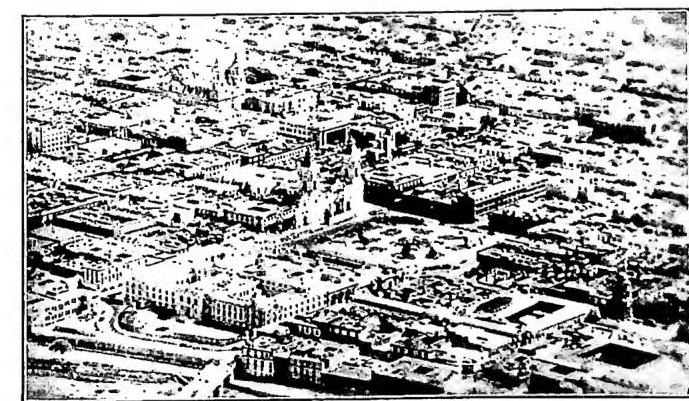
LIMA, ARCHDIOCESE of. – Archdiocese and capital city of Peru in South America.
It has an area of 34,168 sq. km., with 1,031,000 inhabitants, of whom 842,000 are Catholics. It has 94 parishes with 131 diocesan priests and 331 religious priests, one seminary, 53 men’s and 88 women’s religious communities (Annuario Pontificio, 1951, p. 246).
The diocese was created by Pope Paul III by a bull dated 14 May 1541; its first bishop was the Dominican Girolamo Loaza, who was succeeded by s. Toribio Mogravejo; on 12 Feb. 1546 it was elevated to metropolitan status. Its suffragan sees are the dioceses of Huanuco, Huaraz, Huancavelica, Huancayo, and Ica. A great impetus to education and instruction was provided by the arrival in L. of the Jesuits, who founded schools and colleges there. The first book printed in America was a catechism printed by the Jesuits in 1577 at Iuli (Lake Titicaca).
The Cathedral, dedicated to s. John the Evangelist, was begun by L.’s founder himself, Francesco Pizarro, and consecrated on 1 Oct. 1626. It was damaged by the earthquake of 1746, and during its restoration two bell towers were added (1758). It has five naves; the high altar has a painting by Murillo, and F. Pizarro is buried there. The monumental church of S. Dominic was commissioned by F. Pizarro, and it preserves a relic of the Holy Cross, sent by Paul III in 1540. Other churches worthy of mention are those of S. Francis, Our Lady of Mercy, S. Augustine, and SS. Peter and Paul, formerly belonging to the Jesuits; the beautiful church in honor of the holy bishop Toribio was erected by the Jesuits. The sanctuary of S. Rosa de Lima, patroness of Peru, was built on the site of the house in which the Saint was born in 1586.
256. The Faculty of Theology
After the Spaniards had completed the conquest of Peru, the Dominicans opened at L. the convent of Our Lady of the Rosary, which, by royal decree of 12 May 1551, was granted the same academic rights and privileges as Salamanca. Courses began in 1555, giving rise to the University of S. Mark, “the first university, as the diplomas of graduation put it, in all America,” and today the Republic’s largest state university. Pius V ratified its foundation and declared it pontifical with the bull Exponi Nobis of 25 July 1571. Particular importance was assigned, for missionary purposes, to the chair of the indigenous language, called Quechua. The Faculty of Theology remained in the Dominican convent until 1760, when it was transferred to the diocesan Seminary of S. Toribio, where it is still located, and until