
MASOLINO da PANICALE. — Painter, born to a certain Cristofano Fini in 1383 at Panicale in Valdelsa near Empoli (Florence), or at Panicale in Valdarno near S. Giovanni (Arezzo); he appears in the register of the dead of S. Maria del Fiore in Florence on 18 October 1440 or 1447. In 1403 and 1407 he was among Ghiberti’s assistants on the second door of the baptistery, and on 18 January 1423 he was enrolled in the Guild of Physicians and Apothecaries.
In 1424 (2 November), he received payment for the frescoes of the chapel of S. Elena in S. Stefano at Empoli; on 8 July 1425 he is recorded in Florence for a modest commission for the Compagnia di S. Agnese delle Laudi; he then entered the service of Pippo Spano in Hungary, where
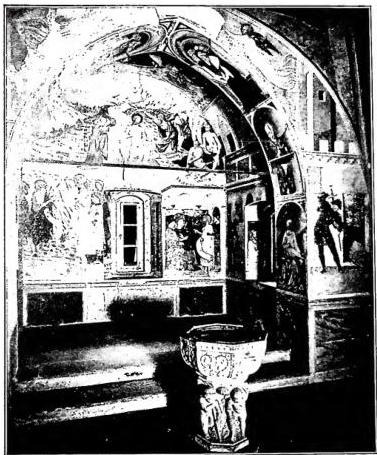
he was still to be found in 1427 after the death of the Florentine condottiero; on 1 November 1432 he was paid at Todi for a fresco in S. Fortunato; in 1435 he executed the frescoes of the baptistery at Castiglione Olona, where, in an unspecified year, he left his name in a Nativity, or rather in an Adoration of the Child (“MASOLINUS DE FLORENTIA PINEIT”), part of a cycle on the vault of the collegiate church, which constitutes the starting point for the reconstruction of M.’s artistic personality.
Having been trained in sculpture within the current of idealized medieval classicism and, perhaps at a later stage, initiated into painting by Starnina (Vasari), in his earliest surviving work, the Madonna of Humility in the Kunsthalle of Bremen (1423), he reveals himself as a late Gothic artist, yet one who created delicate figures full of graceful human cordiality, far removed from the wooden and transcendent figures of a Lorenzo Monaco, and characterized by a soft chiaroscuro of diffused luminosity. He appears congenial to Gentile da Fabriano and especially to Arcangelo di Cola da Camerino (with whom M.’s works suggest certain contacts), both of whom were in Florence at the beginning of the third decade of the century. The same tendencies, with a more developed formalism, recur in the Madonna of the Milk in the Pinacoteca of Munich, and at S. Stefano in Empoli in the fragmentary frescoes of the Chapel of the Cross, in those of the transept, and in the lunette with the Virgin and the Child between two angels. Of more assured modelling and deeper expressive force is the
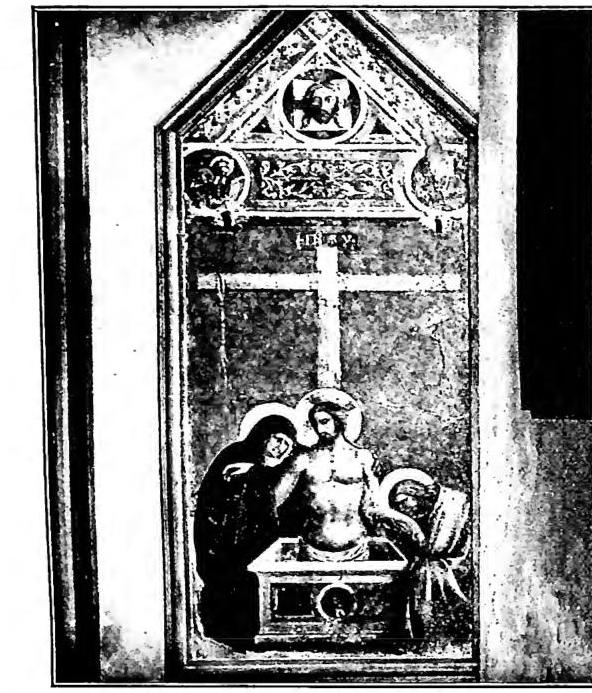
noble Pietà in the collegiate church, likewise at Empoli (datable between the end of 1424 and the beginning of 1425), produced under the influence of the genius of Masaccio, of whom M. may have been an occasional teacher in Florence and with whom, in any case, he was then a companion in the pictorial decoration of the Brancacci Chapel. Perhaps in 1423 itself or at the beginning of 1424, working alone, he decorated the vault compartments of the Brancacci Chapel with the four Evangelists (lost in 1746 when the chapel was remodelled, in which V. Meucci painted the Blessed Simone Stock Receiving the Scapular of the Madonna); Francesco d’Antonio may perhaps have drawn upon them for the organ shutters of Orsanmichele (1429), now in the Galleria dell’Accademia in Florence. In the two large lunettes on the side walls M. executed the Calling of Andrew and Peter, of which an eighteenth-century copy was in the Giovannelli collection in Venice, and the Shipwreck of the Apostles, derived from Giotto’s Navicella in S. Pietro in Vaticano in Rome, though with variants probably preserved in a fresco by Mezastris and one of his collaborators in S. Maria in Campis at Foligno (after 1452). In the lunette at the rear, beside the large window (transformed into an ordinary window in 1746), M. painted Peter Denying Jesus; but Masaccio appeared beside him in the narrative with the Saint Raising the Dead, demonstrating a collaboration that had already been established, with a secondary role for M., in Masaccio’s panel in the Uffizi, with S. Anna, the Madonna, the Child and five angels. In those early frescoes (destroyed in the eighteenth century and then replaced by the architectural ornament painted by C. Sacconi), it may be presumed that an accentuated spatiality and the concreteness of the lighting already suggested the influence of Masaccio. Yet the separation between the two personalities is visible in the surviving frescoes of the Chapel. M.’s Tempted Foreparents reveal his persistence in the late Gothic:
(Alinari photograph)
MASOLINO DA PANICALE — Frescoes in the baptistery of Castiglione Olona.
(Alinari photograph)
MASOLINO DA PANICALE — The Pietà — Empoli, collegiate church.
the vault webs (especially in Giovanni, Matteo, Luca, and Girolamo), in certain Apostles of the intrados, and in various passages of the spectacular, spacious Crucifixion on the rear wall (foreshortened views of horsemen, pious women, and a young man bending and kneeling beside the Crucified to the right), but disconnected, incoherent, at times crowded and descriptive in its display of costumes echoing Pisanello, and as a whole tied to the Padan taste that M. had come to know. But if the Masaccian element is of vague derivation, it is suspected that alongside M., precise and even micrographic in the Jerusalem in the background, there intervened an assistant who gave greater vigor to certain Masaccian reminiscences, such as Arcangelo di Cola, whose style had grown stronger precisely through the influence of Masaccio. In the five Stories of s. Ambrogio on the right wall and the equal number of Events of the Saint of Alexandria on the opposite side, M. returned to recounting things ingenuously and joyfully, with his poetic imagination directed toward the episodic and descriptive, in the beautiful costumes of northern courts, with his enchanting, clear colors, yet always abstract and devoid of atmospheric feeling when they range among the buildings of fabulous cities, incapable of movement (Miracle of the Wheel) but always an evocative narrator, as when amid the placid hills of Latium he raises an improbable Alpine crag (Death and Burial of s. Caterina). And M.’s amiable language can still be discerned, despite the restorations it has undergone, in the gigantic S. Cristoforo at the entrance and in the Annunciation on the triumphal arch of the Chapel, where the ambitious, complicated perspective scheme, with an overly abrupt succession of planes, is not, though it would like to be, Renaissance, because of the persistence of the parallelism of the ceiling lines within an empiricism that is still wholly Gothic. Of a triptych in S. Maria Maggiore, mistakenly attributed by Vasari to Masaccio and painted in two parts, the two central panels remain in the Museo nazionale di Napoli: one of them, with the Foundation of the Liberian Basilica, coincides in style with the stories of s. Ambrogio; the other, with the Assumption and its variegated angelic retinue, anticipates aspects that would be found in the two cycles at Castiglione Olona. Also remaining, in two panels in the Johnson collection in Philadelphia, are the four noble figures of saints, arranged two by two, that flanked one of them; as are the other two compartments, recently rediscovered and acquired by the National Gallery in London. After executing the Annunciation now in the Goldmann collection in New York, whose perspective arrangement develops that of the fresco in the church of S. Clemente, and the Archangel Announcing and the Annunciation in the National Gallery of Washington (Kress collection), M. left at Todi (1432) a most pure Madonna and a milky-white Child between two gentle praying angels, in the Franciscan church of S. Fortunato; then he crossed the Apennines once more to paint, in the service of Cardinal Branda, in his native town, raised above the narrow but pleasant valley of the Olona (Varese). M. first decorated the six long vault webs (erroneously thought by others to date from around 1423), and then the entire baptistery (the date 1435 has been repainted but is correct). In the former (they represent, without following the order of the legend, the Annunciation, the Marriage, the Nativity of the Child, the Adoration of the Magi, the Assumption, and the Coronation; on the walls, Paolo Schiavo, partly a pupil of M., and the Vecchietta displayed the Stories of s. Stefano and s. Lorenzo), in adapting himself to the form of the webs, and perhaps also because he found himself in a late Gothic setting, M. returned to elegant formal archaisms, though rich in Roman reminiscences and stylistic correspondences with the paintings of the baptistery; hence they display the firm modeling and mature experience also found in the highly stylized and refined Madonna of Humility, formerly Contini Bonacossi, which migrated to Germany. In the baptistery, whose façade preserves the remains of an ethereal Annunciation, M. frescoed the Evangelists in the webs of a vault and painted Prophets and Doctors of the Church in the intrados of the arch dividing the bipartite space. The loquacious painter covered the rest, even the window splays, with Stories of the Baptist. And, in recounting events in a plain, tranquil, and somewhat timid language, he finally expressed himself, evoking the past as a receptive artist, representing the Eternal City in a faithful, attentive view, and displaying in his poetic backgrounds (Baptism of Christ; Feast of Herod and Presentation of John’s Head to Herodias) a sensitivity to space in a commixture of Gothic and Renaissance, while remaining, in his exaltation of color and in his fragile, idealized figures of scant plastic substance, always bound to tradition. Thus, in the three essential stages of his art—Firenze, Roma, Castiglione Olona—in noting the outward aspects of life through his own cheerful, fluctuating language, strengthened first by his proximity to Masaccio and then by new influences and resonances, rather than advancing toward the new order, M. gathered himself within the fascinating whirlpools of International Gothic. Belonging to the great Florentine stock, he could seem in Lombardy a constructive and even plastic artist; in Venice he was understood in his most poetic quality: in the clear, golden, luminous color that captivated Antonio Vivarini; in Firenze he was merely a limited episode from which two minor, essentially backward artists partly benefited: Francesco d'Antonio and Paolo Schiavo. — Vedi tav. XXIII.