
DUNS SCOTO, GIOVANNI. — Franciscan philosopher and theologian.
SUMMARY:
I. Life
II. Works
III. Character
IV. Philosophy
V. Theology
VI. Overall assessment.I. LIFE
Thanks to the historical-critical method employed in the scientific investigations of the scholastic period, certain dates have now been established, on the basis of which, through appropriate inductions and considerations, we are able to reconstruct the most significant phases of the life of D. S.A descendant of the D. family, Giovanni was certainly born in Scotland (hence the name S.) and probably (according to an ancient Registrum Ordinis) at Maxton, now Littledean. As his date of birth, the years 1263–66 are generally accepted. He entered the Franciscan Order in 1278, after attending the elementary school at Haddington. He was ordained a priest in 1291; in 1300, he obtained from the bishop of Lincoln the faculty to hear confessions. In 1303 he commented on the Sentences at Paris as a bachelor. Having
His contemporaries called him Doctor subtilis, and posterity also called him Doctor Verbi Incarnati and Doctor Marianus. While still alive, he had a numerous following of disciples, and he soon became and remained the leader of the Franciscan school, which underwent a marvelous development especially in the sixteenth and seventeenth centuries. His name is found in the Martyrologium Franciscanum, and he is venerated in several places. The cause of beatification was officially opened in 1905 with a solemn petition supported by patriarchs, archbishops, bishops, cardinals, and ministers general of religious Orders.
II. WORKS
For years, a special international commission has been engaged in Rome in preparing a worthy critical edition of the works of D. S. In the meantime, the most complete edition remains that edited by L. Wadding, printed at Lyon in 1639 and reprinted by Vivès in the final years of the last century. But of the 24 works published there, some must certainly be regarded as spurious according to the latest historical-critical investigations, namely: De rerum principio (by Vitale da Furno); Grammatica speculativa (by Tommaso di Erfurt); Conclusiones ex XII libris Metaphysicorum (by Gonsalvo di Spagna); Expositio in XII libros Metaphysicorum (by Antonio Andrea, according to the lectures given by S.); Expositio in VIII libros Physicorum (by Marsilio di Inghen); Meteorologicorum libri IV; In librum I et II Priorum Analyt. Aristotelis; Quaestiones in librum I et II Posteriorum Analyt.; Quaestiones miscellaneae de formalitatibus (except for the first question, which is authentic). Probably spurious are: Tractatus de cognitione Dei; De perfectione statum.All the others are authentic, namely: Opus Oxoniense and Opus Parisiense (commentaries on the Sentences of Pietro Lombardo); Quaestiones subtilissime in Metaphysicam Aristotelis (only the first nine books); De anima; Quaestiones super universalia Porphiri; In librum praedicamentorum quaestiones; Quaestiones in I et II librum perhermenias; In duos libros perhermenias operis secundi quod appellant quaestiones octo; Quaestiones in librum elenchorum; Collationes; De primo principio; Theoremata; Quodlibet.
But even among these latter works, not all enjoy the same authority and value for knowledge of the genuine doctrine of the Subtle Doctor. It is known that De anima and Theoremata were composed by the disciples, nor is it known with certainty whether they were corrected and approved by the master. Likewise, the importance and literary character of the Scotist commentaries on the Sentences of Pietro Lombardo, which until now have gone under the names Opus Oxoniense (=Ordinatio) and Opus Parisiense (=Reportationes), are quite different. For while the value of the Reportationes is relative (apart from some version that D. S. himself approved), since they were written by the disciples according to the master’s lectures, the value of the Opus Oxoniense, on the other hand, is immense and decisive, since it was written, dictated, and prepared for publication by S. himself. Indeed, although in the form of a commentary, this work was a definitive undertaking that D. S. composed, elaborated, and perfected by gathering the best of his lectures. Unfortunately, death overtook him before the work was completed: this explains why some questions are entirely absent or have merely been sketched out, and why the margins of the pages abound in cross-references, additions, and corrections. After his death, a well-prepared editio princeps was promptly produced; but from it there developed such a multitude of differing and often arbitrary recensions that at a certain point it seemed impossible to distinguish S.’s authentic pages from the disciples’ alterations. Fortunately, attempts to restore the critical text were not lacking; thanks to cod. 137 of the municipal library of Assisi, written some twenty years after S.’s death with the master’s own autograph and approximately 200 other codices in view, it is possible for us to reconstruct the original Ordinatio as it was left by the Subtle Doctor.
It should also be noted that there are not merely two Opus by S. on Lombardo, as was hitherto believed, but many more. Thus, for book I, alongside the Ordinatio there is a Lectura (unpublished) from Oxford, followed by six different versions of the Reportatio, one of which was examined by the author himself and has until now remained unpublished. For book II as well, there is a Lectura (unpublished) from Oxford, followed by the Additiones (unpublished). For book III, besides the Ordinatio and the Lectura (unpublished), there are four versions of the Reportatio, of which only one has so far been published.
III. CHARACTER
Having appeared when the edifice of scholastic science had already been raised, D. S. was destined, also because of a particular tendency of his acute and subtle intellect, to assume the predominant attitude of a critic toward his predecessors. He was neither a mechanical repeater of what had already been written, nor did he wish to be one. For him, knowledge of the truth is dynamic and always progresses: «In processu generationis humanae - he writes - semper crevit notitia veritatis» (Ox., IV, d. 1, q. 3). Objective and impartial, he loved truth more than systems. A disciple of Guglielmo Ware and heir to the Oxford school, he did indeed prefer metaphysical arguments and held mathematics up as an example of the strictest demonstration; but this did not prevent him from developing a synthesis dominated by the idea of love and the will. As a Franciscan, he was certainly in harmony—especially in his manner of feeling and framing problems—with the Platonico-Augustinian tradition of his Order; but at the same time he held Aristotle in the highest admiration. In many theses he departed from his confrère s. BONAVENTURA, SANTO (v.), and he did not hesitate to pass the severest judgments on Enrico di Gand, who was then regarded as a tenacious opponent of Thomistic theories. He has sometimes been judged (e.g., by Festugiere) to have been a systematic and envious rival of s. Tommaso d'Aquino; but if at times he rejected his doctrine, he did so only amore veritatis, exercising a legitimate freedom in judging disputed questions. In correcting the ancient system, he aimed above all to construct his own philosophical-theological system. Proceeding from the standpoint that fides-ratio-auctoritas do not contradict one another, he endeavored to trace the essential elements of his synthesis to the sources of Revelation and the teaching of the Church, to whose judgment he entirely submitted his thought: «Non est aliter sentiendum quam sentit Ecclesia Romana» (Ox., IV, d. 26). In view of the modesty he displayed in presenting his opinions, Gersono rightly observed that D. S. was not guided «singularitate contentiosa vincendi, sed humilitate concordandi» (I. Gerson, Opera omnia, I, Aia 1728, p. 100).The opinion that D. S. is obscure and difficult is also widespread. His own disciples admit that «cius dicta communem transcendunt facultatem» (G. Vorlion, Opus super libros IV Sent., Venezia 1502, f. 302ᵃ). To tell the truth, in the present state of affairs it is not easy to penetrate and formulate precisely and concretely S.'s complex doctrinal synthesis, since until now there has been no critical edition capable of freeing the Scotist works from the serious textual disorder in which they have been transmitted. For this reason, one must limit oneself to establishing the fundamental and characteristic points of the traditional Scotist philosophical-theological doctrine.
IV. PHILOSOPHY
A large part of Scotistic speculation is devoted to metaphysics, and particularly to the three theories of hylomorphism, formalism, and the principle of individuation. Matter is not a simple and pure potency, but a positive and absolute entity, which could exist — de potentia Dei absoluta — even without the informing principle. In every individual being (= res) there are metaphysical elements (= realitates, entitates, formalitates) which, although really, adequately, and formally identical, nevertheless do not include or merge into one another, but are differentiated. This difference (distinctio formalis a natura rei), or rather the formal non-identity of the diverse realities of one and the same thing, is ante omnem actum intellectus, creati et non creati essentially different from that rationis (which is produced by the intellect), and exists, for example, between essence and existence, between the soul and its faculties, and among these faculties themselves; between the divine essence and the three divine Persons on the one hand, and its divine attributes on the other, as well as among these divine attributes themselves. The principle of individuation of a being consists neither in its existence nor in its specific nature, neither in matter nor in form, nor yet in anything negative; rather, it consists in a particular positive reality called hecceitas.1. Theodicy. — We know God not through intuition but from creatures, by way of causality, negation, and eminence. The concept of being is univocal as applied to God and creatures. This univocity is not contrary to the simplicity of God. Indeed, D. S. writes: «Teneo opinionem mediam, quod cum simplicitate Dei stat quod aliquis conceptus sit communis sibi et creaturae, non tamen aliquis conceptus communis ut generis» (Ox., I, d. 8, q. 3). In turn, the idea of Infinite Being expresses God’s nature in the most perfect manner, namely, «conceptum...perfectissimum conceptibilem vel possibilem a nobis haberi de Deo» (Ox., I, d. 2, q. 2; d. 3, q. 1-2). Among the divine attributes, primacy belongs to the will, which, although essentially free, is by no means despotic or capricious, since it is governed by the intellect «cum sit Deus agens rectissima ratione» (Rep. Paris., IV, d. 1, q. 5).
2. Psychology. — The soul is the substantial form of the living human composite, but the body too has its own form, albeit a secondary one, by which it is a body independently of the soul that gives being to all its parts: this is the forma corporeitatis. Cognition begins with the senses, which, however, cannot attain the actual existence of things in a sure and adequate manner without the assistance of the intellect, whose formal and proper object is the ens. In man too, the intellect is surpassed in nobility by the will, which, being an essentially active and free power, is responsible for every order or disorder of the soul, commands itself, the intellect, and the other powers, and chooses between good and evil or between two goods.
3. Ethics. — Ethics too is founded on voluntaristic principles. For morality is above all a matter of the will. Moral goodness consists formally in the will’s election (actus elicitus voluntatis), which election is already a practice; whereas in commanded practices ad extra there is only goodness materialiter. Perfection resides more in loving God than in knowing him. The natural law is contained in the Decalogue, but principally and strictly speaking in the precepts of the first tablet, insofar as they are ethical principles of immediate evidence and absolute value that directly concern Infinite Being; whereas the other precepts contain contingent elements within themselves, and although they are fully consonant with the intellect, God can dispense from them. Man is not obliged to direct every one of his actions, even the least, toward God; and he can also perform actions which in concrete terms are neither good nor evil, but simply indifferent.
V. THEOLOGY
From the fact that God is love (Deus caritas est), S. draws numerous and highly significant conclusions. Theology itself is a science (although not in the Aristotelian sense) eminently practical, because it treats of God not propter speculari, but precisely propter operari, that is, not to satisfy our idle curiosity, but to enlighten us concerning our ultimate end. The whole of creation is likewise an act of love, because God, the supreme good, necessarily loving himself, wills the existence of other beings who can love him freely. Grace—which is identified with charity—resides in the will; and since the will—which is also the seat of the cardinal virtues—can, with the help of Grace, perform supernatural acts, it follows that infused moral virtues are neither necessary nor existent. Heavenly beatitude consists in the beatific love of God; and this love, while remaining free, is nevertheless stable and indefectible as a result of a positive predetermination of the divine will.But the love of God triumphs above all in the Incarnation, since the existence of Christ—archetype,
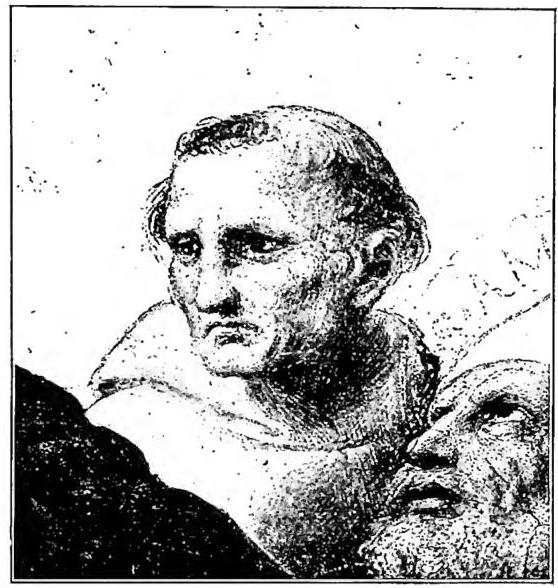
DUNS SCOTO, GIOVANNI - Face of D. S. Detail from Raphael’s Disputation of the Most Holy Sacrament (1309–11) - Vatican, Raphael’s Rooms.
center and end of the universe in its twofold natural and supernatural aspect—was not predestined solely on account of the redemption. Likewise, love constitutes the formal element of the redemption and is the ultimate cause of Christ’s outstanding merits: merits which, however, may be called infinite only in a broad sense.
Among S.’s other theological theses: the mystery of the Most Holy Trinity, although not contrary to reason, cannot be the fruit of an argument quia or propter quid. Original sin consists in the deprivation of the original justice due to man. The angels too, like human beings, are individuals grouped under one and the same species; and just as they could sin at the first moment of their creation, so they could, during their probation, repent and be converted. The Sacraments are not physical causes of Grace, although they truly produce II. The essence of the sacrament of Penance consists principally in the priest’s absolution, and not in the penitent’s three acts. In the Eucharist, the words of consecration—of which those used by the Western Church are not all essential—do not have the power to demonstrate invincibly and fully the mystery of transubstantiation without the exposition of tradition and the doctrine of the Church.
VI. OVERALL JUDGMENT
Throughout the centuries, there has never been any lack of more or less serious attacks on the person and work of D. S. Especially in the first decades of the neo-Scholastic movement, it was almost fashionable to present him as the forerunner of Kantianism, modernism, positivism, and the other errors against which the Church had found herself obliged to fight. It is enough to read the severe and hostile judgments of Z. Gonzales, A. Werber, W. Fox, and B. Landry.In recent years, however, thanks to a more careful historical-critical study of Scholasticism in general and of Scotist works in particular, scholars’ attitude toward the Doctor subtilis has evolved and changed very significantly; and tributes to his profoundly constructive greatness have become increasingly frequent and significant, even outside Franciscan circles. Thus, while D. S. is hailed as «the last great figure of high Scholasticism» (M. Grabmann, Storia della teologia cattolica, Italian trans., Milan 1937, p. 119), Scotism, in turn, is judged by some to be an original and powerful Scholasticism imbued with metaphysics, and a homogeneous synthesis in which everything has been reduced to a marvellous unity (M. De Wulf, Histoire de la philosophie médiévale, 6th ed., Louvain 1936, pp. 347-48); others consider it the greatest attempt to preserve and demonstrate in their entirety the philosophical ideas which, in the Middle Ages, were taught as the foundations of the Christian vision of the world and of life (J. Carreras y Artau, op. cit. in bibl.); for still others, it represents the most complete and most fundamentally Christian synthesis of Scholastic philosophy (C. R. S. Harris, op. cit. in bibl., I, pp. 246-312). Nor are the admonitory words of Fr. Monot without significance (Dictionn. des connaissance relig., VI, col. 268): «Scotism, which has sometimes been despised by ill-informed Catholics, remains in philosophy and theology one of the recognized forms of Christian thought».
Certainly, the progressive affirmation of Scotist thought has also owed much to the historical function it has exercised, and continues to exercise, in the definitive development of certain dogmas and in the elaboration of theological synthesis. The importance and weight of S.’s teaching in not a few decisions of the Council of Trent must not be forgotten. The fact that he established and defended the dogma of the Immaculate Conception is a title sufficient in itself to assure him everlasting glory (cf. J. Pohle, Lehrbuch der Dogmatik, 7th ed., II, Münster in West. 1928, p. 241). Likewise, the doctrine of Christ’s absolute predestination «is today gaining ground, and perhaps the time will come when, just as the Scotist school prevailed over the Thomist with regard to the immaculate conception of Mary, so it may prevail with regard to this opinion, which wonderfully appeals to us» (G. Bonomelli, cf. Etudes franciscaines, 2 [1899], p. 577).
Nor, with regard to S.’s perfect orthodoxy, should it be forgotten that the Church has not only so far condemned none of his doctrinal propositions, but has also expressly declared, by a decree of the Congregation issued by order of Paul V, «immunem esse a censuris doctrinam Scoti», establishing at the same time «ne quis librorum censor prohibere auderet quod certo constaret ex Scoto de promptum esse» (cf. Hurter, IV, col. 369). Thus, on various occasions, the Holy See approved the general constitutions of the Franciscan Order, which prescribed for its readers «ut litteram Scoti solum et non alios auctores ex professo explicare conentur» (cf. W.
Lampen, B. Ioannes Duns Scotus et Sancta Sedes, Quaracchi 1929). At other times, it confirmed the statutes of various universities and theological faculties in Italy, France, England, Poland, Spain, etc., where chairs of S. existed alongside those of s. Tommaso. Thus, for example, Clement XII approved the statutes of the University of Cervera, founded by Philip V, where it was prescribed: «Scoti cathedrae praefectus praecipue caveat ne in conficiendis ad praelectiones suas tractatibus, a mente eiusdem doctoris deflecta» (Bullarium Romanum, Turin ed., XXIII, pp. 165, 170, 172).
This is not intended to disregard the preponderant favor rightly accorded by the Holy See to the doctrine of s. Tommaso d’Aquino, nor to diminish the indisputable merits of the Somma teologica, which, for the clarity and simplicity of its exposition and for the richness and architectural order of its content, has deserved to be chosen as a teaching text in Catholic schools. The curious alternative «either Tommaso or D. S.», which had been posed fifty years ago and to which some had replied «Tommaso and not D. S.», has now proved no longer relevant and must therefore be transformed into Bazala’s more just and serene affirmation (Povijest filozofije, II, p. 174): «Alongside the name of Tommaso, the name of D. S. will always resound worthily».
The great scholar of Scholasticism, Cardinal F. Ehrle, wrote on this subject (La scolastica e i suoi compiti odierni, Turin 1935, p. 92): «Finally, let us fully appreciate the fact that the Church, with all the esteem she has for the Doctor communis, refuses to emphasize the Saint’s doctrine in such a way that the opinions of other important schools might thereby appear condemned or at least diminished. She knows too well how important, in the search for truth, is the free competition of ideas, which makes possible the complete clarification of a problem, even when one begins from different points of view. So long as faith and love are preserved, this can only benefit the truth and the Church herself, the protector of every truth. Therefore she grants to all teachers, students, and investigators the iusta libertas. If an individual scholar, institute, or religious Order wishes to adhere more closely to Tommaso or to another master, it has the full right and full freedom to do so».
In any event, it is now perfectly undisputed that D. S., through his excellent critical method, his extensive use of the most rigorous rational argumentation, his exaltation of the primacy of will, freedom, activity, and love, and his singular Christocentric-Marian speculation, created a solid and enduring doctrinal system which—embraced and defended throughout the centuries by a host of theologians, philosophers, saintly preachers, and undefeated controversialists—imposes itself also, and, we might say, above all, upon the dispassionate research and study of our own time. To the latter has been reserved the merit of placing, for the first time, in its full historical-critical light, the person and work of the great architects of integral Scholasticism, among whom D. S. occupies a position which all, without reservation, recognize as being of no small importance.
BIBLI: Editions: L. Waddingus, Johannis Duns Scoti... Opera Omnia, 12 vols., Lyons 1639; 2nd ed., 26 vols. in-4, Paris-Vivés. 1601-05. Among the many separate editions, only that of M. Fernandez Garcia, B. J. Duns Scoti, Commentaria Oxonitania (first two books), Quaracchi 1912-14, is mentioned. Extracts from texts: H. De Monte Fortino (Arretus), Summa ex Scoti operibus... Rome 1728; 2nd ed., 6 vols., ibid. 1902; Deodatus Maria a Balliaco, Capitalia opera B. I. D. Scoti, Le Havre 1908; D. Scaramuzzi, D. Scoto Summula, Florence 1932; C. Balié, I. D. Scoti Theologiae marianae elementa, Sibenik 1933; M. Müller, I. Duns Scoti Tractatus de primo principio, Freiburg in Br. 1941. Dictionaries: C. De Varesio, Promptuarium scoticum, Venice 1690; M. Fernandez Garcia, Lexicon scholasticum, Quaracchi 1910.
The “conspectus” of modern Scotist literature is found in E. Bettoni, Venti ultimi anni di letteratura scotista, Milan 1943; Franzisianische Studien, 8 (1911), pp. 48–66; Antonianum 3 (1928), pp. 451–84; Quatrième congrès des lecteurs de la langue française, Paris 1934, pp. 190–254; M. De Wulf, Storia della filosofia medievale, Italian trans., II, Florence 1945, pp. 304–23.
The older bibliography is found in: P. Raymond, s. V. in DThC, III, cols. 1865–1947; U. Smeets, Lineamenta bibliographiae scotisticae, Rome 1942.
For the life and works of D. S.: B. Brkié, Zivot Ivana D. S., Sarajevo 1908; A. Bertoni, Le b. J. D. S., Levanto 1917; E. Giusto, La vita del b. G. D. S., Assisi 1919; A. Pelzer, Le premier livre des Reportata Parisiensia de J. D. S., in Annales de l'Institut supérieur de philosophie, V, Louvain 1923; F. Pelzer, Handschriftliches zu Shotus mit neuen Angaben über sein Leben, in Franzisianische Studien, 10 (1923), pp. 1–32; A. Callebaut, A propos du b. J. D. S. de Littledeau, in Archivum Franc. Historium, 24 (1931), pp. 305–29; Ch. Balié, Les commentaires de J. D. C. sur les quatre livres des Sentences, Louvain 1927; id., Ratio criticae editionis operum omnium J. D. S., 2 vols., Rome 1939–41; Béraud de S.-Maurice, J. D. S., un docteur des temps nouveaux, Montreal 1944.
A general synthesis of S.’s doctrine was presented in the Proceedings of the Scotist Congress of Zagreb, Collectanea Franciscana Slovica, I, Sebenico 1937; there is also: R. Seeberg, Die Theologie des J. D. S., Leipzig 1900; E. Longpré, La philosophie du b. D. S., Paris 1924; P. Minges, I. D. S. doctrina philosophica et theologica, 2 vols., Quaracchi 1930; C. R. S. Harris, D. S., 2 vols., Oxford 1930; Z. Van de Woestyne, Scholae franciscanae optatus cursus philosophicus, Malines 1932; S. Belmond, Essai de synthèse philosophique du scotisme, in La France franciscaine (1933), pp. 73–131; Déodat Marie de Basly, S. docens, Paris 1934; E. Bettoni, D. S., Brescia 1946.
On individual philosophical-theological questions: Déodat M. de Basly, Grandes thèses catholiques, I, Paris 1900; II, Rome–Paris 1903; P. Minges, Die Gnadenlehre des D. S. ..., Münster 1906; id., Der Gottesbegriff des D. S., Vienna 1907; id., Das Verhältnis zwischen Glauben und Wissen, Theologie und Philosophie nach D. S., Paderborn 1908; J. Belmond, Dieu, Paris 1913; J. Klein, Der Gottesbegriff des J. D. S., Paderborn 1913; M. Heidegger, Die Kategorien und Bedeutungslehre des D. S., Tübingen 1916; J. Carreras y Artau, Ensayo sobre el voluntarismo de J. D. S., Gerona 1923; J. Klein, Die Charitablehre des J. D. S., Münster 1926; E. Gilson, Avicenne et le point de départ de D. S., in Archives d'histoire doctrinale et litt. du moyen âge, 11 (1927), pp. 88–149; J. Kraus, Die Lehre des J. D. S. von der natura communis, Paderborn 1927; D. Scaramuzzi, Il pensiero di G. D. S. nel mezzogiorno d'Italia, Rome 1927; H. Klug, B. J. D. S. doctrina de sacrificio, praesertion de sacrosancto Missae sacrificio, Barcelona 1929; H. Schwamm, Das Göttliche Vorherzusen bei D. S. und seinen ersten Anhängern, Innsbruck 1934; F. Chauvet, Las pasiones, Barcelona 1936; H. Storf, De natura transsubstantiationis iuxta I. D. S., Quaracchi 1936; J. Binkowski, Die Wertlehre des D. S., Berlin 1936; E. Gilson, Les seize premiers Theoremata et la pensée de D. S., in Archives d'histoire doctrinale et litt. du moyen âge, 22 (1938), pp. 5–86; N. Petruzzellis, Studi sull'Edice di D. S., in Archivio di filosofia, 10 (1940), pp. 66–87, 219–33, 390–416; C. Balié, De debito peccati originali in B. V. Maria, Investigations de doctrina quam tenuit I. D. S., Rome 1941; E. Bettoni, L'ascesa a Dio in D. S., Milan 1943; M. Grajewski, The Formal distinction of D. S., Washington 1944; A. B. Wolter, The Transcendentals and their function in the Metaphysics of D. S., New York 1946.