
WINDELBAND, WILHELM. – Philosopher and historian of philosophy, born in Potsdam on 8 May 1848, died in Heidelberg on 22 October 1915. He studied at Jena, Berlin, and Göttingen, under K. Fischer and H. Lotze (v.). He taught philosophy at Leipzig (1873), Zurich (1876), Freiburg (1882), Strasbourg (1882), and Heidelberg (1903).
W.’s work unfolded above all in the field of the history of philosophy, to which he made notable contributions, chiefly through the criteria that informed II. Alongside careful and well-informed historical research, he made a rigorous scientific method prevail in it, enabling him to insert the history of philosophy into philosophy and the history of culture. This is better understood if one bears in mind that W. belongs to the « philosophy of values » (v.), one of the foremost expressions of neo-Kantianism.
Among his principal works on the history of philosophy are: Die Gesch. d. neueren Philos. in ihrem Zusammenhange mit der allgem. Kultur u. den' besond. Wissenschaften (2 vols., Leipzig 1878; 7th ed. 1922; Italian translation by A. Oberdorfer, 3 vols., Florence 1925), one of the most comprehensive investigations of modern philosophical thought, from the Renaissance to early positivism. In one respect more significant is the Lehrbuch der Gesch. d. Philos. (1891; 12th ed. completed by E. Rothackers, Tübingen–Leipzig 1928; Italian translation by C. Dentice D'Accadia from the 13th German ed., Palermo 1938; 14th ed. edited by H. Heimsoeth, Tübingen–Leipzig 1950), which is a history of the problems and fundamental expressions of philosophical thought, and is therefore of more directly theoretical interest. Platon should also be mentioned (7th ed., Stuttgart 1900; Italian translation by M. Graziussi, Palermo 1914). Of his contributions to philosophical research, the best known is Präludien, Aufsätze u. Reden zur Einleitung in die Philos. (2 vols., Freiburg 1884; 9th ed. 1924; Italian translation by G. Arrighi, Milan 1947).
W. regards philosophy as the science of the « values » that are the fruit of spiritual activity and at the same time constitute its
MONUMENTI ANTICHI INEDITI
SPIEGATI ED ILLUSTRATI
D A
GIOVANNI WINCKELMANN
PREFETTO DELLE ANTICHITA DI ROMA
ROMA MDCCLXVII.
A SPERE DELL'AUTORE
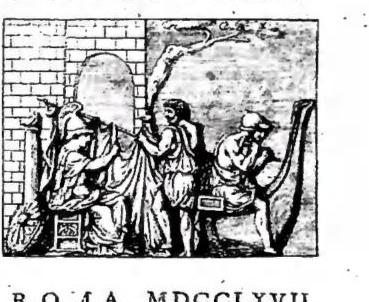
WINCKELMANN, JOHANN JOACHIM - Frontispiece of the Monumenti antichi inediti spiegati e illustrati by G. W., I, Rome 1767, with an engraving by the author reproducing a terracotta bas-relief from the Albani collection, depicting the construction of the ship of the Argonauts - Copy in the Vatican Library.
necessary presuppositions. Among values, particular significance belongs to the logical, aesthetic, and ethical ones, as they are manifested both in the life of the individual and in the process of culture. It is possible to find a synthesis of these values and a transcendent expression of them in religious consciousness, to which W. devotes particular attention (cf. the essay Il divino, Italian ed. of the Preludi, pp. 200–27). It has been said that the position of the philosophy of values represents a meeting of the Kantian attitude with that of Goethe, and this is particularly evident in the effort toward a critical foundation of human values as realized by W. The historical sciences acquire particular importance in relation to the natural sciences; since the historical sciences form part of the human sciences, they are, as such, sciences of values par excellence and therefore norms of thought and action, of culture and life.