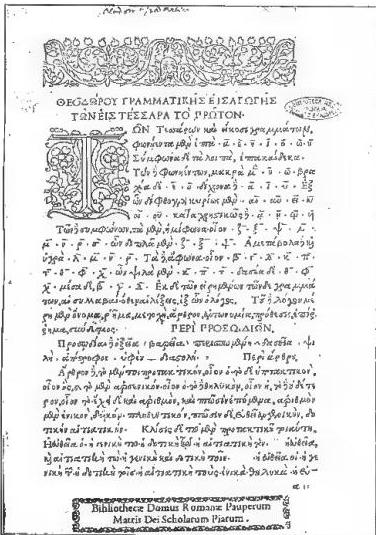
GAZA, TEODORO. — Greek humanist, born in Thessaloniki around 1398, died at Badia di S. Giovanni a Piro in 1475. He took part in the Council of Ferrara-Florence and adhered to the union of the Greek and Latin Churches. Remaining in Italy, he learned Latin under Vittorino da Feltre at Mantua (1442–46); he then taught Greek at the University of Ferrara; from 1449 to 1455, in Rome, he held from Niccolò V the chair of philosophy and the task of translating Greek writers into Latin. After spending several years at the court of Naples, he returned to Rome and, through the support of Cardinal Bessarione, obtained the commendam of the abbey of S. Giovanni a Piro (diocese of Policastro), where he lived in retirement until his death.
He composed a Greek grammar that was the first in the West, remained the only one for a long time, and went through very numerous reprints. He translated into Latin, with the utmost elegance, treatises by Aristotle (De natura animalium), Theophrastus (De historia plantarum), and Alexander of Aphrodisias (Problemata). A learned Aristotelian, he composed various philosophical writings against Plethon (Adversus Pletonem pro Aristotele de substantialis; Antirreticam) and played an active part in the controversy between Platonists and Aristotelians. His austere way of life and integrity of character made him one of the finest figures among the humanists of his time.
Editions: Institutiones grammaticae libri IV (Basiles 1540); Laudatio canis (PG 161, 985–88); De origine Turcarum (ibid., 997–1006); Epistolae (ibid., 1005–1014); the treatises of the Platonic-Aristotelian controversy, speeches, and letters in L. Molher, Am Bessarius Gelehstenkreis (Quellen und Forschungen aus dem Gebiete der Geschichte, 24), Paderborn 1942.
BIBLI.: U. Chevalier, Bio-bibliographie, I, Paris 1903, p. 1680