
LUSTRAZIONE. — From Lat. lustro, “I enlighten” and hence “I purify,” it is the purification of things and persons. This may be required either with a view to the sacred designation of the object or person (l. consecrataria), since the world of the “sacred” and the world of the “profane” are rigorously separate, and passage from one to the other cannot take place without suitable preparation; or to remedy a pollution of any kind and restore the defiled thing or person to its normal state (l. espiatoria); or to prevent and neutralize at the root the possible evil influences that may infest a person or place (l. preventiva).
The l. consecrataria is that which renders the victim to be sacrificed fit for sacrifice, or the priest or object intended for sacred use fit for the exercise of its particular office; it is performed by ablutions with water and by sprinkling the sacrificial victim with purifying substances (barley and salt in Greece and Rome, butter in India); the l. espiatoria is performed by sprinkling with the blood of a victim designated for this purpose (e.g., the pig in Greece, the ram in Babylonia, the goat in Israel); the l. circumambulation (v.) of the place or object to be preserved, by sprinkling or immersion in water, by fumigation with resinous plants, by salt, which preserves and safeguards, and by fire, which illuminates and warms and which requires ritual purity on the part of whoever tends it or of the material that feeds II. From the solemn quinquennial lustratory circumambulation performed in Rome by the censor around the people assembled as an army in the Campus Martius, the word “lustro” was derived to designate a period of five years.
(phot. Alinari)
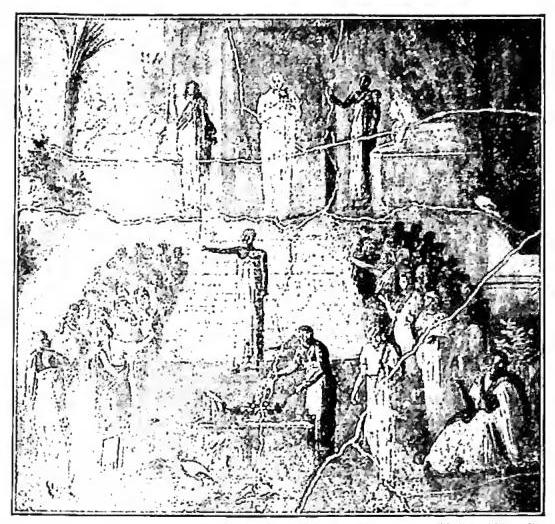
LUSTRAZIONE – Lustral ceremony of an Egyptian rite with water from the Nile. Painting from Pompeii—Naples, National Museum.