
DEDICATION OF THE TEMPLE (Heb. hānuk-kāh). — Jewish feast, held on the 25th day of the month of casleu, corresponding to December, and lasting 8 days, to commemorate the purification of the Temple of Jerusalem, carried out in 165–164 B.C. by Judas Maccabeus.
By order of Antiochus IV Epiphanes, worship was interrupted in 168 B.C. After the Jews’ victory at Bethsur, Judas and his warriors first mourned the desecration that had taken place. The defiled altar was removed, a new altar was constructed, the entire Temple was purified, and new sacred furnishings were then installed. On this occasion a feast lasting 8 days was begun; he ordered that it be celebrated every year (I Mach. 4:36–59; II Mach. 10:1–9). The Palestinian doctors enjoined-
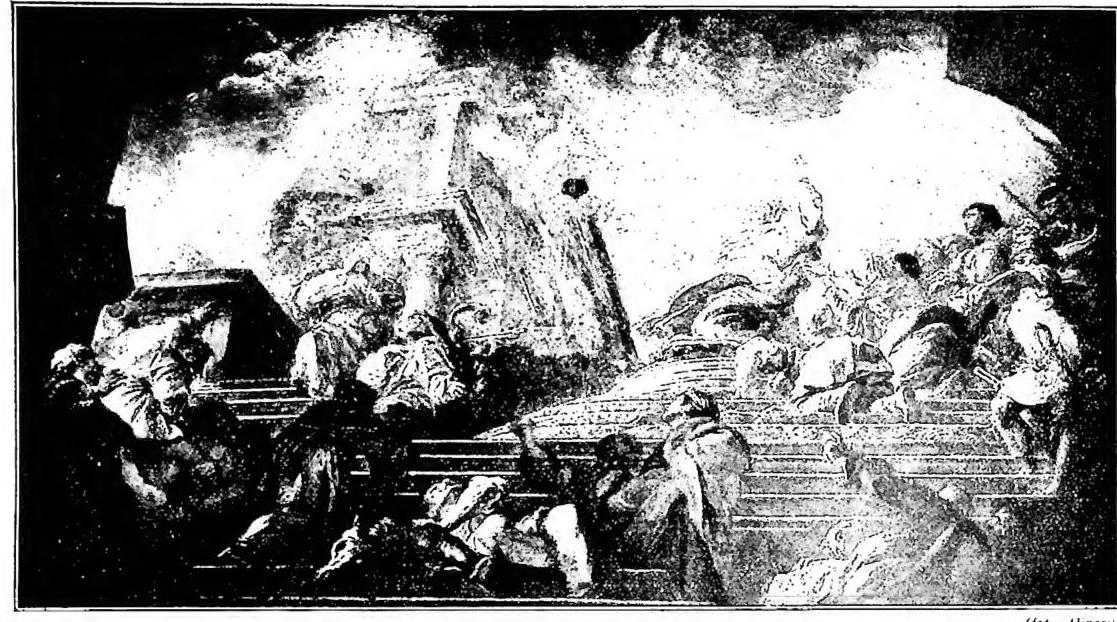
ordered, by means of special letters, that this feast be celebrated in the Jewish communities of the Diaspora. In one of these letters addressed to the Egyptian Jews (II Mach. 1, 1–2. 18), Judas is placed, for his historical importance, alongside Moses, Solomon, and Nehemiah.
In ancient times, the central feature of the solemnity was considered to be the return of the sacred fire to the altar for burnt offerings. The feast was later associated with that of the pouring of water on the altar, which was celebrated by the lighting of torches (Sukkáth, V, 3). Since the feast of the dedication of the Temple under Solomon (I Reg. 8, 2) and Zerubbabel (Eid. 3, 4) took place during the feast of sukkáth, a connection was also established between the feast of the dedication and that of the tabernacles or booths. Flavius Josephus defines the feast as φῶτα, while the author of II Maccabees calls it the feast of the (sacred) fire (τοῦ πυρός). Josephus believes that the lights symbolized God’s unexpected help (Antiq. Iud., XII, 325). The academy of Jamnia decreed that on the first evening only one light should be lit, and that one should be added each evening until the number of eight was reached. In the Talmudic period, the account of the miracle was already known according to which the supply of sacred oil for illuminating the Sanctuary, sufficient for only one day, miraculously lasted for eight days—that is, the time necessary to prepare more sacred oil.
In Hellenistic usage, this feast was called ἐγκαίνια, Volg. encaenia. During the week of the d., in the last year of his ministry, Jesus affirmed his divinity in the “portico of Solomon,” in the Temple (Io. 10, 22–39; “it was winter”).