DEDEROTH, JOHANNES. – An important figure in the monastic reform in Germany in the 15th century, he died a victim of the plague on 6 February 1439. He was called Johannes von Münden (in Westphalia) from his native city. Nothing is known of his youth. He was a Benedictine monk at Reinhausen and at Nordheim.
J. Busch always calls him Johannes von Nordheim, while the monk chronicler Heinrich Bodo calls him Johann Dederoth (cf. Chron. Clusinum, op. cit. in bibl.).
Through the prior Rembert von Wittenberg he came into contact with the Windesheim monastic reform. On 21 July 1439 he was elected abbot of Clus and in 1433 abbot of the monastery of Bursfeld, which under his direction became the centre of the reform and of the Congregation.
---
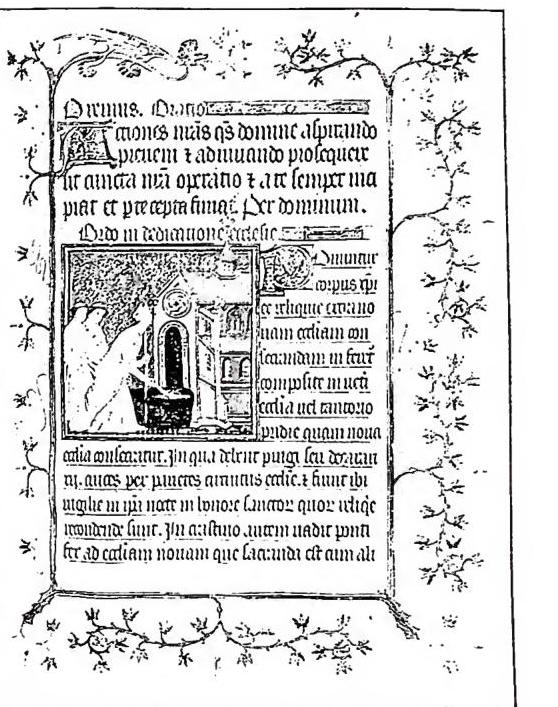
DEDICATION, RITE OF. – The dedication of a church. After blessing the water, the consecrating bishop proceeds to sprinkle the building. Pontifical of Siena (second half and end of the 14th century) – Paris, Bibliothèque Nationale, ms. lat. 962, f. 63.
Originally, churches were without relics, and the law prevented their deposition within the city. Over time, the custom arose of dedicating the church to a saint; with this, the transport and placement of the relics also came to occupy a fixed place in the rite of dedication, so that the most solemn part of the dedication was the triumphal procession with the relics, as attested by St Ambrose (Epist., 22, 1-2), Sozomen (Hist. eccl., VII, 21) and St Jerome (Contra Vigilantium, 5). Thus the deposition did not take place with the dedication of the church, and it became customary to place relics beneath the altars. The rite of dedication was then composed as follows: 1) throughout the preceding night, vigils were celebrated before the relics solemnly exposed in another church. 2) The following morning, the relics were carried in procession with psalms and hymns and many lit lamps into the church to be dedicated, where they were deposited in the altar. 3) The solemnity concluded with the Mass celebrated there. According to a letter of Pope Vigilius to Profuturus of Braga, the consecration of a church consisted simply in the celebration of the divine Sacrifice within it; if the church was dedicated to a saint, the deposition of the relics of the saints was added. The pope also already knew, though not as an obligatory ceremony, a blessing of the church with holy water, later called the Gregorian water (v. Acqua). Other ceremonies were added later: in the East, especially the anointing of the altar with chrism, already mentioned by St Ephrem; in the West, such anointing is not found before the Council of Agde (506), can. 14 (Mansi, VIII, 327); from the Gallican rite came the anointing of the church walls, the washings, and other elements. These rites—deposition, sprinkling, and anointing—were already united in the 6th century in the Gallican rite of dedication (Gregory of Tours, De gloria confessorum, 20) and subsequently grew ever more elaborate, as is shown, from the 8th century onwards, by the numerous Ordines dedicationis. As Eastern and Western usages spread and merged, there resulted that complex of rites which today make the dedication of a church one of the most solemn and significant ecclesiastical ceremonies. The present rite of the dedication of a church is contained in the Roman Pontifical.
On the evening before the consecration, in the place where the relics of the saints to be placed on the altar are kept, the Matins and Lauds of the Common of Several Martyrs must be recited, because, according to ancient usage, at least one relic must be of martyrs. During the night, a guard of honour is kept before the relics. On the following day, after the penitential psalms have been recited before them, a procession is made to the door of the church to be consecrated, and with the singing of the Litany the protection of all the saints is implored; then the water and salt are blessed, and, having given the blessing with holy water, the consecration begins with the solemn taking possession of the new house of God by the bishop, who at the outset, making three times with his clergy the external circuit of the church, sprinkles its walls; at the end of each circuit he strikes the door of the church asking: Attollite portas, etc. (Ps. 23, 7). At the third circuit the church is opened, and the bishop makes the sign of the cross on the threshold with his crozier, driving away demons, for Christ crucified thus takes possession of the church, a thought which is then further illustrated by other ceremonies. The bishop then enters the church with only the clergy and servers, and, having closed the door, invokes the Holy Spirit, recites the Litany of the Saints again, and while the Benedicamus is sung, he writes with his crozier the Greek and Latin alphabets in two strips of ash, in the form of a cross, extending from the four corners of the church. For it was the Roman custom to mark with a large X on the ground the space intended for the construction of a new house, and Roman surveyors were accustomed to draw transverse lines, marked at the ends with letters, in measuring lands; and since this X had the form of a decussate cross and of the first letter of the name of Christ (Χριστός), this ceremony came to signify that Christ was taking possession of that place; the recollection of the phrase from Rev. 22:13 («I am the Alpha and the Omega») suggested the idea of inscribing in the two lines of the X the Greek alphabet, to which the Latin was later added, and in some places also the Hebrew (v. ABECEDARI).
The building, now the property of God, receives a special sanctification, and first of all the altar. After invoking God, the bishop prepares and blesses the Gregorian water, in which salt, wine, and ash are mixed, probably in imitation of the rite of Moses (Ex. 24:6 ff.). With it the bishop marks a cross on the upper and lower part of the door to sanctify it and washes the five crosses on the altar, one in the middle and the others at each of the four corners; he sprinkles the altar seven times, then, moving about the church, he also sprinkles the internal walls and the floor three times; passing from the high altar to the door and from one side to the other from the middle of the church, he pours the holy water in the four cardinal directions, thus symbolically indicating the four rivers of paradise flowing from the new paradise, that is, the church. With these sprinklings, joined to prayers of very ancient origin, are expressed the lustral or purificatory effects of the consecration. This is followed by a solemn Preface imploring the sanctification of the place. The remaining water is then poured at the base of the altar, together with the lime. The bishop then
The clergy then leave the church and go to the chapel where the relics are kept and solemnly exposed. A solemn procession is formed with them, in which the people take part, making a circuit around the new church. After the door has been anointed with chrism, the bishop makes a solemn entrance, and anoints the four corners of the altar’s sepulchre, or small pit, with chrism, placing the relics inside and closing it, anointing the lid with chrism in the form of a cross above and below. The consecration of the altar, thus begun, is completed by the numerous anointings that follow: twice with the oil of catechumens and once with chrism on the five places marked by a cross, then the entire mensa first with the oil of catechumens and then with chrism. During these anointings, antiphons and psalms are sung which explain their deep and symbolic meaning. After the anointing of the altar’s mensa, the bishop consecrates the interior walls of the church, making twelve anointings with chrism on them, or on the columns or pillars, thrice incensing each cross. Returning to the altar, he burns a symbolic sacrifice composed of grains of incense and wax candles, and while all kneel, the Holy Spirit is invoked. All the prayers recited or sung by the bishop up to this point are now summarized in a new Preface. The bishop then anoints with chrism the front part of the altar and the point of junction of the mensa with the body of the altar at the four corners. With this final anointing, the consecration of the altar and church is completed. Then, after the altar cloths and other furnishings have been blessed, the altar cleaned and adorned with its ornaments, and after a final incensation and some prayers, the solemn Mass begins, during which, after the consecration, the lamp is lit which is to burn perpetually before the Most Holy Sacrament. Thus the ceremony comes to an end.
For the anniversary of the dedication, see also CHIESA, in Enc. Catt., III, cols. 1508-11.
D. “ANGELICA.” – By this expression is usually meant the miraculous dedication of a church attributed to Christ with the assistance of angels and saints.
The most famous example is the angelic dedication of Einsiedeln, celebrated annually on 14 September; if, however, this day falls on a Sunday, the solemnity lasts eight consecutive days (until 1853, fourteen days), with a great influx of pilgrims. The primitive chapel was dedicated on 14 September 948 by Conrad, Bishop of Constance. According to legend, the prelate, keeping vigil the night before the dedication, heard angelic singing in the chapel, precisely that of the dedication rite. The next morning a heavenly voice cried out three times that the sanctuary had been consecrated by divine intervention. This event is reported in a bull of Leo VIII, dated 11 September 964 (Jaffé-Wattenbach, no. 3708), extant only in 14th-century copies of highly disputed authenticity. The legend, fully developed in the same 14th century, tells how Christ, descending from heaven, took the violet chasuble (the solemn Mass is still celebrated in violet), and with the assistance of saints (St. Stephen would have sung the epistle, St. Lawrence the gospel) and angels proceeded to the consecration. The first general accounts of this miraculous dedication date only from the 11th century. In the 17th–18th centuries the angelic dedication became an extraordinary solemnity throughout Switzerland, and even today the feast remains very popular. The foundation of this account is purely legendary.
and Christ, descending from heaven, took the violet chasuble (the solemn Mass is still celebrated in violet), and with the assistance of saints (St. Stephen would have sung the epistle, St. Lawrence the gospel) and angels proceeded to the consecration. The first general accounts of this miraculous dedication date only from the 11th century. In the 17th–18th centuries the angelic dedication became an extraordinary solemnity throughout Switzerland, and even today the feast remains very popular. The foundation of this account is purely legendary.
(100 r., Liturgionis, 122 pæstipidæe mæsæeritis..., Paris BII, tæ. 7) Dedication, error of the - D. of a church: the consecrating bishop knocks on the door with the foot of his crozier. Drawing from the Pontificale of St. Germans in Cornwall (10th century) - Rouen, Municipal Library, ms. 368 (A. 27), f. 27.
Other alleged angelic dedications include those of the churches of St-Denis (Paris), St-Pierre-le-Vif (Sens), the cathedrals of Westminster (London), Augsburg, Prague, Vercelli, Avignon, and the sanctuary of Monte Gargano.