
CHERCHEL. – In Algeria. It is ancient Caesarea in Mauretania, founded by the Carthaginians, who called it Iol (a Phoenician divinity). King Juba II called it Caesarea after his protector Augustus; from the time of Caligula it was the seat of the governor of the Roman province of Mauretania Caesariensis.
The known bishops of C. are Fortunatus, present at the Council of Arles in 314; Clement (371–72); Deuterius, who took part in the Council of Carthage in 411; then Emeritus, Apocorius (484), and Crescentius. C. still had its bishop at the beginning of the eighth century. Today it is a titular bishopric.
Among the martyrs of C., the best known is St. Fabius the standard-bearer, very probably a victim of the final persecution under Diocletian, martyred at C. but buried at Cartenna (BHL, 2818; P. Franchi de' Cavalieri, S. Fabio vessillifero, in Note agiografiche, 8 [Studi e Testi, 65], Città del Vaticano 1935, pp. 101–13). The Hieronymian Martyrology commemorates on 23 January St. Severianus and his wife Aquila igni combustorum; some have sought to identify him with M. A. I. Severianus of the well-known inscription, but neither De Rossi (CIL, VIII, 9585, p. 818) nor H. Delehaye (Les origines du culte des martyrs, 2nd ed., Bruxelles 1933, p. 391) accepts this proposal. On 11 July the Hieronymian Martyrology likewise commemorates at C. in Mauretania a martyr named Marciana, whose Passio has been preserved (BHL, 5256, 5259). St. Arcadius is known from the Passio (BHL, 659) and from a sermon in his honor by St. Zeno of Verona (BHL, 658). The same document records on 21 May, in the province of Mauretania, the deacon Timothy, while his companion Polyutus is said to have been from Caesarea in Cappadocia.
No monumental remains of the places of worship in C. are known. St. Augustine preached in 418 in the ecclesia maiori, from which it may be inferred that in that year C. had more than one church.
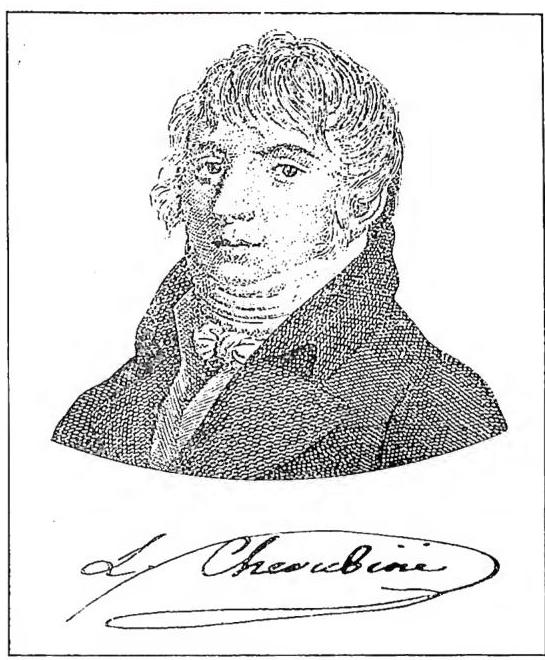
(from D. Hohmann, L. C., Lippia 1911)
CHERUBINI, LUIGI — Portrait with autograph signature.
Contemporary engraving.
small structure with two apses, entirely occupied by tombs superimposed one upon another, up to six. Two very well-known inscriptions were found there. The first (E. Diehl, Inscriptiones latinae christ. veteres, I, Berlino 1925, no. 1583) records the area at sepulcra and the cella built at his own expense by Marcus Antonius Julius Severianus and donated to the entire community (cunctis fratribus). De Rossi considered the inscription pre-Constantinian (Bull. arch. crist., 1st series, 2 [1864], p. 28), which is ruled out by the presence of the two apocalyptic letters α and ω. The second inscription commemorates four deceased persons buried in this accubitorio hoc, belonging to the presbyter Victor, qui hunc locum cunctis fratribus fecit (E. Diehl, op. cit., 1179). The two inscriptions are now in the museum of Algeri. In the same area, a chapel (12.08 × 8.40 m.) was found, divided by pillars into two naves and with adjoining rooms.
East of the city, near the amphitheatre, another chapel, likewise apsidal and entirely occupied by tombs, was discovered. From this area come two Christian sarcophagi, one bearing the anchor and the other the Good Shepherd, together with an inscription containing the rare indication of the length of time lived after Baptism (CIL, VIII, 9592). A fragment of a sarcophagus with Eve and the serpent and a sarcophagus lid with the three Jewish youths in the furnace were transported to the museum of the Louvre in Parigi (Wilpert, Sarcofagi, III, pl. 288, 12, 13, p. 42). In 1926, in the courtyard between the town hall and the museum, a stone sarcophagus had a T, the symbol of the cross, carved on its front. The museum of C. preserves several Christian cippi certainly dating from before Constantine; one bears the inscription Amanda (CIL, 21421); a second has the Good Shepherd, the anchor, and the dove carved on it; a third, the anchor, the tree, and the dove. Later inscriptions are those in CIL, VIII, 9590, 9591, 9593, in mosaic, 9594, and 9595, now in the museum of Algeri.