Also known as:
Ramesses the Great, Ramses the Great, Usermaatre Setepenre, Rameses II, Ramesses II
RAMSES ("Râ' Has Generated Him") II. - Pharaoh of the XIX dynasty, son of Seti I (Sethos) and Queen Tewe, he reigned for 67 years from 1299 to 1233 B.C. (cf. Flavius Josephus, C. Apion., I, 15, 26, 32).
He continued the work of reclaiming Egypt's hold over the territories of Palestine and Syria, begun by his father, perhaps also making use of Lycian, Dardanian, Mysian, Sardian mercenaries, etc.; he won a famous battle at Kadesh (Qidfa) on the Orontes against the Hittite king Mutallu (Muovatalli), probably the first maneuver battle remembered by history; it is exalted, together with the sovereign, in the Egyptian poem of Pentaur, of which papyri and an inscription survive. Despite the deserved victory, R. II did not succeed in subduing the country thus conquered, except after other
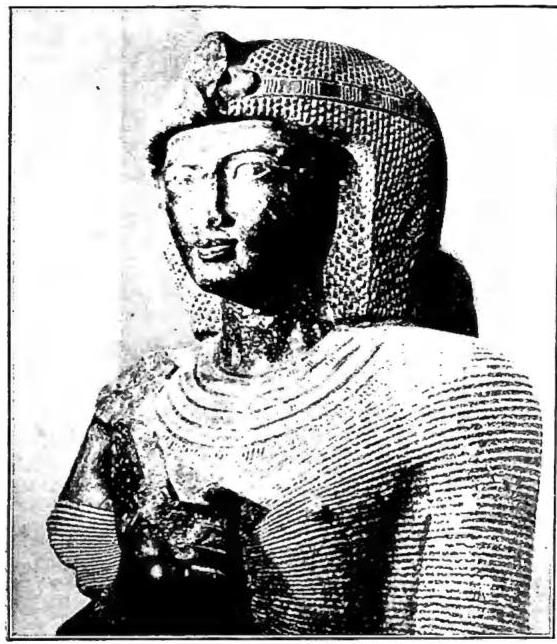
RAMSES II - Bust of R. II.(from Encyclopédie photographique de l'art, Le Musée du Caire, Ed. • Tel • 1915, pl. 118)
16 years of wars against the rebels, until he made (1290) a treaty of peace and friendship with the new Hittite king Hattushil, a treaty of which the hieroglyphic text survives in an inscription in the temple of Amun at Karnak and in another in the funerary sanctuary of his temple at 'Abd el-Qurnah, together with the cuneiform text on a tablet from Boghazköy. The pact was sealed by the marriage of R. II to a daughter of Hattushil; the sculptors of the portico of Abu Simbel reproduced the scene of the meeting between the father-in-law and the son-in-law on this occasion. R. II was buried in the Valley of the Kings at Biban el-Muluk; but his body is currently in the Cairo Museum. Innumerable and grandiose are the monuments erected by him in every part of Egypt: splendid, among others, the Ramesseum of Thebes.
According to many exegetes R. II is identified with the "new king" who began the oppression of the Israelites exiled in Egypt (Ex. 1:8-22) and whose daughter introduced Moses to his court (ibid. 2:9-10); he would have had the cities of R. (Pr-R'misso) and Pithom ([v.]; ibid. 1:11-14) built by the Hebrews. After his death "after a long time" (ibid. 2:23), his successor Merneptah (v.) would be the pharaoh of the exodus (v.), against whom Moses carried out the divine mission of liberating Israel (ibid. 3:10-15, 19).
Bibliography6 worksS. Langdon-A. Gardiner, The treaty between Hathishil and R. II, in Journ. Egypt. Archeol., 6 (1920), pp. 179-205; I. H. Breasted, Hist. d'Eg
BIBL.: S. Langdon-A. Gardiner, The treaty between Hathishil and R. II, in Journ. Egypt. Archeol., 6 (1920), pp. 179-205; I. H. Breasted, Hist. d'Egypte, trad. franc., II, Bruxelles 1926, p. 433 ff.; id., Ancient Records of Egypt, III, Chicago 1927, p. 102 ff.; P. Bovier la Pierre, Précis de l'hist. d'Egypte, I, Paris 1932, p. 158 ff.; E. Drioton-J. Vandier, L'Egypte, ibid. 1946, p. 405 ff.; P. Gilbert, Esquisse d'une hist. de l'Egypte ancienne et de sa culture, Bruxelles 1949, p. 68 ff.
Calderini, Aristide. “Ramses (« Râ' Lo Ha Generato ») II.” In Enciclopedia Cattolica, vol. X, coll. 518–519. Città del Vaticano: Ente per l’Enciclopedia Cattolica e per il Libro Cattolico, 1953. https://azioneromana.com/article/ramses-ra-lo-ha-generato-ii.
MLA
Calderini, Aristide. “Ramses (« Râ' Lo Ha Generato ») II.” Enciclopedia Cattolica, vol. X, Ente per l’Enciclopedia Cattolica e per il Libro Cattolico, 1953, coll. 518–519. Azione Romana, https://azioneromana.com/article/ramses-ra-lo-ha-generato-ii.
BibTeX
@incollection{ec10_ramses_ra_lo_ha_generato_ii,
  author    = {Calderini, Aristide},
  title     = {Ramses (« Râ' Lo Ha Generato ») II},
  booktitle = {Enciclopedia Cattolica},
  volume    = {X},
  pages     = {518--519},
  note      = {Cited by column},
  publisher = {Ente per l’Enciclopedia Cattolica e per il Libro Cattolico},
  address   = {Città del Vaticano},
  year      = {1953},
  url       = {https://azioneromana.com/article/ramses-ra-lo-ha-generato-ii}
}
One of some 20,000 entries brought back from the twelve printed volumes (1948–54). Spotted something? Help us improve it.
Click or scroll to zoom · drag to pan · Esc to close