
TRAVERSARI, AMBROGIO. — Camaldolese theologian and humanist, born at Portico di Romagna on 16 September 1386, died at Florence on 21 October 1439. At the age of fourteen he entered the monastery of S. Maria degli Angeli, a Florentine center of humanistic culture. There he devoted himself enthusiastically to the study of Latin and Greek literature, in which he was the teacher of Giannozzo Manetti, the sons of Cosimo de' Medici, and many members of the patriciate. He maintained relations with the finest men and writers of the period (N. Niccoli, P. Bracciolini, L. Giustiniani, F. Barbaro, T. Parentucelli), from whom he received visits and letters, codices to correct or transcribe, and manuscripts to revise or submit to his judgment.
T. engaged in literary activity equal to that of the most fervent humanists. Indeed, for his translations of Greek authors he employed at least three copyists, and he translated with such speed that Niccoli himself was amazed. Famous are his Latin versions of the sermons of St. Ephrem and of the lives of the philosophers by Diogenes Laërtius, both dedicated to his patron, Cosimo de' Medici. Very many codices passed through his hands, often improved in their text and always in their script, for which he employed excellent illuminators and calligraphers, who still existed at S. Maria degli Angeli.
His elevation to the office of superior general (which took place in 1431 at the monastery of S. Maria in Urano, near Bertinoro) considerably hindered this activity, which had to give way to another, more difficult and less gratifying: the reform of his Order, begun in 1431 with the visitation of the houses of the Congregation and continued until 1434. He left a meticulous account of it in the Hodoeporicon or Itinerarium, a realistic documentation of the sad condition in which, generally speaking, the religious of the fifteenth century found themselves.
In 1435 he was sent on a diplomatic mission to the Council of Basel, where, on 26 August of that same year, he delivered, in a plenary session, a speech (Mansi, XXIX, 1250–57), in which he attacked the conciliar theory (v. CONCILIARISMO), appealing to the principle that in every society there must be one head and one teacher; he warned
TRAVERSARI, AMBROGIO – Effigy from a portrait by P. Dandino, analogous to that of the Maglisbechiano codex, containing the Letters of T.
that the correction of the pope, in the event of error and fault, pertained rather to the piety of individual faithful than to the authority of a general assembly.
His intervention with Cardinal Cesarini, president of the Council, proved effective; with others, Cesarini was won back to the cause of the Holy See. At Ferrara (1438) and Florence (1439), where the Council was transferred, the presence of T. was perhaps even more valuable, because through his tact he succeeded in smoothing the rough edges of Eugene IV’s character, which would have compro-
(from K. Hielscher, Jugoslavien, Berlin 1918, plate 16)
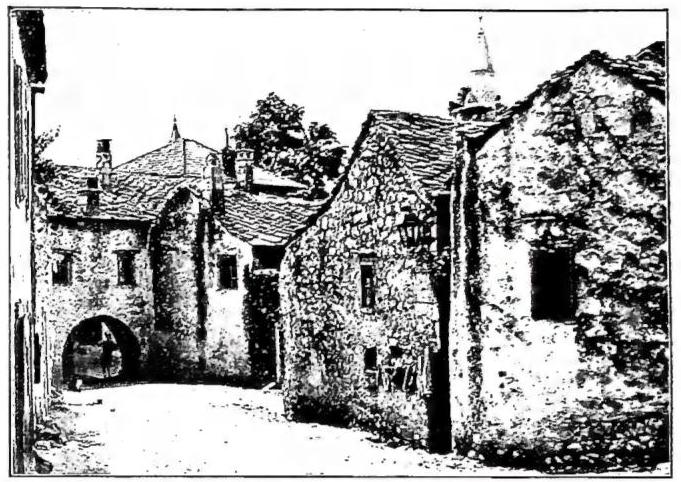
TREBIGNE, DIOCESE of – A street in the city.
mised any good understanding with the Greeks, and through his profound knowledge of Greek and Latin he facilitated the course of the discussions and prepared the way for their happy conclusion. It is not known whether his work was solely that of a translator, or whether he combined the activity of a theologian with the office of interpreter. One of his statements (letter 555) suggests that he had entered the contest with the adversary in the same doctrinal debate. T. was entrusted with the task of drafting the decree of union. After several months he died suddenly. He was buried in the church of the sacred hermitage of Camaldoli.
History has taken little interest in this great monk. If he himself had not left an Epistolario, rich in autobiographical information, and if in the Hodoeporicon he had not recounted the events of his generalate, very little would be known of his work. Today his figure has once again become of interest, because in T. the humanist it has been observed that what matters is not so much the cultivator of classical studies as the man who, amid the excesses of two opposing tendencies, followed the path of right balance.