Machine translation of the 1948–1954 Italian original. The original text is authoritative.
RODOLFO I of Habsburg, king of GERMANY. – Born on 1 May 1218, count of Habsburg in Aargau and of Kiburg (near Zurich), and lord of a large part of Alsace, he was the most powerful prince of the ancient Duchy of Swabia, which was never reconstituted after the death of the last Hohenstaufen; a man “of great enterprise and magnanimous, valiant in arms and very fortunate in battle, greatly feared by the Alamanni and the Italians” (Giovanni Villani, Cron., VII, 55).
He had the good fortune to succeed in restoring the Kingdom of Germany. When the claimant Riccar-
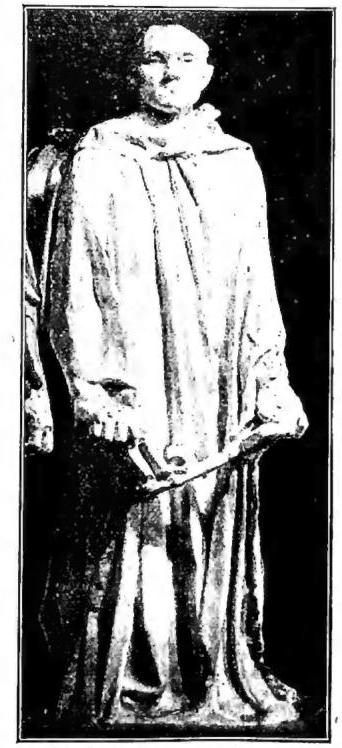
(from J. Charbonneaux, Les sculptures de R., Paris 1818, plate 80) RODIN, AUGUSTE – One of the Burghers of Calais (1886) – Paris, Musée Rodin.do of Cornwall (2 April 1272), Alfonso of Castile, his adversary, claimed that Gregory X should recognize his rights and prohibit a new election. But the Pope replied that his rights still remained disputed and that the opinion of the electors, known to be opposed to him, had to be heard; for his part, Charles of Anjou favored his nephew Philip III, king of France, for the throne of Germany. The electors began to concern themselves with the new election in the summer of 1272; and at the beginning of 1273 Werner of Eppenstein, archbishop of Mainz, worked to reconcile the ecclesiastical and secular princes, whereupon Frederick, burgrave of Nuremberg, championed the cause of R., his friend. He was in fact elected on 1 October 1273 at Frankfurt and crowned at Aachen on the 24th. Gregory X, to whom R. had communicated his election, officially recognized him as king on 20 September 1274, after having invited Alfonso and Ottokar II of Bohemia to recognize him; he then met with him at Lausanne in October 1275 and accepted his oath to help recover the possessions of the Church from Radicofani to Ceprano, the Exarchate, the Pentapolis, Ancona, Spoleto, Bertinoro and its surrounding territory, the Matildine possessions, and the rights over Sicily—in short, everything that Louis the Pious and Otto I had sworn to restore. In addition, R. received the Cross from the Pope for the defense of the Holy Land, with the promise of an imperial coronation. But R. did not descend into Italy despite repeated promises, being concerned to secure his own power in Germany together with that of his family (cf. Dante, Purg., VI, 97 ff.; VII, 91-96). Above all, he encountered the opposition of Ottokar II, king of Bohemia. The latter had succeeded in extending his rule over the southeastern duchies, advancing as far as the borders of Friuli; in June 1276 R. went to war against him, besieged Vienna, and with the help of Meinhard of Tyrol and Albert of Gorizia occupied Austria, Styria, and Carinthia, forcing Ottokar to swear allegiance to him in November. When Ottokar broke the agreements in 1278, R. again went to war against him in June, defeated and killed him (26 August), and invaded Bohemia and Moravia; then, in 1281, he assigned Austria and Styria to his son Albert, and in 1286 Carinthia to Meinhard.
R. did not, however, intend to renounce his rights in Italy, where Charles of Anjou, king of Naples, exercised effective preponderance, particularly in Rome as senator and in Tuscany as vicar. Pope Gregory worked to establish an understanding between the two, whereby Charles received the imperial investiture of Provence and Forcalquier, and in 1280 R. gave his daughter Clementia in marriage to Charles Martel, Charles’s son. R. proved more reluctant to cede Romagna to the Pope, where his vicars continued to exercise power, and only in 1278 did Nicholas III (v.) succeed in installing his rector there, Bertoldo Orsini, after compelling R. to observe what he had promised several times. In compensation, R. succeeded in claiming for himself the vicariates of Tuscany and Lombardy.
R. encountered open opposition instead at the Diet of Frankfurt in May 1291 from the German princes, when he wished to designate his son Albert as king of Germany; from there he proceeded to Speyer, where he d. on 15 July 1291.
BIBL.: O. Redlich, Rudolf V. Habsburg, Innsbruck 1903 (fundamental); F. M. Mayer – R. F. Kaindl, Gesch. V. Kulturgesch. Deutschösterreichs, I, Vienna 1929, pp. 89-98; H. Hantsch, Die Entwicklung Österreich-Ungarns zur Grossmacht, Freiburg i. Br. 1933, pp. 9-22; E. Tomek, Kirchengesch. Österreichs, I, Innsbruck 1936, pp. 238-46; H. Hantsch, Gesch. Österreichs, 2nd ed., ibid. 1948, pp. 90-129. Pio Paschin
Cite this article
“RODOLFO I D'ASBURGO, RE DI GERMANIA.” Enciclopedia Cattolica, vol. X (1953), p. 630. Azione Romana digital edition, https://azioneromana.com/article/rodolfo-i-d-asburgo-re-di-germania.