Machine translation of the 1948–1954 Italian original. The original text is authoritative.
ROSA da VITERBO, santa. — Born in Viterbo, where she spent her brief life, most probably between 1233 and 1251.
She lived most of her eighteen years in the obscurity of her humble family, at a time when Viterbo was being ravaged by the heresy of the Patareni and by political factions. In the summer of 1250, having been miraculously cured of a serious illness, and following a vision of the Madonna, she wished to be clothed in the habit of a Franciscan tertiary. After a brief period of preparation in prayer and meditation on the Passion of Christ, she began to walk through the streets of Viterbo carrying a sacred image in her hand, publicly praising the names of Jesus and Mary and inviting everyone to attend the churches. This aroused the anger of the heretics, some of whom persuaded the podestà, who governed the city in the name of the emperor Frederick II, to expel the Saint and her parents on 4 December 1250, in the depths of winter. She then reached Soriano al Cimino and, following the death of Frederick II on those days (13 December), returned to Viterbo by way of Vitorchiano. She did not leave Viterbo again until her death, which came a few months later in her father’s house, after she had vainly asked to be received among the Poor Clares. Her reputation for holiness and miracles led to the transfer of her body from the church of S. Maria to that of the nuns, and to Innocent IV’s ordering, from Perugia on 25 November 1252, the opening of the canonization process. This was not brought to completion; nor did the process opened in 1457 at the behest of Callixtus III lead to the desired canonization. S. R. was nevertheless venerated as a saint in her city, in the Franciscan Order, and by certain popes (cf., for example, the letter of Pius XII for the seventh centenary of s. R. dated 25 February 1952); her name was inserted into the Martirologio romano by Baronius, and churches and altars were erected in her honor and public honors attributed to her. Her feast is celebrated on 6 March, and the translation of her body on 4 September.
(courtesy of Msgr. A. P. Frutaz)
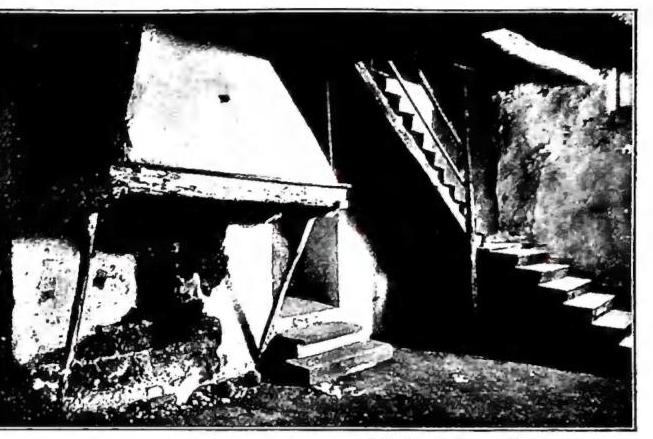
ROSA da VITERBO, santa — Interior of the house where S. R. was born, lived, and died, Viterbo.
BIBL.:Martyr. Romanum, p. 380; G. Abate, S. R. da Viterbo, terziaria francescana (1233-51). Fonti storiche della vita e loro revisione critica, in Miscell. franc., 52 (1952), pp. 113-278 (it contains a list and critical assessment of all the literature concerning the Saint). Pio Paschini
(courtesy of Fr. G. Abate, O. F. M. Conv.)
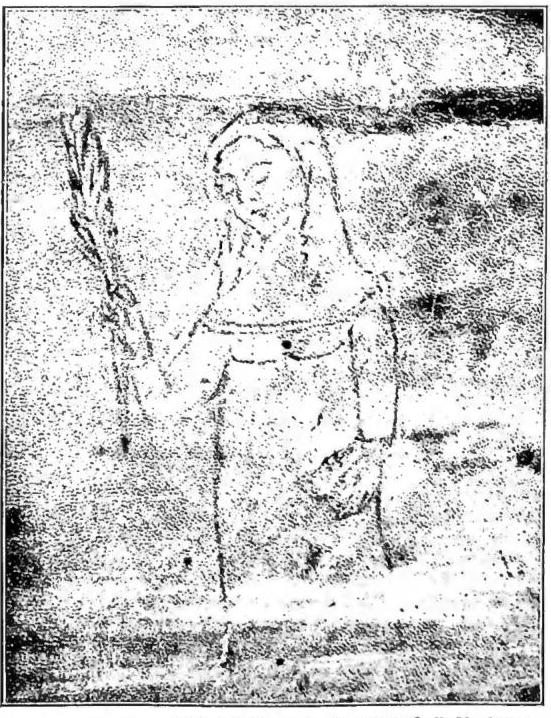
ROSA da VITERBO, santa — The oldest portrait of s. R., drawn on the verso of the parchment roll of the Vita I (the first decades of the second half of the thirteenth century) — Viterbo, Archive of the Monastery of S. R.
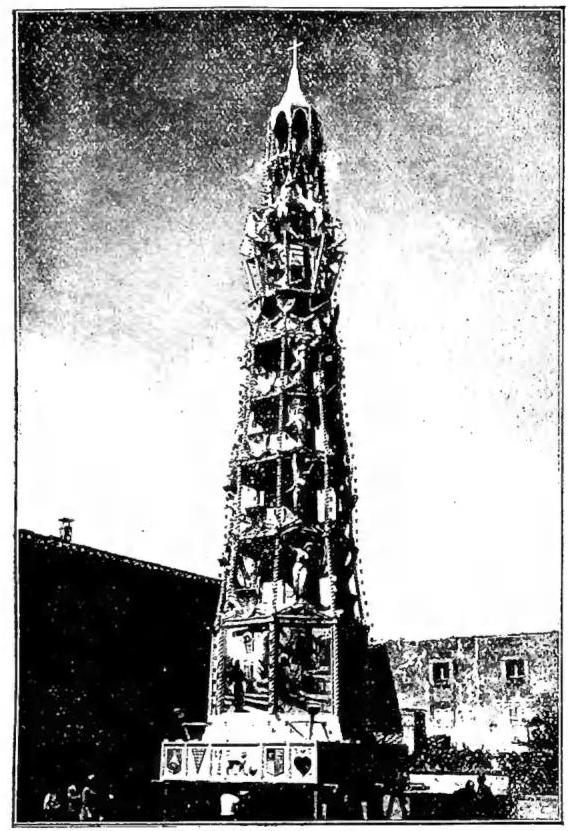
FOLKLORE. - Two annual feasts are celebrated in Viterbo in honor of s. R., patroness of the city: one is strictly ecclesiastical in character, on the day of her death (6 March); the other, popular and more solemn, takes place on 4 September, commemorating the translation of her body. On the evening of 3 September, an immense tower-like structure, with a wooden framework and an exterior of canvas or cardboard, more than 20 m. high and variously decorated and painted, at the top of which the statue of the Saint shines amid torches and candles, is carried on the shoulders through the city streets by 62 bearers known as the «cavalieri di s. R.», dressed in white with a red sash around their waists and a white tuft on their heads; having remained in seclusion that morning, before beginning the triumphant procession they receive the bishop’s blessing and visit 5 churches, praying that everything may proceed without mishap (the structure’s falling or catching fire is regarded as a sign of misfortune: this happened, for example, in 1801 and 1815, causing deaths and injuries). Upon reaching the forecourt of the monastery of S. R., the imposing structure is set down on trestles, amid the applause, cheers, and emotion of the crowd that has devoutly followed II. Orchestras, races, fairs, illuminations, and fireworks enliven the festival, which concludes on 5 September with a poetry contest organized by the Accademia degli Ardenti to celebrate the praises of R. The use of the structure dates back to 1656, in fulfillment of a vow made by the people of Viterbo following a terrible plague, and the first procession took place in 1657; the designs for its construction, selected by competition, vary each year and are collected in the municipal Pinacoteca (the oldest known one dates from 1690). From a folkloristic point of view, the structure is a symbol of strength, protection, and prayer, like other popular manifestations such as the lilies of Nola, the candles of Gubbio, and the float of s. Rosalia in Palermo.
On the occasion of the feast of 6 March, mementos of the Saint are distributed to the faithful: roses, little flowers, and small trees, which tradition holds grew on her tomb, or pieces of the coffin and clothing; special healing powers for fever or headache are attributed to the water
ROSA, SANTA - Machine of s. R. from 1952 - Viterbo.and to the ribbon of s. R. The cult was further enhanced by the iconography, which, although not very rich, includes some successful representations (e.g., the paintings by Benozzo Gozzoli on the walls of the church of S. R. in Viterbo), illustrating the most important events in the Saint’s life according to the traditional version of her life. Altars consecrated to her stand in Rome, in the church of S. Caterina, formerly called that of S. R., and in the church of Aracoeli (as well as an oratory shared by the two holy virgins R. of Viterbo and Rosalia of Palermo), and also in Vitorchiano, Bolsena, Tivoli, Fabriano, Salerno, and Foggia.
BIBL.: the works that follow, whose historical value should be assessed in light of the study by Fr. G. Abate cited above, are mentioned only for the part concerning the Saint’s folklore: B. Mencarini, Racconti della vita, de' prodigi e del culto di s. R., Viterbo 1828; G. Selli, Vita e miracoli di s. R. vergine viterbese, there 1828; J. Ch. D. Barascud, Vie et miracles de ste R. de Viterbe, Paris 1864; L. Ceccotti, Descrizione di nove storie di s. R. dipinte da B. Gozzoli nel 1453 con commentario storico, Viterbo 1872; A. Brisse, Viterbo e le feste di s. R., in Illustrazione italiana, 22 (1883), pp. 231, 234, 237; anon., St. Rose of Viterbo, in The Month, 94 (1899), pp. 276-81; P. Egidi, I disegni degli affreschi di B. Gozzoli in S. R. di Viterbo, s. l. 1904; G. Signorelli, Viterbo nella storia della Chiesa, I, Viterbo 1907-1908, p. 216; R. Papini, L'opera di B. Gozzoli in S. R. di Viterbo, in L'arte, 1910, pp. 35-42; F. Cristofori, La vita di s. R. dipinta a fresco da B. Gozzoli nel 1453, in Misc. francescana, 3 (1888), pp. 167-70; A. Scrittoli, Viterbo nei suoi monumenti, II, Rome 1915-20, p. 263 ff. (with illustrations). Giovanni Bronzini
Cite this article
“ROSA DA VITERBO, SANTA.” Enciclopedia Cattolica, vol. X (1953), p. 799. Azione Romana digital edition, https://azioneromana.com/article/rosa-da-viterbo-santa.