
HYMNOGRAPHY. – A hymn is understood as a lyric poem sung in honor of God, the Virgin, or the saints. In the early Church, the foundational religious poetry consisted of the Psalms and scriptural canticles. It is undeniable, however, that hymns of an eucological or eucharistic character flourished, used in liturgical celebrations or for private devotion. Often, in their earliest forms, these were charismatic improvisations, adopting the characteristic movements of the psalm (idiotikoi psalmoi) or composed according to popular poetic styles—all without artistic pretensions.
I. CHRISTIAN-LATIN
Two principal factors contributed to bringing Christian-Latin hymnody to its artistic perfection and maturity. Heretics (Gnostics, Arians, Donatists) readily resorted to religious hymns, sung by the people, as a means to spread their ideas. Against this propaganda, St. Ephrem the Syrian (d. 373), endowed with magnificent poetic qualities, opposed his own hymns, full of candor, sentiment, lyrical exaltation, and symbolic force; he had imitators in the Greek-speaking Churches and later also in the West. With the Constantinian peace and the subsequent triumph of the Church, the number of cultured individuals adhering to the Gospel increased. Their aesthetic demands could not be satisfied by the primitive Christian hymns, nor could they find fulfillment in them. The first representatives of the classicizing poetic school are Commodian, Juvencus, and Faltonia Proba: the first employs the classical hexameter, though exempting it from the rules of prosody, and expresses himself in popular language; the second, with the language and technique of Virgil, retells the Gospel of St. Matthew; the third employs the cento genre. Their poetic value is scant, and lyrical sense is absent. St. Hilary of Poitiers (d. 367) was the first to attempt the path of Latin religious lyric, but with little success. The three fragments of abecedarian hymns, part of his Liber hymnorum, found in the Aretine Codex published by Gamurrini (1887), demonstrate him to be a theologian of grand conceptions but an involuted and ineffective versifier. The glory of being the father of Western hymnody belongs entirely to St. Ambrose. St. Augustine recalls how his mother witnessed the birth of Ambrose’s poetry, which arose during the most threatening phase of the anti-Arian struggle, when the bishop and the people of Milan were besieged in the Porzian Basilica by the henchmen of Justina: «on that occasion, the custom of the Eastern lands of singing hymns and psalms was introduced, so that the people would not be consumed by sadness and weariness» (Conf., IX, 7). The poetic form chosen by Ambrose for his hymns is that of the acatalectic iambic dimeter, which was later called the Ambrosian verse; it is simple, fluid, and musical. What is its origin? It is excluded that this should be sought in the East. From the Easterners, the great bishop drew the use of antiphonal singing and perhaps also the melodic mode. Of popular inspiration and artistic craftsmanship, meticulous in meter, the poetry of St. Ambrose, full of elegance, Roman gravity, and virile tenderness in the effusion of Christian piety, is a great model that will have more imitators than any other. The thesis that the authentic hymns of Ambrose are fifteen is acceptable: Aeterne rerum Conditor; Iam surgit hora tertia; Deus creator omnium; Intende qui regis Israël; Splendor paternae gloriae; Inluminae altissimus; Apostolorum supparem; Victor, Nabor, Felix pii; Apostolorum passio; Hic est dies verus Dei; Agnes beatae Virginis; Amore Christi nobilis; Aeterna Christi munera; Grates tibi, Iesu, novus. Aurelius Prudentius (d. at the beginning of the 5th century), who emerges in his poetic activity as Ambrose declines, adopts the latter’s versification scheme in some of his hymns.(from Chronologia Romanorum Pontificum, Rome 1751, p. 122)
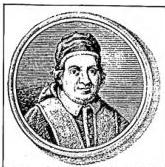
INNOCENT XIII - Portrait.
It should be noted that the introduction of hymns into the liturgy of the Western Churches occurred gradually. It began in Milan. The Rule of St. Benedict, prescribing the recitation or singing of a hymn at every canonical hour, greatly contributed to this diffusion, which is particularly evident in France, Germany, and Ireland. In Spain, destined to become the land of hymns, the practice flourished after the Fourth Council of Toledo (633). Rome followed the example only in the second half of the 12th century, borrowing from the Mozarabic Breviary. From 600 to the Carolingian era, the hymnographic literature of the Irish-Scottish monks in their islands, as well as on the European continent, where many emigrated, is noteworthy.
Alongside rhythmic and metrical poems, there are, predominantly, those in which neither regular accent nor prosody is observed, but rather rhyme and assonance.
The Carolingian Renaissance entailed an intense poetic production, due to the reassertion of classicism, predominantly metrical (hexameters, distichs, Sapphics). The poets were numerous and honored at the Carolingian court, which later, in the cult of the Latin muse, was replaced by episcopal residences and abbeys (Liège, Trier, Metz, Speyer, Bamberg, Regensburg, St. Gall, Naples, Montecassino, etc.). The principal poets who had the glory of writing hymns that became liturgical are: Paul the Deacon (d. 798), Paulinus of Aquileia (d. 802), Theodulf of Orléans (d. 798), Rabanus Maurus (d. 856). Of Paul the Deacon are the two hymns to St. John the Baptist: O nimis felix meritique celsis and Ut queant laxis resonare fibris, which offered Guido of Arezzo the nomenclature of the musical scale. Of Paulinus of Aquileia is the hymn to the Holy Apostles Peter and Paul (O Roma Felix, quae tantorum principum). Of Theodulf, called the Pindar, are the distichs for the Palm Sunday procession: Gloria, laus et honor, in which the glorification of Christ the King is exquisitely veiled by the lament for His Passion. Of Rabanus Maurus are two hymns for the Feast of All Saints, already much loved and used: Christe, redemptor omnium and Iesu, salvator saeculi. To this period dates the composition of the Veni creator Spiritus, attributed to Charlemagne. In the 9th century, the translation of relics and the cult of the saints intensified. Consequently, for processions and feasts, a flourishing of hymns with an epic flavor arose. Rhymes appear regular and careful; in Sapphics, at the end of the verse and also after the caesura: O veneranda Trinitas laudanda. In this age originated the poem Christe rex regum, which represents the almost orgiastic triumph of rhyme.
With the rise of the mendicant Orders, Franciscans and Dominicans, and particularly through their work, hymnodic poetry received a new, warm, and innovative impulse, which developed and favored private prayer. Rhyme was esteemed and sought with diligence; from the mid-12th century, the bisyllabic feminine rhyme predominated. Jacopone da Todi, Adam of St. Victor, Alfanus of Salerno, and John Peckham are to be mentioned. For the Office of Corpus Domini, introduced by Urban IV (1264), St. Thomas Aquinas wrote the hymns, of vast resonance, grand in form and expression, rhythmic and rhymed: Pange lingua, gloriosi; Verbum supernum prodens; Sacris solemnis iuncta sint gaudia. Of inferior craftsmanship, but heartfelt, are the hymns attributed to St. Bonaventure, widely used: In passione Domini; Imperatrix clementiae; and O gloriosa Domina quae tua cruciamina. From 1300 to 1500, a decline in hymnody is noted. The compositions are numerous but mediocre due to lack of expression, puerile wordplay, and disregard for the laws of accentuation. They rise above the common level for their perceived poetic qualities: Thomas à Kempis (d. 1471), John of Jenstein (d. 1400), the anonymous author of the iubitus rythmicus, Bernardine in substance, Iesus dulcis memoria. In the 15th century, the cult of St. Joseph arose, and hymns were composed in his honor. In this regard, far better known and widespread than that of Simon Gerson (d. 1429): O veneranda Trinitas-Iesus, Joseph et Maria, is the other by an anonymous author: Plaude caelestis curia.
The 70 or 75 hymns of the Breviary represent but a small part of the thirty thousand that have been found and published to date, a true poetic forest of the Middle Ages, largely due to the Platonic-Augustinian direction of theological thought. The hymns of the Breviary, in which the two poetic tendencies proper to Christian literature are reflected—
BIBL.:
A. S. Walpole, Early Latin Hymns, Cambridge 1922; U. Chevalier, Repertorium Hymnologicum, Louvain 1892-1921; F. J. E. Raby, A History of Christian-Latin Poetry, Oxford 1927; Id., A History of Secular Latin Poetry, ivi 1934; P. Cagin, L'Hymnodie occidentale, Solesmes 1906; G. M. Dreves, Analecta Hymnica Medii Aevi, Lipsia 1886-1926; C. Blume, Ein Jahrtausend lateinischer Hymnendichtung, Lipsia 1909; H. Leclercq, in Dictionnaire d'archéologie chrétienne et de liturgie, VII, Parigi 1927, coll. 2877-2922; A. Wilmart, Auteurs spirituels et textes dévots du moyen âge latin, Parigi 1932; G. Vecchi, L'inno cristiano nella letteratura latina, Bologna 1936; M. Simonetti, La poesia cristiana antica, Brescia 1948; V. anche INNO; LITURGIA; POESIA CRISTIANA.
A. Lentini
Latin hymns, both metrical and rhythmic—reflecting the two poetic tendencies of Christian literature—underwent a revision at the initiative of Urban VIII (1623–44), which reduced them to almost total metrical uniformity: a victory, this, of classicizing Humanism. The Pope, himself a Latin poet, was assisted in this reform by the Latinists Strada, Galluzzi, Petrucci, and Sarbiewski. Ardent in their zeal for the purity of classical prosody and meter, they identified 1000 "errors," though they corrected only 952. With the earliest poets, such as St. Ambrose, Prudentius, Sedulius, and Venantius Fortunatus, they were fairly respectful, but with many of the later ones they were merciless; some hymns were subjected to radical revision: thus, two hymns—Tibi, Christe, splendor Patris for the feast of St. Michael and Urbs beata Ierusalem for the dedication of the Church—were recast and rewritten in a new meter; the hymns of St. Thomas Aquinas were left untouched. This hymnographic revision was approved by the Sacred Congregation of Rites in 1629. Some judged it harshly, to the point of saying: «accessit latinitas et recessit pietas.»
II. IN THE GREEK CHURCH
Little or nothing is known of the origins of hymnography in the Greek Church: the first accounts, which come from a pagan source, Pliny the Younger (Ep., X, 97), refer not so much to the content as to the form of execution of the hymnographic complex. Antiphonal chant held predominance in the early centuries of Christianity: it consisted of an alternation between two choirs in which the verses of a psalm were sung in turn by the two groups (proper antiphons) or were commented upon by a refrain (responsory) or by a simple formula independent of the text (alleluia, amen, kyrie eleison, etc.), which later acquired various names according to developments and usages (ὑπακοή, ὑπῆλμα, ἀκροστῆλον, ἐφύμνιον).Of the ecclesiastical hymns of the very earliest centuries, which must nevertheless have flourished in an era of religious fervor and glorious martyrs, very few have been handed down: the morning hymn δόξα ἐν ὀξίαναις, sung in Gregorian chant in the West during the early centuries; the vesper hymn αἰνεῖτε, παῖδες, κύριον; the lucernarium φῶς Ἰλαρόν; the thanksgiving hymn for the meal εὐλογητὸς εἶ, Κύριε, ὁ τρέφων με ἐκ νεότητός μου; the antiphon for the Madonna, preserved in its primitive form by a third-century papyrus ὑπὸ τὴν σκέπην εὐσπλαγχνίας σου = sub tuum praesidium (C. H. Roberts, Catalogue of the Greek and Latin Papyri, III, Manchester 1938, no. 470).
Yet these are still far from hymnography understood as an independent and free creation of the poet’s enthusiasm: the hymns of the Synagogue, especially the Psalms of David, were regarded as the highest human expression, and thus the most fitting that the Christian soul could address to the Divine Majesty; and new creations were considered all the more worthy insofar as they echoed the forms and words of the ancient texts. Opposing criteria were debated in the early centuries regarding the orientation of sacred hymnography: while the Antiochean Council of 269 condemned Bishop Paul of Samosata for having excluded from his church recent chants not modeled on the Psalter of David (Eusebius, Hist. eccl., VII, ch. 30), an opposing view was expressed around 370 by the Synod of Laodicea, which deemed new hymnody dangerous to the soul’s salvation. These prejudices were detrimental to the development of hymnography, and their influence is evident in the creation and diffusion of the canon and, indirectly, in most of Byzantine sacred poetry.
Meanwhile, a vigorous contribution to free creation had come, indirectly, from heretical hymnographers (above all the Syrian Bardesane, whom St. Ephrem credits with 150 hymns with their respective meters and musical airs; St. Clement of Alexandria and the Egyptian Nepis, who preferred rhythmic prose to strict metrical form; and Arius, author of the Thaleia). The independence from traditional norms and the use these figures made of sacred poetry for the diffusion of their heresies placed the hymnographers defending orthodoxy on the same level of free and personal composition. Thus, St. Ephrem countered Bardesane’s hymns with his own, reproducing their rhythms and musical airs. In the fourth century, Methodius of Olympus, Gregory of Nazianzus, and Synesius introduced classical meters into sacred poetry, with great skill but little success; while rhythmic poetry later found, between the fifth and sixth centuries, exponents in the anchorite Cyriacus, Cyril of Alexandria, Antimus, Marcian, Assentius, Anastasius, and even the Emperor Justinian, author of the famous «ὁ μονογενὴς Υἱὸς καὶ Λόγος» (Christ., p. 32).
A new hymnographic genre suddenly appears in its full development in the sixth century: the kontakion (κοντάκιον), whose greatest and unsurpassed exponent was Romanos of Emesa. In its original form, it consists of a complex of 18–24 strophes (οἶκοι = stanzas) of equal metrical structure, preceded by a proem (κοκοκύλιον) of different rhythm and composition, whose closing line serves as a refrain (ἐφύμνιον) for all subsequent strophes. While the name derives from κοντός, the wooden rod around which the parchment was rolled, the hymn is said to have had precursors in Syrian poetry. The subjects of the kontakion are drawn from the mysteries of the Gospel and the spiritual and historical world of Christianity; its form is closely connected to both the homily and drama. Indeed, Romanos closely recalls the acrostic dialogues of St. Proclus’ homilies. Among the many exponents of the kontakion, besides Romanos, are Anastasius, Domitius, and Cyril. Particularly famous and widespread is the brilliant hymn Akathistos (sung standing), of disputed authorship.
The kontakion dominated until the eighth century, that is, until the appearance of the canon. This new hymnographic genre consists of nine odes—later reduced to eight with the elimination of the second, reserved for the Lenten period—each with different meter and melody. Each ode is composed of four or more strophes (troparia), the last of which is always dedicated to the Madonna (theotokion). During Lent, canons of three or four odes (triodia–tetraodia) are adopted.
In the standard canons—with original meter and melody—the first strophe of each ode begins, by allusion or juxtaposition, from a predetermined biblical hymn: the first from the Song of the Israelites (Ex. 15:1–8); the second—the Song of Moses at his death (Deut. 32:1–43); the third—the Song of Hannah (1 Sam. 2:1–10); the fourth—the Prayer of Habakkuk (Hab. 3:2–19); the fifth—the Prayer of Isaiah (Is. 26:9–21); the sixth—the Prayer of Jonah (Jon. 2:3–10); the seventh—the Hymn of the Three Young Men in Babylon, also called of Azariah (Dan. 3:2–33); the eighth—the Hymn of the Young Men in the Furnace (ibid. 3:34–65); the ninth—the Hymn of the Virgin, the Magnificat (Lk. 1:46–55). In this consistently observed norm, it is not difficult to discern a compromise between rigid traditionalism, opposed to the use of hymns not drawn from Scripture, and the tendency to adopt new chants while respecting tradition. It is logical that the canon originated precisely in monastic circles.
The creation of original rhythms and melodies waned, eventually ceasing entirely in the 9th century. Instead, simple hymnography flourished vigorously among poets who were not musicians, who adopted rhythms composed by others. These hymns, like all others modeled on a prototype, were called prosomia; those original melodies borrowed by hymnographers were termed automela, while those entirely unborrowed were called idiomela. The needs of hymnographers and choirs led to the compilation of the poetic and melurgic texts of the first strophes of original Canons, which were chosen as models (hirmi), forming the Hirmologhion.
Among the hymnographers, Mitrofane, author of numerous canons of the octoechos, Metodio of Syracuse, and his fellow citizens Gregorio and Teodosio should be mentioned. However, a far more extensive legacy was left by Giuseppe of Catania, known by antonomasia as the Hymnographer, and his disciple Teofane. Their works, preserved in the Menaia and the Paracletica, were so vast as to nearly complete the entire liturgical year. Giuseppe of Thessalonica, author of many canons of the Pentecostarion and the Triodion, and other scholars such as Antonio, Arsenio, Basilio, Gabriele, and Nicola also contributed significantly.
The canon became the center of the liturgy, particularly of Matins. The kontakion was affected by this shift: it was not eliminated but reduced to its proemium and a single strophe (the first), inserted between the sixth and seventh odes. Similarly, the cathisma, the catavasia, and the synaxarion were placed between the preceding odes. This liturgical norm often resulted in the same author composing the canon, the kontakion, and the intervening troparia.
Toward the end of the 7th century, a new hymnographic genre emerged: the syntomon, a concise hymn with heptasyllabic verses and pentastich strophes. Cipriano was its author, and the prototype (ὕλιος τοῦ Ἐφραδά) was borrowed by Damasceno, Germano, Giuseppe the Hymnographer, Stefano Italogreco (11th century), and, in later centuries, by many other unfortunately anonymous hymnographers.
After the 8th century, melodes became noticeably rarer. Less prolific but continuators of the glorious tradition were the poetess Casia, Fazio, and the emperors Leone the Wise and Costantino Porfirogenito. The decline of hymnography intensified after the 10th century: poetry became increasingly clumsy with bombastic phrases and insipid with commonplaces. Nonetheless, Giovanni Mauropa, Giovanni Zonara, and Nicetore Blemmida deserve mention, as do the Italo-Greek hymnographers of Grottaferrata, Nilo Bartolomeo, Paolo, and Stefano.
It was customary, though not without exceptions, for the author to include their name in the hymns, preceded, where the compilation’s structure allowed, by a phrase. Both were expressed through the initial letters of the troparia (acrostichis). Sometimes, these initials formed neither a phrase nor a name but simply the ordered sequence of the alphabet’s letters: «ἡμνοι ἀλεφάγησι».
Meter was not based on duration but on syllable count and word accent. Within strophes of the same composition, verses strictly corresponded in isosyllabism and homotony. The Greek people’s sense of long and short syllables had long been lost, and the learned attempt by Gregorio Nazianzeno, Sinesio, and a few others to adopt classical metrics was inevitably doomed to failure.
III. IN THE ARMENIAN RITE
The hymns used in the Armenian liturgy are quite numerous. The Hymnal or Sharaknots (v. ARMENIA), which contains almost all of them, includes 1,166 hymns. These can be divided into three groups: those called "canons," which are intended for the office of a specific day (the feasts of the Lord and of the great saints); those forming a series of hymns not tied to a fixed day but regulated according to one of the eight tones prescribed for that day (Sundays, the commemoration of the Saints, Lenten ferias); and finally, nearly isolated hymns in honor of a saint or intended for some particular purpose.To be complete, the "canon" or "series" must comprise eight hymns, distributed as follows: the first, in the Midnight Office, is added to the canticle of Ex. 15:1-21; the second, third, fourth, and fifth, in the Matins Office, are added to the hymn of the three youths (Benedictus), the Magnificat, the Miserere psalm, and the Lauds psalm; the sixth, in the Holy Mass, is sung before the Trisagion and is the proper hymn of the day; the seventh, in Vespers, to Psalm 120 Leuavi; and the eighth, in Matins, to Psalm 102 Laudate pueri. The central core consists of the second, fourth, and fifth hymns; often the third is missing, even more frequently the sixth, and the seventh is rarely found; the missing ones are replaced by hymns taken from similar canons.
These hymns generally have from three to five strophes, but may have as many as ten. Some are in prose, others in measured prose, still others with blank verse, and finally some with full rhymes. The versification system is similar to that of the Greeks, and the length of a strophe is akin to that of a troparion in Greek hymnography.
In addition to the Sharaknots, hymns are also found in the Khorhrdatetr (= Missal): the one beginning with "Profound mystery" is well known; then there is the incensation hymn, the Introit, after the lessons the hagiology, then the hymn during the kiss of peace, after the Consecration three hymns respectively to the Father, the Son, and the Holy Spirit, and finally the Communion hymn. Almost all these chants are not hymns in the strict sense of the word, as they consist of a single strophe.
Other hymns are found in the Mashtots (= Ritual) in the rites of Baptism and Marriage, but especially in those of the various degrees of Ordination. These hymns are sung at the beginning, during the entrance, on the occasion of a procession, or even at the end, e.g., after the handing over of the instruments or the vesting of the newly ordained (cf. H. Denzinger, Ritus Orientalium, Würzburg 1853; F. C. Conybeare, Rituale Armenorum, Oxford 1905).
Finally, the Jamagirk (this book contains the fixed parts of the Divine Office) provides, in addition to the hymns of the minor hours also found in the Sharaknots, at Nocturns three hymns by Nerses the Gracious, and at Vespers the ancient hymn Φάς Παρβν (text quite different from the Greek; cf. Breviarium armenium, Venice 1908).
Contrary to the overly skeptical thesis of Ter Mikaelian, it can be believed that some hymns were composed as early as the 5th century and that while others were lost or not admitted into the Hymnal, new ones were written until the 15th century; however, one should not trust the attributions of many hymns to this or that author, as it seems those attributions were established only in the 11th century. Undoubtedly, the most prolific, elegant, and widely represented author is St. Nerses the Gracious (1102-72). Many of these hymns excel in simplicity of form, clarity of content, originality of imagery, and solemnity of tone; but this criterion is not sufficient to distinguish between ancient and more recent hymns.
IV. NEL RITO COPTO
Inni liturgici si cantano nel rito del Battesimo, del Matrimonio, dell'Estrema unzione, dei funerali (versione inglese in R. M. Woolley, Coptic Offices, Londra 1930, pp. 34, 52, 74, 77, 80, 92, 110, 147-52) e della benedizione della chiesa (testo e versione inglese in G. Horner, The Service for the Consecration of a church and altar, Londra 1912, p. 12). Numerosi sono gli inni cantati nell'Ufficio divino; nelle Ore minori si canta un troparion seguito da un breve inno alla Madre di Dio, dei quali si è ritrovato l'antico originale greco (cf. O. H. E. Burmester, The Canonical Hours of the Coptic Church, in Or. Chr. Periodica, II [1936], pp. 78-100); nelle grandi ore del vespro, notturno e mattutino si eseguono i veri inni copti; ai canti scritturistici si riallaccia un psali, seguito dalla theotokia del giorno dellasettimana e dall'antifona del santo del giorno, in altri momenti dell'Ufficio si intercala la dossologia in onore dei santi. Il libro corale contenente i diversi inni si chiama Psalmodia o anche Theotokia, dalla prima edizione fatta da Tuki (Roma 1764); ma Theotokia designa anche un Ufficio in onore della Madonna aggiunto, ad libitum, al vespro, specialmente nel mese di Khoiak (= dicembre), che comprende un psali, il theotokion propriamente detto, un lobs (= parte finale) e un targ (= glossa). Tutti questi inni sono composti di molte strofe, generalmente di quattro versi con rima, ma senza ritmo o metro prosodico. La loro ispirazione poetica è piuttosto povera, eccetto nelle theotokia le quali manifestano più vivacità e spontaneità.
V. NEL RITO ETIOPICO
La liturgia etiopica non è finora abbastanza studiata per potere determinare in quale misura gli inni del rito copto sono stati adottati nel rito etiopico e tradotti in ge'ez. I tre innarii etiopici più importanti sono inediti, cioè il Degnâ, raccolta di inni per le feste, la quaresima, il tempo dopo Pasqua (cf. C. Conti Rossini, Aethiopica II, in Riv. Studi orient., 10 [1923-25], pp. 515-16); il Me'eraf, raccolta di inni per le feste dell'anno; e il Maccâse'et, antifonario per tutto l'anno; anche l'Egzi'abhêr nagsa, contenente gli inni in onore dei santi, ordinati secondo il Sinassario, è inedito. Esiste però un'edizione del Weddâsê Môtjâm, corrispondente alle Theotokia copte (ed. con versione tedesca di K. Fries, Lipsia 1892; il principio delle sette parti è tradotto in francese da S. Grébaut, Manuscrits éthiopiens appartenant à M. N. Bergey, in Rev. Or. chrétien, 22 [1920-21], pp. 426-38) e del Weddâsê wa-genâj, parafrasi della theotokia della domenica (cf. Grébaut, ibid, pp. 438-42). Gli inni mariani più belli e più profondi sono l'Arghâna Weddâsê, diviso in sette canti (ed. e vers. tedesca con note di S. Euringer, Die Marienharfe, in Or. Christ., 3ª serie, 2 [1927], pp. 120-45), e il Mâḇêta segê, di 156 strofe, cantate dal 26 giugno al 26 sett. (ed. e vers. tedesca con note di A. Grohmann, Äthiopische Marienhymnen, Lipsia 1919, pp. 47-321). Questi inni non hanno metro prosodico, ma unicamente la rima; la strofa conta generalmente cinque versi.VI. HYMNODY IN THE SYRO-WESTERN RITE
The first Christian hymns in the Syriac language are attributed to Bardesanes, who used such songs to spread his heretical ideas. To employ the same means of propaganda, the deacon St. Ephrem directed a choir of youths who performed his compositions. His hymns belong to various types of poetry.The madrāšā (pl. madrāšê) consists of a series of strophes sung by the soloist, separated by a refrain or 'ānîtā performed by the choir. The strophes have a variable number of verses, from four to ten, often arranged in pairs to form a bajtā (= οἶκος); each bajtā conveys a complete meaning. Homotony, and sometimes isosyllabism, is the rule, though with many exceptions. St. Ephrem is said to have composed three hundred madrāšê.
The second type is the sāgîtā, composed of several strophes linked by an alphabetic acrostic. After a brief introduction, it unfolds in dialogue, with one strophe responding to another. This element of vivid dramatic character distinguishes it, and here, at least in part, the origin of the Greek kontakion must be sought. Among the poetic works of St. Ephrem, see especially Th. I. Lamy, S. Ephraem Syri hymni et sermones (3 vols., Malines 1882-89; text and Latin translation); Inni alla Vergine di s. Efrem Siro, complete translation by G. Ricciotti (Rome 1925).
To these two types of liturgical poetry should be added a genre of rhythmic prose, the mēmra, an instructive homily intended not for singing but for reading. It can be very long (in Jacob of Serugh, sometimes over a thousand verses). After St. Ephrem, this genre found other practitioners: Bālaj, Cyrillona (v.), but especially Jacob of Serugh (v.), called the "flute of the Holy Spirit" and the "harp of the Orthodox Church."
Rabbula (v.) are attributed hymns performed with melismatic chant, called taḥšefātā. Today, they are sung in the Night Office and during Holy Mass at Communion.
In the 6th century, hymns of another genre appeared in the liturgy. First among these are the hymns contained in the so-called Octoechos of Severus of Antioch, translated into Syriac first by Paul of Edessa, then more perfectly by Jacob of Edessa. Each of these chants is called a ma'nītā; it is a very long strophe that can be compared to the Latin antiphon and is sung in the same way, alternating with the verses of a psalm (cf. ed. and trans. by E. W. Brooks, The hymns of Severus...: PO 6, 1-179; 7, 595-802).
Another genre, more popular and thus more successful, is the qālā, created by the genius of a deacon, Simeon of Gesir, a humble potter, whence the name qāqā sometimes given to this genre. It consists of a series of identical strophes (cf. examples in the Baptismal Rite in H. Denzinger, Ritus Orientalium, I, Würzburg 1873, p. 270).
In the same 6th century, a third type of hymn emerged, the ba'ūtā (pl. ba'ācūtā), which was cultivated more intensively from the 9th century onward. The word means "supplication" (v. Aṭā). It is divided into strophes and uses a refrain like the madrāšê, but generally has longer verses with a strongly accented rhythm like the mēmra. Depending on the number of syllables in each verse—7, 5, or 12—it is called Ephremic, Balaitic, or Jacobite meter. Examples from the baptismal and matrimonial rites can be found in Denzinger, op. cit., I, p. 287; II, pp. 390-399, 400, 404, etc.
The last type of hymn to appear is the 'enjānā. Here, the biblical canticle or psalm is the primary element, while the poetic strophe is secondary. The soloist sings the psalm, and the choir responds with the refrain, following the ancient responsorial manner. Among the Syrians in the Syriac language, it first appears in Psalm 50, in the psalms of the Laudes (like the oikoi of the Byzantines), and in the scriptural canticles of Vespers, Nocturns, and Matins. They were called "ancient canons" when, in the 9th century, the canons of the Greeks began to be translated into Syriac. While the Greeks entirely detached the strophes of the nine odes from their biblical chant, the Syrians continued to sing the latter recto tono, though giving the poetic strophe a varied melody. An example is Psalm 50 in the baptismal rite (cf. Denzinger, op. cit., I, pp. 295, 302. Cf. also the special studies by O. Heiming, Die 'Enjānēhymmen der Berliner Handschr. Sachau 349, in Or. Christ., 3rd series, 5 [1930], pp. 19-55; id., Syrische 'Enjānē und griechische Kanones, Münster 1932).
It is understandable that the emergence of ever-new types of liturgical poetry led to the disappearance of many older compositions or to their adaptation within the new genres. Today, the qālē and ba'ācūtā predominate in liturgical books over other types of hymns.
VII. IN THE SYRO-ORIENTAL (CHALDEAN) RITE
From the 4th to the 17th century, the Chaldean liturgy was continually enriched and renewed through the composition of new hymns and religious poetry. However, two periods within this timeframe exhibit a remarkable flourishing of poetic creations: the period of hymnography’s formation itself, from the 4th to the 6th century, and a second flourishing from the late 13th to the 16th century. It is the production of this latter period that still dominates the chants of the various liturgical offices in the Chaldean rite today; ancient poems have either been supplanted or preserved only in part, or sometimes retained as vestiges of antiquity inserted into new creations, occasionally forming part of a different poetic genre.The formation of this tradition was primarily the work of St. Ephrem (v. rite). From him, the current Office preserves mēmra (in the Office of the Fast of Nineveh), madrāsē (in the Marriage rite), qālē (in funerals), and tebēhātā* (in the Morning Office).
After him, Narsai, the founder of the School of Nisibis—who earned the title "harp of the Holy Spirit"—composed 360 poems divided according to the twelve months of the year. These are mēmra, which, due to the refrain placed at the beginning of each, belong to the madrāsē (published without translation by A. Mingana, Narsai homiliae et carmina, 2 vols., Mosul 1905). Some of his works are also preserved in current liturgical books; notably, the pāsāqē in the funeral rite (partially edited and translated by M. Wolff, in Oriens Christ., new series, 12-14 [1925], pp. 1-29). The attribution of a series of sōgātā is disputed (published with a German translation by F. Feldmann, Syrische Wechslieder von Narses, Leipzig 1896; in any case, they are clear examples of that genre of dialogic poetry). Among the poets of this period, the katholikós Mār Ābā and Bābaj of Nisibis should be mentioned, of whom several tebēhātā remain—a poetic genre cultivated with preference by monks before the Arab invasion. To Giovanni dēbēt Rabban (d. probably in 566-67) are attributed the 28 qālē dē'ūdrānā found in the appendix of P. Bedjan’s Breviarium chaldaicum (anastatic edition, Rome 1938), forming an important part of the ferial Nocturnal Office. This is a series of strophes, sometimes shorter, sometimes longer, of metrical structure, theoretically uniform and preceded by a few words taken from a psalm. The final strophes are successively dedicated to the Virgin Mary, the saints, the Cross, the titular saint of the church or monastery, and the deceased. Several of the qālē have one or more bahāfē, that is, alternative texts whose metrical structure is independent of that of the main qālā (cf. A. Baumstark, Paradigmengebete ostsyrischer Kirchendichtung, in Oriens Christianus, new series, 9-10 [1920-21], p. 1 ff.).
From the subsequent period, Išō'jahb III should be noted, who organized the choir book (Hūdrā), the priest’s book (Euchologion), and the ordination book. Some madrāsē are attributed to him. Then, Bābaj of Gēbūtā, a reformer of music and founder of music schools, authored many acrostic poems and 'ōnjātā dēhāsājē.
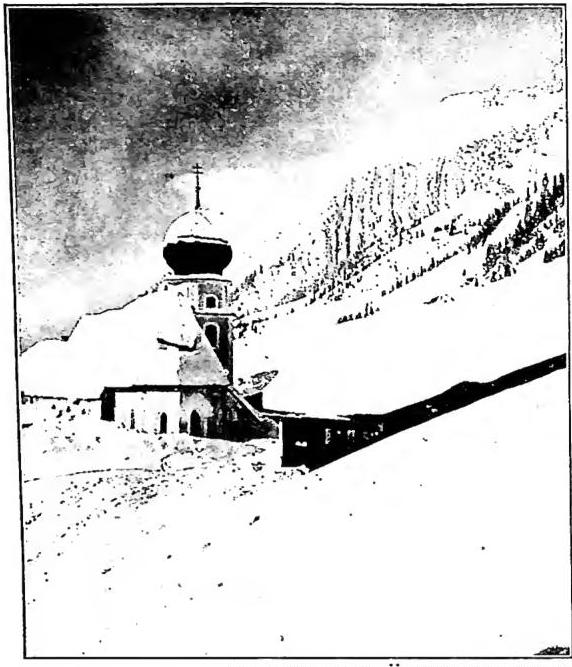
(photo: Bildarchiv d. Ö. Nationalbibliothek)
INNSBRUCK - Parish church of Stuben (1507) in Vorarlberg;
the bell tower is Baroque.
After Giwargis Wardā, many others composed
the various types of liturgical poetry, such as Īšōʿjahb bar
Mēqaddam and ʿAṭṭājē bar Atelī in the 15th and 16th centuries.
In the 14th century, a new poetic genre appears that
was not widespread everywhere, as it seems, and is almost
abandoned even today, namely the türgāmā; it is a poem with
an alphabetic acrostic of stanzas generally consisting of two
verses of 12 syllables, which introduce or explain the Gospel
of the Mass; rarely also the Epistle; cf. an example
of both, in English translation, in F. E. Brightman, Eastern and Western Liturgies, Oxford 1896, pp. 275
and 259.
Hymns of every kind occupy a large part of the Hours
of the Divine Office, especially the ʿōnjātā, teṣbēhātā, and
qālē (cf. A. J. Maclean, East Syrian Daily Offices, London
1894), but they are not absent from the celebration
of the Eucharistic sacrifice (cf. A. Rücker, *Die
wechselnden Gesangsstücke der ostsyrischen
Messe, in Jahrb. f. Liturgiewissenschaft.*, I [1921],
pp. 61-86), in the administration of the Sacraments,
particularly Baptism and Marriage (cf. H. Denzinger, Ritus Orientalium, Würzburg 1873, very deficient),
as well as in the rites of ordinations, the consecration of the church or monastic vesting,
and even more so in funerals with
related Offices (cf. for all these rites,
J. P. Badger, *The Nestorians and Their
Rituals*, II, London 1852).