
TOMMASO da KEMPIS. – Ascetic writer (Thomas Hamerhen [Lat. Malleolus] van Kempen), born in Kempen (near Cologne) around 1380, died at St-Agnienberg on 13 June 1471. After attending the school in his village, at the age of 12 he went to Deventer, where he continued his studies from 1392–93 to 1399; there Florentius (v.) Radevijns, who provided for his material needs and guided him spiritually.
Edified by his teachers and fellow students, who lived under the influence of Brothers of the Common Life (v.), and encouraged by his friend Radevijns, once he had completed his studies he entered the monastery of the Canons Regular of St. Ago-
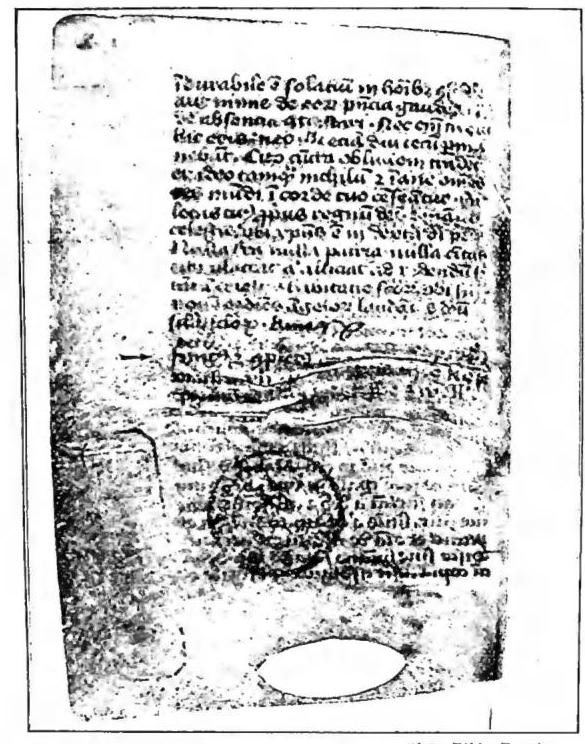
TOMMASO DA KEMPIS – Autograph subscription, rubricated; the arrow indicates its beginning: Finit(us) (et) (con)plet(us) an(n)o D(omi)ni M. CCCC. [XLI. p(er) mat(nu) (frat)ris tho(m)e ke(m)p(en)si) [In mo(n)e S(ance) agnet(is) p(ro)pe zwol(is). Bruxelles, Bibl. Royale de Belgique, ms. 5835-61, f. 192v.
stino, recently founded at St-Agnietenberg (Mons Sanctae Agnetis), near Zwolle, where his elder brother Giovanni was prior. For unknown reasons he was admitted to profession only on 10 June 1406. Ordained a priest in 1413–14, he was elected subprior in 1429. To escape the consequences of the interdict imposed on Utrecht, he went into exile with the entire community of St-Agnietenberg at Lunekerck (Frisia) from 1429 to 1432. On his return he was appointed « procurator » and, in 1448, prior. He died at the age of 92. His holiness of life earned him the title of « venerabilis ».
T. is known for the many (39) writings he left, which may be classified into five categories: 1) sermons, addressed both to the faithful, on the life and Passion of Jesus, and to his community and the novices, on the virtues and practices of religious life; an affective and practical tone predominates in them; 2) letters, many of which constitute genuine treatises expounding a complete doctrine on some point relating to religious and ascetic life; 3) ascetic and mystical opuscula, treating various themes in relation to religious life or Christian life in general, with insistence on the soul’s ascent to God through the interior or mystical ways; 4) devotional opuscula, in which T. excels by presenting fervent meditations on the Life and Passion of Jesus, or by composing prayers and « soliloquies » overflowing with pious affections; 5) historical works (Chronica Montis Sanctae Agnetis), biographical works (Vita Gerardi Magni, etc.), and hagiographical works (Vita Lidewigis virginis; V. LIDWINA (LIDWIGE), BEATA). T.’s best-known ascetic and devotional treatises are (in addition to those cited below): Hortulus rosarum, Vallis liliorum, De disciplina claustralium, Hospitale pauperum, Libellus spiritualis exerciti. The attribution to T. of De imitatione Christi (v. IMITAZIONE DI CRISTO) remains a disputed question. A single treatise by him in thioia is known: Van goeden worden te horen ende die te spreken.
T. presents the flower of the « Devotio moderna » (v.) in full bloom. He had a clear and solid intellect,
a fertile imagination, and exquisite sensitivity. His asceticism is austere, uncompromising, and sincere; it does not withdraw into itself, but leads directly to love, of which it remains the indispensable safeguard. T.’s spirituality remains for the most part on the plane of « interior life », in which the Soliloquium animae cum solo Deo is the spontaneous outpouring of a spirit and heart penetrated by love and Grace: the concepts of « devotio », « gratia », « visitatio », etc., are of primary importance there. This attitude is in no way speculative or abstract, but affective. T. does not reject the soul’s ascent to God through the mystical graces of superessential contemplation (« sine forma corporea, sine luce creata »). Moreover, he himself received paramystical graces, such as visions. This timid man, of delicate health, little suited to governing his own community, and who preferred to remain « in een huexken met een buexken » (« in agello cum libello »), exerted an enormous influence on his Congregation and on posterity, as attested by the multitude of manuscripts of his works, by the great number of their editions, and by their translations into various languages.