
ABIATHAR (Heb. 'Ebhithār, “father of abundance”). — High priest, great-grandson of Heli through Phinehas, son of the high priest Achimelech; he escaped the massacre that Saul carried out against his father, the priests, and the inhabitants of Nob for having sheltered David, who was being pursued by the wicked king, and took refuge at Maspha (Moab) with David. He thereafter remained faithful at the side of David in his wanderings, and with the ephod that he had brought with him he made known to him the divine will (I Sam. 23, 6-13). With Sadoc, he was present at and directed the solemn transfer of the ark to Cerusalemme (I Por. 15, 11 ff.).
The simultaneous existence of two high priests constitutes a singular problem. When David, during the insurrection of Absalom, had to abandon the capital, A. remained there with Sadoc and provided the king with valuable information (II Sam. 15, 24-29, 35-37; 17, 15). In the final years of David’s life he supported Adonia in his attempt to usurp the throne (I Reg. 1, 7, 19); but Salomon, who succeeded David, was generous toward the traitor and, in memory of the services he had rendered to his father, merely confined him (I Reg. 2, 26 ff.).
In Mc. 2, 26, the episode of the bread of the Presence eaten by David is assigned to the time of A. ACHIMELEK (v.), either through a copyist’s error, or because A. bore two names, or because A.’s name dominates the entire period of David.
'ABIB (Septuagint: μὴν τῶν νεῶν; Vulgate: mensis novorum frugum). — The first month of the ancient Hebrew calendar (Ex. 13, 4; 23, 15; 34, 18; Deut. 16, 1), called 'abib, “ear of grain” (Ex. 9, 31; Lev. 2, 14; Ex. 3, 15: “Tell Abib”): it coincided with the beginning of spring. It began with the new moon of March and lasted thirty days. It was later given the Babylonian name nīsān (v.). In this month the Hebrews were delivered from Egypt and the Passover was instituted.
ABIDJAN, APOSTOLIC PREFECTURE. — The mission of the Ivory Coast, in West Africa, entrusted to the Society for African Missions of Lyon and erected as an apostolic prefecture on 28 June 1895 by division of the prefecture of the Gold Coast (v.), was elevated to a vicariate on 17 Nov. 1911. After the rectification of boundaries (decree of 18 Sept. 1905) with the vicariate of the Sahara in French Sudan (v. EHARTUM), two important territorial changes followed: the northern part of the Ivory Coast was detached and erected Korhogo (v.); then the western part was Sassandra (v.), while the remaining mother mission assumed the designation of A. (from the see of the ordinary), by the brief Quo intra fines of 9 Apr. 1940. The territory covers 200,000 sq. km.; and the total population (approximate estimate for 1941) is about 680,000 inhabitants, including more than 500,000 pagans, 75,100 Catholics (4,500 Europeans, with a few Syro-Lebanese), and 36,976 catechumens; 48,000 Protestants and approximately 25,000 Muslims. The 18 quasi-parishes are assisted by 391 catechists scattered among the 507 secondary stations; churches and chapels number 523.
The personnel consists of one secular priest and 33 missionaries, including two brothers of the African Missions of the province of Lyon, together with 54 sisters of Our Lady of the Apostles (Venissieux). Education, entrusted to religious women and 103 lay teachers, takes place in officially recognized district schools and in other private schools, as well as in orphanages and colleges: altogether, in 91 primary schools (3,095 pupils) and 19 secondary schools (3,291). In addition to a preparatory seminary, there is a minor seminary, established in 1936 and transferred to new premises at Birgerville (28 pupils).
The periodical La Côte d'Ivoire Chrétienne (1,500 copies) is issued by the rudimentary printing press at Grand-Bassam. Almost all the villages have been evangelized, except those in the districts of Bouaké and Dimbokro; the movement of conversions is rapidly intensifying, including among the Baule, who had previously been resistant.
Schools and charitable and social works (especially at the workers’ center of Treicheville), together with Catholic Action youth associations, contribute to spiritual progress, despite difficulties and obstacles (shortage of personnel, enormous distances, lack of communications, and Muslim proselytism, due especially to merchants of the Dule race, who come from the north).
God frequently contributes to forming the state of a., especially in souls called by him to mystical union. These are subjected to particularly painful trials independent of their free choice: external trials (repugnant illnesses requiring treatments that are highly inconvenient and offensive to those nearby, persecution by men, calumnies, deprivation of temporal goods or of liberty, etc.) and internal trials (vehement temptations, obscurity of conscience, a vivid awareness of one’s sins or faults, desolation and sadness, repugnance toward the good, doubts that the divine gifts are an illusion, fear of one’s own damnation, etc.). “These are states in which the soul seems to succumb, fall apart, go to ruin, or vanish. Its powers become inert, all the springs of its life are slackened: it is like a spiritual paralysis. The soul has only the feeling of a total annihilation” (C. Gay). Cf. passive purifications, nights of the senses and of the spirit, in the doctrine of s. Giovanni della Croce. In this state, however, the soul must be far from voluntary inertia: rather, it must struggle more than ever by responding to actual grace and remain with Jesus in tribulations (cf. Lc. 22:28). Just as in a. it dies and is buried with Christ, so with him it will rise again, freed from the many impediments to union with God, especially vanity and pride.
In this connection, there have been in the past serious and most disastrous errors: thus Lutero, because of his pessimistic conception of fallen nature and because he confused original sin with concupiscence, asserted that all its movements are already sins; and since such movements are inevitable, sin too would be inevitable. Likewise the quietists, whose MOLINISMO (v.), by making the perfect life consist in a state of total annihilation of the powers of the soul and of voluntary inactivity (“to wish to act is to offend God, whereas he wishes to act alone in us”; whoever has attained mystical death “no longer has a will, and God has taken it from him”), arrived at moral irresponsibility, openly drawing from it the consequence that it is permissible to abandon oneself to temptation and perform heinous actions, since this is beneficial for humiliation (Propp. 1–4, 41–52, 55–57, 61, etc., condemned by Innocenzo XI). Such enormities have nothing to do with the state of a. as conceived by Catholic doctrine: therefore the Church has condemned quietism in the various forms in which it has appeared, especially that of passivity in temptations.
In the 17th century, Fr. Giov. Crisostomo di Saint-Lô, of the Third Order of the Franciscans, founded in France the Società della santa a.
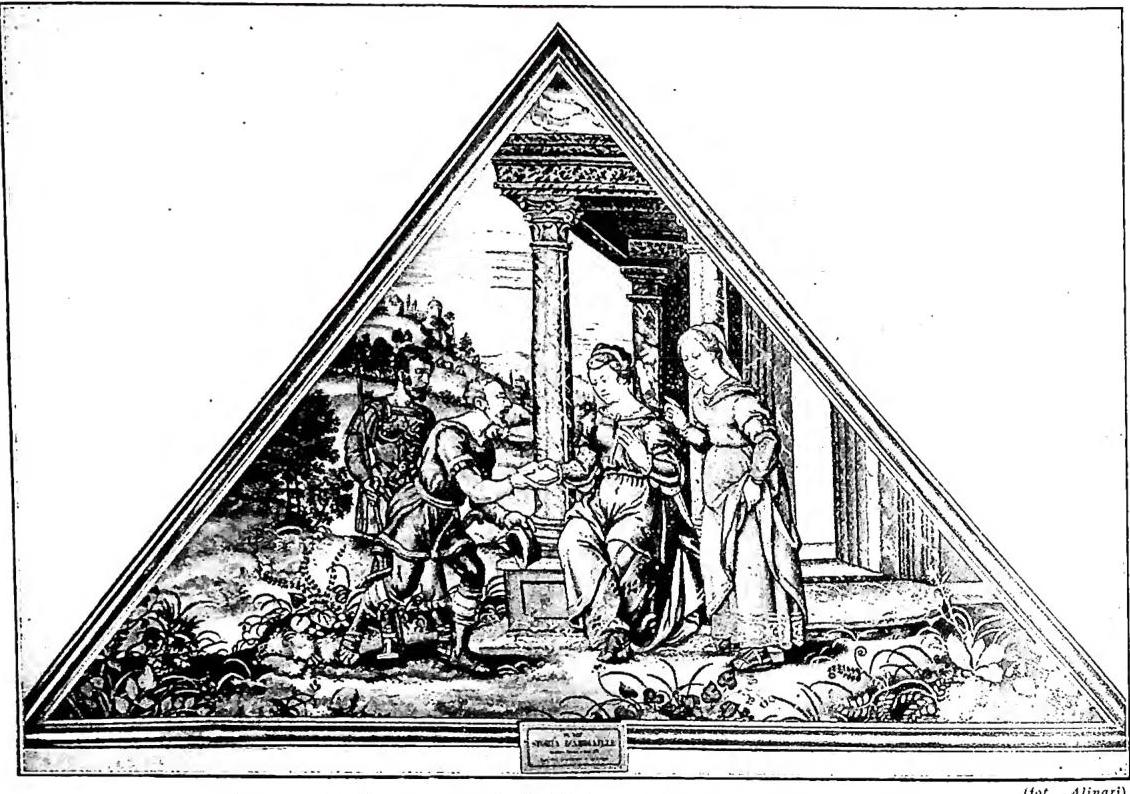
(Alinari photograph)